
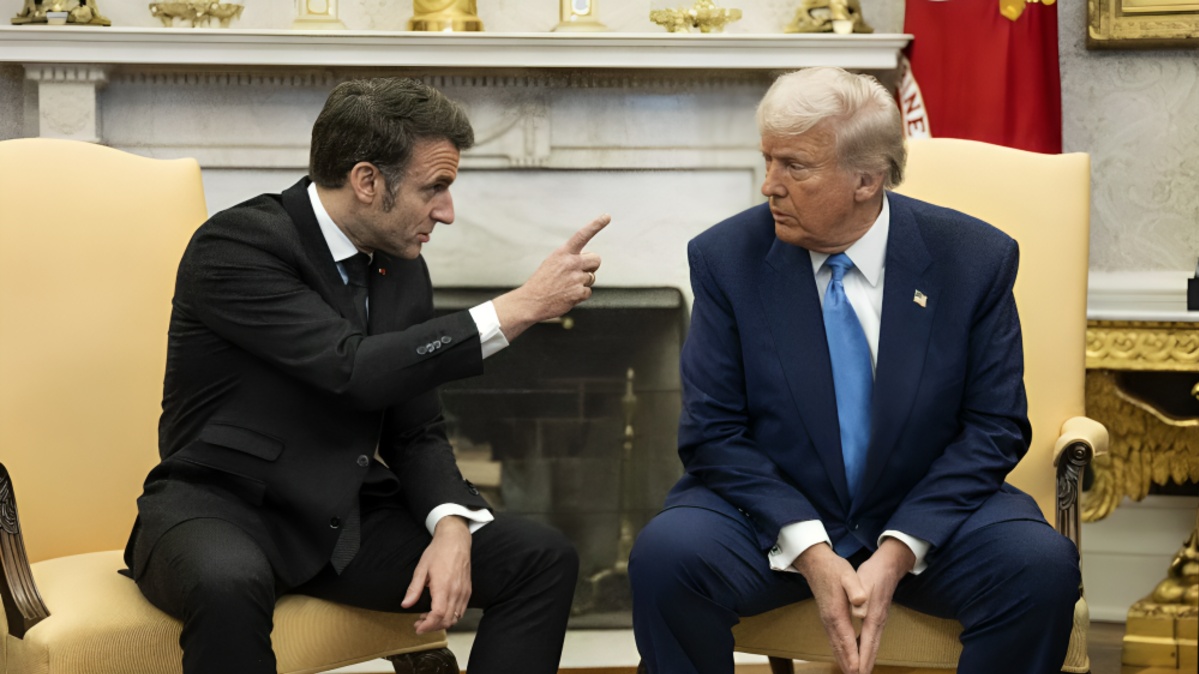
French President Emmanuel Macron criticised US President Donald Trump’s description of his Gaza peace efforts during Macron’s final address to the United Nations General Assembly on September 22, 2026.
Macron questioned whether the situation in Gaza supported the claim that a lasting peace had been achieved. Speaking at the United Nations in New York, he said humanitarian access to Gaza had not been restored despite claims of a diplomatic breakthrough. He described the situation as a spectacle that should concern the international community.
Macron’s comments came only hours after Trump addressed the same UN General Assembly. Trump presented his administration’s Gaza initiative as a significant diplomatic achievement. According to Reuters, Trump said the war in Gaza had ended and credited his efforts with saving lives. He also promoted his 20 Point Plan for Peace in Gaza.
The contrasting speeches highlighted different assessments of the situation in Gaza. Trump’s remarks focused on the diplomatic and political framework of his administration’s plan, while Macron concentrated on conditions on the ground, particularly humanitarian access and the continuing difficulties faced by Palestinians.
Macron referred to the international recognition of Palestine during his speech. He noted that around a dozen countries had recognised Palestine at the United Nations a year earlier and questioned the argument that recognition was merely symbolic. His broader point was that international diplomatic decisions needed to be accompanied by concrete improvements for people affected by the conflict.
The French president also referred to the situation in the West Bank. He said violations were continuing and criticised what he described as ongoing violence and problems affecting Palestinians. France has taken measures against certain individuals over settler violence and has also moved toward restrictions involving products from Israeli settlements in the occupied West Bank, according to Reuters reporting.
Macron’s remarks came as the 81st session of the United Nations General Assembly brought world leaders together to discuss major international conflicts and global security concerns. Gaza remained one of the central issues at the gathering, alongside conflicts involving Iran, Ukraine and other regions.
The French president’s speech was particularly significant because it was his final address to the United Nations before he is due to leave office in May 2027. Macron used the occasion to argue for continued international cooperation and support for multilateral institutions.
The White House responded directly to Macron’s criticism. White House spokeswoman Anna Kelly defended Trump’s approach and said the US president had ended the war between Israel and Hamas, facilitated the release of living hostages and the return of the remains of deceased hostages to their families. She also said Trump was leading implementation of the 20 Point Plan for Peace in Gaza.
The White House’s response reflects the administration’s position that the diplomatic initiative should be assessed as an ongoing process rather than only through immediate humanitarian conditions. The administration has presented Trump’s plan as a framework intended to address the conflict and establish a broader path toward peace and stability.
Macron, however, focused on the difference between diplomatic declarations and conditions experienced by people in Gaza. His comments specifically questioned whether peace claims could be considered credible without restored humanitarian access.
The disagreement does not necessarily represent a complete rejection by France of diplomatic efforts involving the United States. Rather, Macron’s comments highlighted France’s stated emphasis on humanitarian access, international law and a political solution involving Palestinian statehood.
France has previously supported recognition of a Palestinian state and has continued to call for a political settlement to the Israeli Palestinian conflict. Macron’s position has also attracted criticism within France from politicians and activists who have argued that his government has not done enough regarding Gaza. Reuters noted that Macron has faced such criticism following France’s recognition of Palestine.
The latest exchange between Macron and the White House therefore reflects a wider international debate over how progress toward peace in Gaza should be measured. The Trump administration has highlighted negotiations, the release of hostages and the implementation of its 20 Point Plan, while Macron has stressed humanitarian access and conditions on the ground.
The humanitarian situation remains a central issue in international discussions. Access to food, medical assistance and other essential supplies has been repeatedly raised by governments and international organisations during the Gaza conflict. For France, restoring humanitarian access is an important component of any credible peace process.
Trump’s speech at the UN also covered several other international issues. He defended US foreign policy, addressed Iran and Ukraine, criticised the International Criminal Court and discussed the future role of the United Nations. His remarks reflected the administration’s broader foreign policy priorities and its emphasis on US national interests.
Macron’s speech, meanwhile, placed greater emphasis on multilateral cooperation and the role of international institutions. He warned against a return to what he described as a system dominated by confrontation rather than international rules and cooperation. His remarks were consistent with France’s broader support for multilateral diplomacy and the role of the United Nations.
The exchange between the two leaders is significant because both France and the United States remain influential actors in diplomatic discussions concerning the Middle East. Their differing assessments demonstrate the challenges involved in establishing international agreement on the progress of peace initiatives.
At present, Trump’s administration continues to describe the 20 Point Plan as a framework for peace in Gaza, while Macron has questioned whether the reported diplomatic progress is reflected in humanitarian conditions. The White House has defended Trump’s record and rejected the criticism by pointing to the reported outcomes of his initiative.
The issue is expected to remain part of international diplomatic discussions as governments assess the implementation of the US plan, humanitarian access and the prospects for a longer-term political settlement. The contrasting statements at the United Nations underline the continuing differences among major countries over how the Gaza conflict should be resolved and what conditions are necessary for a sustainable peace.