
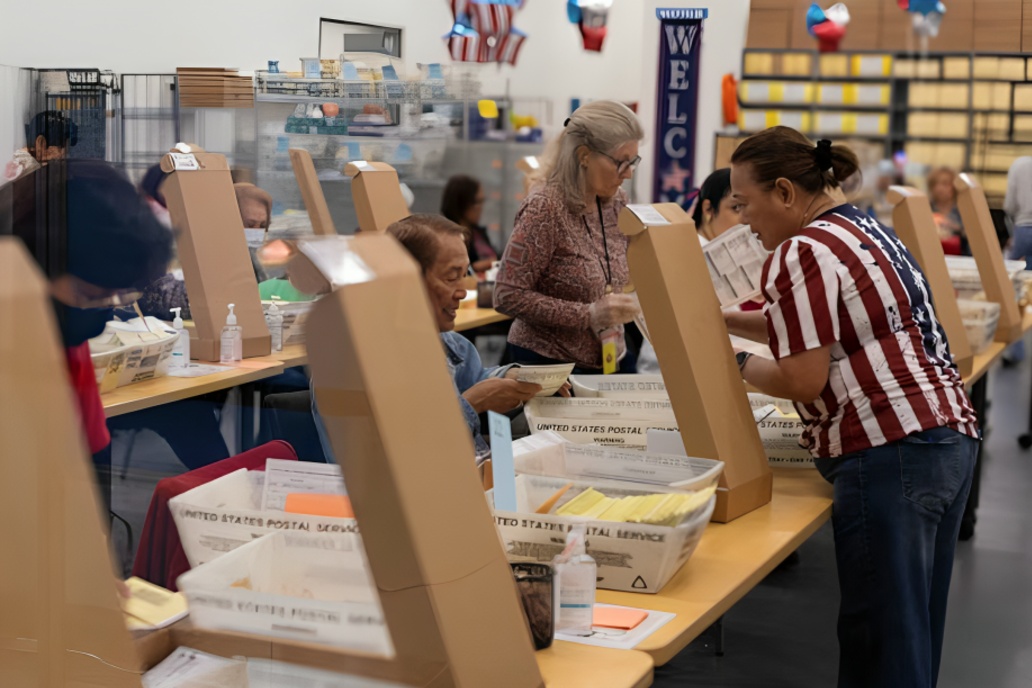
The US Supreme Court has dealt a significant setback to President Donald Trump’s efforts to introduce new restrictions on mail-in voting before the 2026 midterm elections. The court declined to allow the US Postal Service to enforce new rules that would have changed how states prepare and deliver mail ballots to voters.
The ruling means states can continue using the mail voting procedures that have been in place for years for the upcoming midterm elections. The decision comes at a particularly important stage of the election cycle, with voting already underway in some states and election officials preparing for the November 3 midterm elections.
Trump’s administration had sought to give the Postal Service a greater role in checking mail ballots before delivery. Under the proposed system, states would have been required to provide lists of voters who were supposed to receive mail ballots. The Postal Service would then have used those lists as part of a process for determining whether ballots could be delivered.
The proposed rules also included new requirements concerning the design and identification of ballot envelopes. Among the measures were requirements involving standardized envelope specifications and tracking technology. Supporters of the administration’s approach argued that additional controls could strengthen election procedures and improve the handling of mail ballots.
However, state officials and voting rights organizations challenged the measures in court. They argued that the new requirements could interfere with state authority over election administration and create significant logistical problems if implemented shortly before voting.
US District Judge Indira Talwani had previously blocked important parts of the administration’s plan. The Trump administration appealed the decision and asked the Supreme Court to allow the restrictions to take effect. The Supreme Court’s latest action leaves the lower court restrictions in place, preventing the Postal Service from implementing the disputed rules for the upcoming election.
The case has attracted national attention because mail voting is widely used across the United States. According to Associated Press reporting, mail voting has accounted for nearly one-third of ballots cast in recent elections. This makes any major change to the system potentially significant for millions of voters, particularly those who depend on absentee or mail ballots because of distance, disability, work schedules, military service or other circumstances.
The Supreme Court’s decision came after months of legal disputes over the administration’s election-related policies. Trump issued an executive order earlier in 2026 that sought to introduce new federal requirements concerning election administration and voting eligibility. Parts of the administration’s approach have faced challenges from states and voting rights groups, who argue that federal authorities cannot unilaterally impose certain election procedures that traditionally have been administered by individual states.
The latest dispute specifically focused on the Postal Service’s proposed role in handling mail ballots. Critics said that requiring states to submit voter information through a new federal system and introducing new envelope standards so close to the election could create confusion for election administrators.
Some election officials also raised concerns about whether the Postal Service had enough time and technical preparation to implement the new system before ballots were distributed on a large scale. The concerns became more significant as states moved closer to the midterm elections and some voters had already begun receiving or returning ballots.
The Supreme Court’s decision does not eliminate the broader debate over mail-in voting in the United States. Mail voting remains a politically sensitive issue, with Republicans and Democrats frequently disagreeing over how ballots should be requested, delivered, verified and counted.
The Trump administration has repeatedly argued for stronger election safeguards. Opponents of the proposed Postal Service rules, however, maintained that the measures could result in legitimate ballots being delayed or rejected because of administrative or technical requirements.
The Supreme Court did not endorse the implementation of the new restrictions for the 2026 midterms. The ruling instead allows the existing state-level systems to remain in operation while the broader legal issues surrounding the administration’s election policies continue to be contested.
The decision also highlights the continuing constitutional debate over the balance between federal authority and state control of elections. Election administration in the United States is largely carried out by individual states, resulting in different rules and procedures across the country.
For voters, the immediate effect is that states can continue operating their established mail ballot systems rather than shifting to the new federal requirements proposed by the Trump administration. This provides greater continuity for election officials and voters as the November midterm elections approach.
The ruling is particularly important because nearly one-third of voters have used mail ballots in recent elections. Any last-minute change to the system could therefore affect a large number of voters and election administrators.
The Supreme Court’s decision represents a major legal setback for the Trump administration’s effort to impose the new mail ballot restrictions before the midterms. However, the wider legal and political debate over voting rules, election administration and federal authority is expected to continue beyond the immediate dispute