
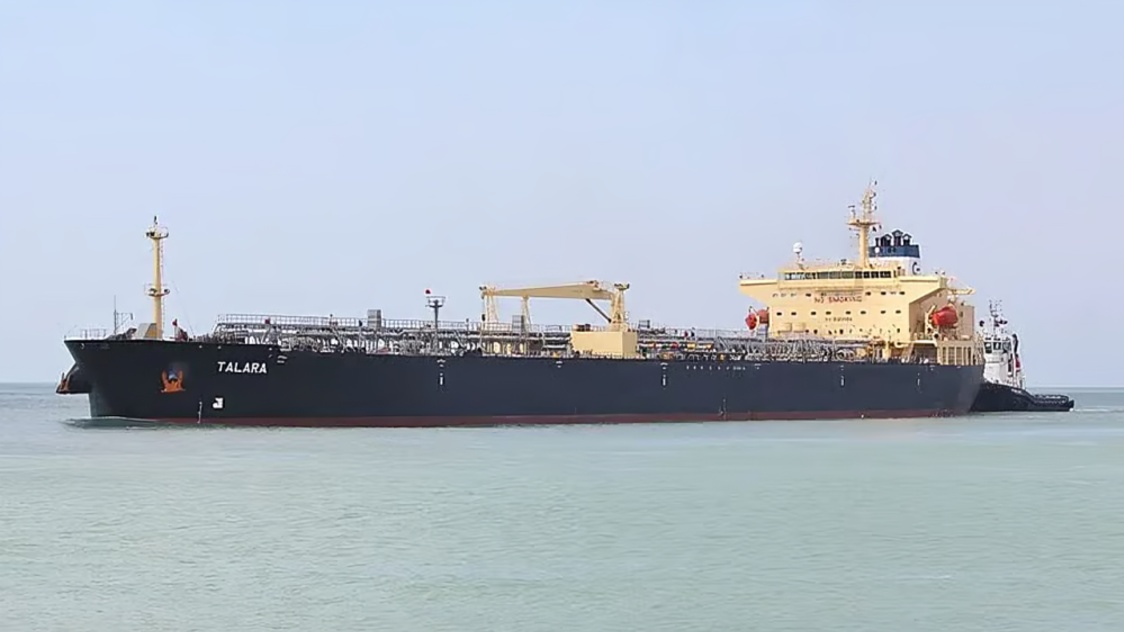
The United States has rejected a claim by Iran’s Islamic Revolutionary Guard Corps that the Panama-flagged oil tanker MT El Gaia was damaged after striking a naval mine in the Strait of Hormuz. The US military has instead alleged that the vessel was attacked by Iranian forces on two separate occasions.
US Central Command said the tanker was first struck by an Iranian missile last month, leaving the vessel inoperable. According to the US account, the ship was attacked again over the weekend by a drone while it was in waters off the coast of Oman. CENTCOM said the tanker is currently being towed by a regional partner.
The Iranian Revolutionary Guard had offered a different explanation for the incident. Iranian state media reported that the tanker had struck a naval mine while attempting to pass through the Strait of Hormuz. The incident reportedly caused an explosion and fire on the vessel. The IRGC-linked account placed responsibility for the damage on the presence of mines in the strategic waterway.
CENTCOM strongly disputed that version of events. The US military said the claim that the tanker struck a naval mine was false and maintained that the vessel had been hit by Iranian weapons. The conflicting accounts have added to concerns about the safety of commercial shipping in and around the Strait of Hormuz, one of the world's most important maritime routes.
The incident is particularly significant for India because MT El Gaia was carrying Indian crew members. India's Ministry of External Affairs said 14 Indian nationals were aboard the commercial vessel when the incident occurred off the coast of Oman. Thirteen Indian crew members were rescued, while search and rescue operations continued for the remaining sailor. The Indian Embassy in Oman has been coordinating with Omani authorities over the rescue effort.
India has condemned the attack on the commercial vessel and called for an immediate reduction in regional tensions. The Ministry of External Affairs has also stressed the importance of protecting commercial ships and seafarers and restoring free and safe navigation through international waterways.
The incident comes at a time when maritime traffic around the Strait of Hormuz has been severely affected by the wider conflict in the region. Shipping companies have faced growing security concerns, while vessels have reduced or delayed movements through the waterway.
The Strait of Hormuz is a critical route for international energy trade. A prolonged disruption can affect the movement of crude oil, liquefied natural gas and other energy products from Gulf producers to international markets. The latest security incidents have therefore created concerns extending beyond the immediate region.
Recent shipping data indicates that traffic through the Strait has remained well below normal levels. Reuters reported that only a small number of commodity vessels passed through the waterway on Monday, compared with a much higher pre-conflict daily average. The decline highlights the extent to which security concerns are affecting commercial navigation.
The shipping disruption is also contributing to volatility in global energy markets. Oil prices have risen as traders assess the potential impact of reduced supplies and continuing attacks on energy infrastructure. Reuters reported that crude prices gained significantly amid renewed concerns over regional supply disruptions, including damage to Saudi Arabia's East-West oil pipeline.
For India, developments around the Strait of Hormuz are especially important because the country is heavily dependent on imported crude oil. Any prolonged disruption to Gulf shipping can increase transportation costs, insurance premiums and uncertainty for energy importers. However, the effect on Indian petrol and diesel prices depends on several factors, including international crude prices, the rupee-dollar exchange rate, refinery costs, taxes and pricing decisions by domestic oil marketing companies.
The dispute over MT El Gaia also demonstrates the difficulty of independently establishing responsibility during an active regional conflict. Iran's Revolutionary Guard has presented the incident as a mine-related accident, while the United States says the vessel was deliberately attacked with Iranian weapons. At present, these competing accounts should be treated as claims from the respective sides rather than as an independently established explanation.
The broader security situation remains tense. Maritime authorities have continued to warn commercial operators about risks in the region, while diplomatic efforts to reduce tensions have faced difficulties. The combination of attacks on commercial vessels, uncertainty over navigation routes and reduced shipping activity has increased pressure on international energy markets.
For the Indian crew involved, the immediate priority remains the safety of the seafarers. With 13 crew members rescued and one still missing according to India's Ministry of External Affairs, search and rescue efforts remain central to the response. India has also reiterated its call for dialogue, diplomacy and the restoration of safe commercial navigation.
The MT El Gaia incident is therefore significant on several levels. It has become another point of disagreement between Washington and Tehran, has raised fresh concerns about maritime security in the Gulf region, and has directly affected Indian seafarers. At the same time, continued disruption in the Strait of Hormuz could have wider consequences for global energy supplies and oil prices.
As the regional conflict continues, international attention remains focused on the safety of commercial vessels and the possibility of restoring regular shipping through the Strait. Any sustained improvement in maritime security would be important for energy markets, shipping companies, seafarers and countries such as India that rely heavily on stable Gulf energy supplies.