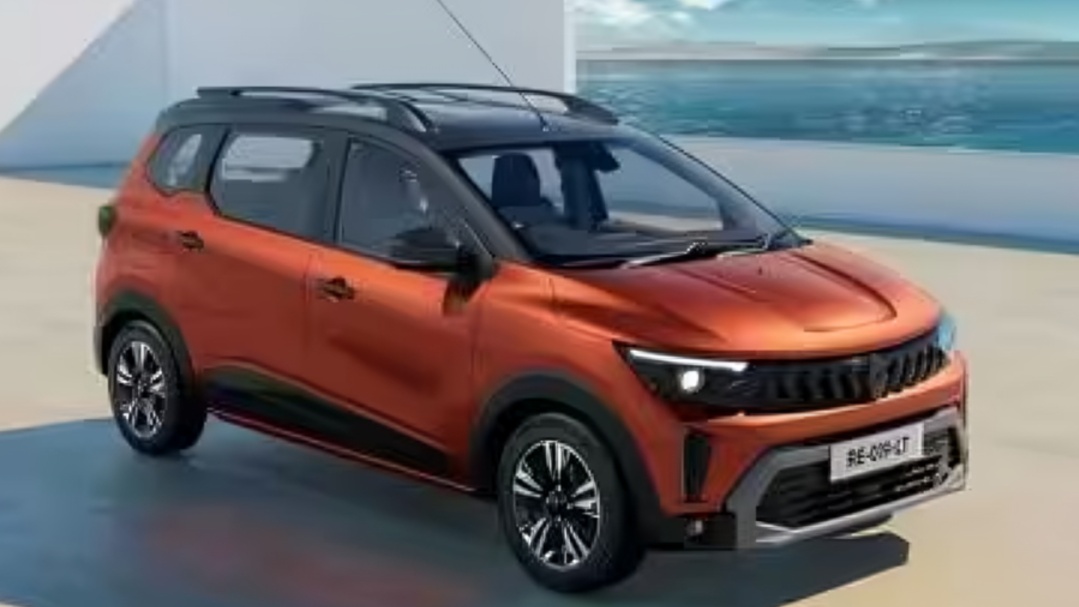
Renault is preparing a major powertrain update for the Triber compact MPV, with a test vehicle featuring both Turbo and CNG markings recently spotted in Pune. The latest sighting has raised expectations that Renault could introduce a turbocharged CNG version of the seven seat Triber in India. However, the company has not officially confirmed the production version, specifications or launch date of the turbo CNG model.
The development is significant because the Triber has traditionally been powered by a naturally aspirated 1.0 litre three cylinder petrol engine. The current engine produces around 72 PS and 96 Nm of torque and is available with manual and automated manual transmission options. Renault positions the Triber as a practical seven seat MPV aimed at families and urban buyers.
One of the biggest criticisms of the existing Triber has been its performance when the vehicle is carrying a full load of passengers. A turbocharged engine could address this limitation by providing stronger power and torque, particularly during highway driving and overtaking.
Renault is already developing a turbo petrol version of the Triber. Recent testing has shown a Triber prototype carrying a Turbo badge on its tailgate. Reports suggest that the turbo petrol version could use Renault's 1.0 litre three cylinder turbocharged engine, similar to the unit used in the Renault Kiger and Nissan Magnite. In those applications, the engine produces around 100 PS and 160 Nm of torque.
The latest test vehicle adds another important detail because it has reportedly been spotted with a CNG sticker in addition to the Turbo badge. This suggests that Renault may be evaluating the possibility of combining turbocharging with compressed natural gas technology.
If introduced as a factory fitted system, the Triber Turbo CNG could offer two major advantages. The turbocharged engine could provide stronger performance than the existing naturally aspirated unit, while CNG could help reduce fuel expenses for customers who cover significant distances.
The exact specifications of the proposed powertrain remain unknown. Renault has not confirmed the engine output, CNG capacity, fuel efficiency or transmission options for the potential production model. Therefore, current reports about performance and mileage should be treated as expectations rather than confirmed specifications.
One possibility is that Renault could use a twin cylinder CNG tank arrangement. Such a configuration can help manufacturers package CNG storage more efficiently and preserve usable luggage space. The Renault Group Entry Platform is understood to support different powertrain configurations, including underbody CNG technology.
The packaging of the CNG system will be particularly important for the Triber because the vehicle is designed around a three row seating layout. Maintaining practical luggage space while accommodating the CNG system could be one of the key engineering challenges.
A factory fitted CNG system could also offer advantages over aftermarket conversions. It would allow Renault to integrate the fuel system into the vehicle during production and conduct the necessary validation and homologation before the vehicle reaches customers.
The possible introduction of a turbo CNG powertrain would also place the Triber in an interesting position within India's affordable MPV market. CNG has become increasingly popular among private owners and commercial users because of its potential running cost advantages.
The seven seat layout gives the Triber a practical advantage for families. A turbo CNG version could make the model even more attractive to customers who want additional performance without giving up the potential fuel cost benefits of CNG.
The current Triber's naturally aspirated engine is adequate for city driving, but the additional weight of several passengers can make acceleration and highway performance less responsive. A turbocharged engine with higher torque could improve this aspect of the driving experience.
The potential powertrain could also strengthen Renault's product portfolio in India. The company has been working to expand its offerings and improve the competitiveness of its entry level models. The Triber remains an important product because of its combination of compact dimensions and three row seating.
The company has not yet announced whether the turbo CNG version will be sold alongside the existing petrol variants or offered only in selected trims. Transmission choices are also yet to be confirmed. Industry reports suggest that the turbo petrol version could be offered with a manual gearbox and potentially a CVT, while the turbo CNG version is expected to use a manual transmission.
Pricing will be another important factor. The current Triber is positioned as one of the more affordable three row passenger vehicles in India. Adding a turbocharged engine and factory fitted CNG hardware would increase manufacturing costs, so the final price could be higher than the existing petrol variants.
However, if Renault manages to maintain competitive pricing, the new powertrain could attract customers who want a combination of space, performance and lower fuel costs.
The Triber's compact dimensions are also useful for urban driving. At under four metres in length, it is designed to offer substantial interior space without the larger footprint of many traditional MPVs. The model's modular seating arrangement further increases its practicality.
The upcoming powertrain could therefore improve one of the Triber's main weaknesses without changing its fundamental strengths. The vehicle could retain its seven seat layout and compact dimensions while offering improved performance and an alternative fuel option.
Renault is also expected to continue offering the standard petrol version, meaning buyers could have multiple powertrain choices depending on their requirements. The petrol version may remain suitable for customers who prioritise simplicity, while the potential turbo CNG version could appeal to those seeking lower running costs and stronger performance.
It is important to note that the test vehicle does not guarantee that Renault will launch the exact same configuration. Automakers frequently test different powertrain combinations during development, and some prototypes do not reach production.
The presence of both Turbo and CNG markings nevertheless provides a strong indication that Renault is evaluating this combination. Further testing and regulatory certification would be required before the vehicle could be sold commercially.
The potential launch timing is currently linked to Renault's upcoming turbo petrol Triber plans. Recent reports expect the turbo petrol model to arrive around September 2026, although Renault has not officially announced a specific launch date. The turbo CNG version could follow later depending on development and homologation progress.
For buyers, the key details to watch will be engine specifications, CNG tank capacity, claimed fuel efficiency, boot space, transmission options and price. These factors will determine whether the new version becomes a compelling alternative to existing CNG MPVs.
The introduction of a turbo CNG Triber could also increase competition in India's CNG passenger vehicle market. Manufacturers are increasingly exploring ways to combine improved performance with alternative fuel technology, giving consumers more choices beyond conventional petrol and diesel vehicles.
Overall, the Renault Triber Turbo CNG test vehicle represents an interesting development for the Indian MPV market. The combination of a turbocharged engine and CNG could address the Triber's performance concerns while potentially reducing everyday fuel expenses.
However, Renault has not officially confirmed the production version at this stage. The engine output, fuel economy, CNG configuration, price and launch date remain subject to official confirmation.
Until Renault makes a formal announcement, the Triber Turbo CNG should therefore be considered an upcoming possibility rather than a confirmed production model. The ongoing road testing indicates that development is progressing, and more information is expected as the company moves closer to finalising its future Triber powertrain strategy.