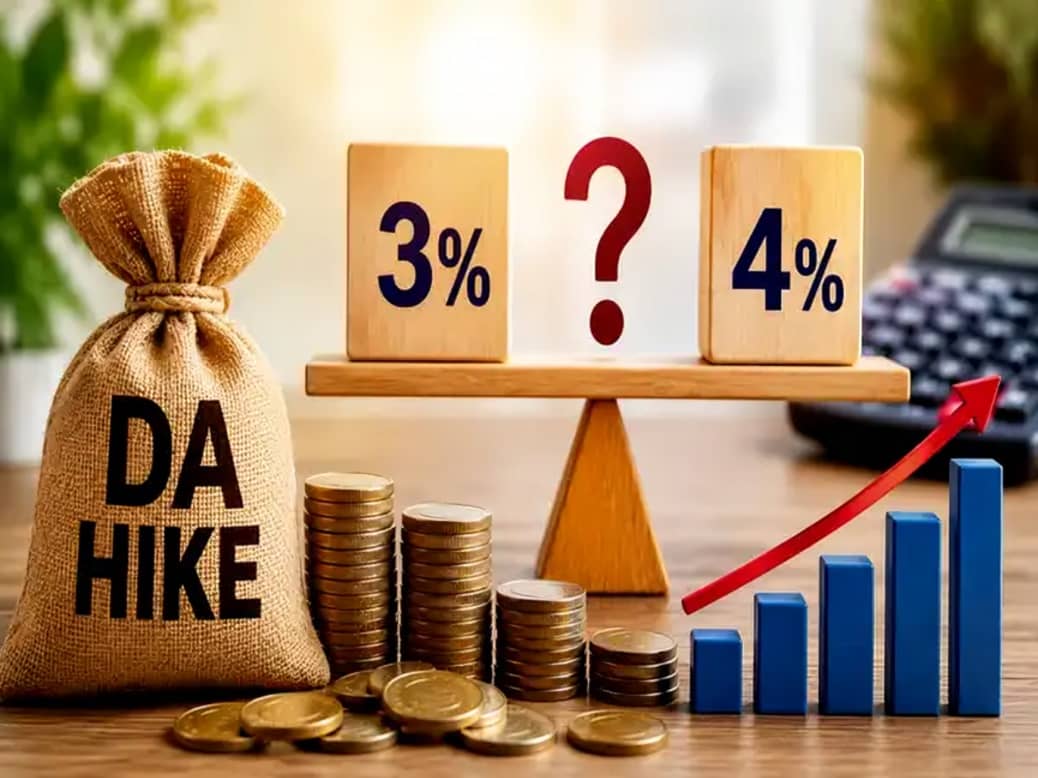

Central government employees and pensioners are closely watching the July 2026 Dearness Allowance revision, with the latest inflation data pointing towards a 3 percentage point increase. If approved and formally notified, the Dearness Allowance for central government employees would move from the current 60 percent to 63 percent of basic pay.
The latest development follows the release of Consumer Price Index for Industrial Workers data by the Labour Bureau under the Ministry of Labour and Employment. The CPI IW is one of the key indicators used in the calculation of Dearness Allowance for central government employees and Dearness Relief for pensioners.
The Labour Bureau data shows that the CPI IW for January 2026 stood at 148.6. It was 148.5 in February, 149.1 in March, 149.9 in April, 150.8 in May and 151.9 in June. The June figure completed the six month period used for calculating the July 2026 DA revision.
What the latest AICPI IW data indicates
The DA revision is linked to changes in the Consumer Price Index for Industrial Workers. Under the existing 7th Central Pay Commission framework, the relevant CPI IW data is used to calculate the rate of Dearness Allowance.
With the June 2026 CPI IW figure at 151.9, the calculation based on the available data works out to around 63.75 percent. Since the payable DA rate is expressed as a whole percentage, reports based on the calculation indicate a rate of 63 percent.
This would represent a 3 percentage point increase over the current 60 percent DA. However, the distinction between a calculated rate and an officially approved rate is important. The final DA rate becomes official only after the Union government approves the proposal and the Department of Expenditure issues the relevant notification.
Current DA stands at 60 percent
The existing Dearness Allowance for central government employees is 60 percent of basic pay. The government increased the rate from 58 percent to 60 percent with effect from January 1, 2026.
The Department of Expenditure issued the relevant Office Memorandum in April 2026, confirming the 2 percentage point increase for the January 2026 instalment. The order states that the revised DA is calculated on basic pay under the pay structure accepted under the 7th Central Pay Commission.
The next revision is applicable from July 1, 2026. The calculation is based on the inflation data covering the required period. The June CPI IW figure was therefore an important final data point for determining the July instalment.
How much could employees receive
If the DA increases from 60 percent to 63 percent, the difference would be 3 percent of basic pay.
For example, an employee with a basic pay of Rs 18,000 would currently receive Rs 10,800 as DA at 60 percent. At 63 percent, the DA component would become Rs 11,340. The difference would therefore be Rs 540 per month.
For an employee with a basic pay of Rs 35,400, the existing DA at 60 percent is Rs 21,240. At 63 percent, it would become Rs 22,302. The monthly difference would be Rs 1,062.
For a basic pay of Rs 44,900, the increase would be Rs 1,347 per month because 3 percent of Rs 44,900 is Rs 1,347.
An employee drawing a basic pay of Rs 56,100 would see a difference of Rs 1,683 per month if the DA moves from 60 percent to 63 percent.
These calculations represent only the additional DA component. The actual change in take home salary can vary depending on other salary components, deductions and applicable rules.
Effect on pensioners
The July DA revision is also relevant to central government pensioners because they receive Dearness Relief rather than Dearness Allowance.
When the government revises DA for serving employees, the corresponding Dearness Relief rate for eligible pensioners is generally revised at the same percentage. Therefore, a 63 percent DA rate would correspond to a 63 percent DR rate, subject to the formal government order.
The impact on an individual pensioner would depend on the basic pension and other applicable provisions.
Why CPI IW data matters
The Consumer Price Index for Industrial Workers measures changes in the prices of a basket of goods and services consumed by industrial workers. The Labour Bureau maintains this index, which is also used for wage and Dearness Allowance related purposes.
The current CPI IW series uses 2016 as its base year. The Labour Bureau explains that the index measures changes in retail prices of a fixed basket of goods and services consumed by industrial workers over time.
The January to June 2026 numbers show a gradual increase during the period used for the July DA calculation.
January 2026 recorded 148.6.
February 2026 recorded 148.5.
March 2026 recorded 149.1.
April 2026 recorded 149.9.
May 2026 recorded 150.8.
June 2026 recorded 151.9.
The Labour Bureau has subsequently published a July 2026 CPI IW reading of 153.2. However, the July figure does not form part of the January to June six month calculation for the July 2026 DA revision.
When will the revised DA be officially announced
The calculation and the government announcement are two separate stages. The CPI IW data provides the basis for the calculation, but the revised DA rate has to be formally approved and notified by the government.
Recent reports have indicated that the July 2026 DA calculation points to 63 percent. At the same time, reports have noted that the Union Cabinet approval and Department of Expenditure notification are required before employees can treat the revised rate as officially sanctioned.
As of the latest information reviewed, the government has not yet issued a formal Department of Expenditure notification confirming the July 2026 DA rate. The Department of Expenditure maintains an official archive for government orders and circulars, including Dearness Allowance-related orders.
Arrears from July
If the revised rate is formally approved after July 1, the increase would be applicable from the effective date specified in the government order. This can result in arrears for the period between the effective date and the month in which the revised amount is actually paid.
For example, if the revised rate is approved and implemented after several months, eligible employees may receive the difference for the intervening months along with the salary payment under the government's implementation instructions.
The exact timing and method of arrears payment will depend on the official notification.
Connection with the 8th Pay Commission
The July 2026 DA revision is also taking place while the 8th Central Pay Commission is working on its mandate. The Commission is expected to make recommendations on the future pay structure, allowances and related matters.
Until a new pay structure is formally implemented, the existing pay framework and applicable DA revision mechanism continue to be relevant for central government employees.
The July DA revision therefore remains a separate matter from the eventual recommendations of the 8th Pay Commission.
What employees should watch next
The most important development now is the formal government decision on the July 2026 DA revision. Employees should distinguish between calculations based on CPI IW data and an official government notification.
The Labour Bureau's data has provided the inflation figures required for the calculation. The January to June 2026 CPI IW series points towards a DA rate of 63 percent, compared with the existing 60 percent.
However, the final implementation requires the government's formal approval and notification.
For employees, the potential 3 percentage point increase would mean an additional 3 percent of basic pay in the DA component each month. Pensioners would similarly be affected through the corresponding Dearness Relief revision if the government approves the same rate.
Until the official order is issued, the 63 percent figure should therefore be described as the calculated or expected rate rather than as a formally notified increase.