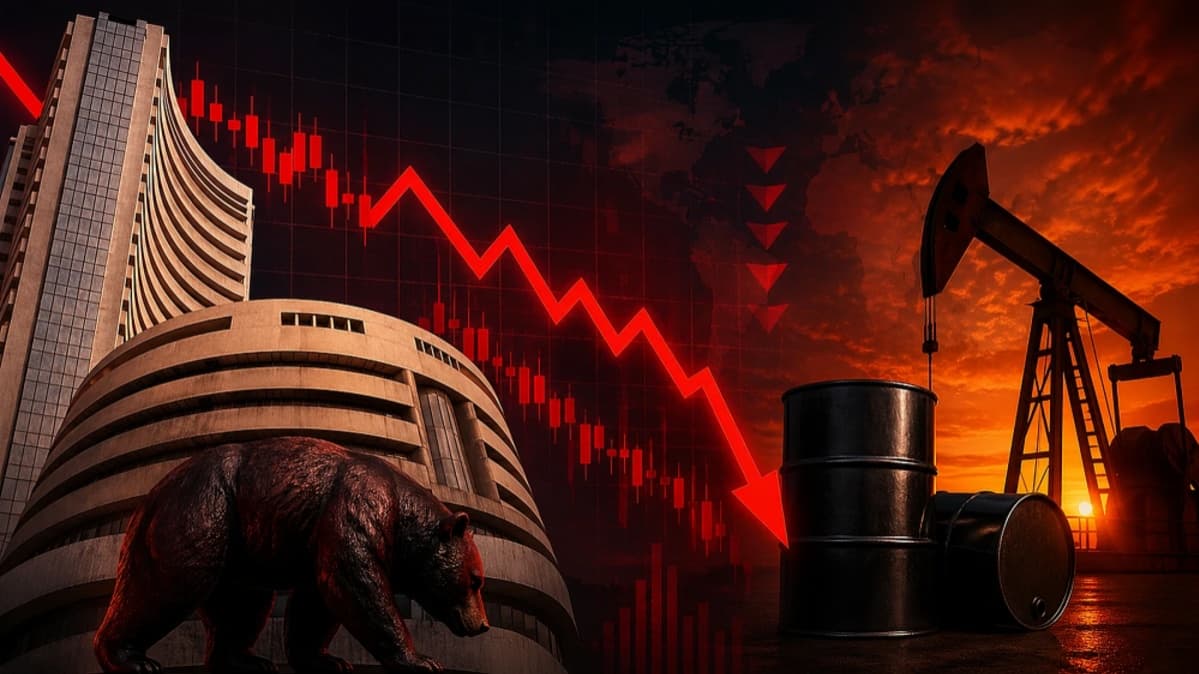
Indian benchmark equity indices Sensex and Nifty ended the week in negative territory, extending their losing streak to five consecutive trading sessions. Investors remained cautious as rising international crude oil prices, continued selling by foreign institutional investors, weakness in the Indian rupee, and uncertainty in global financial markets combined to dampen market sentiment.
Throughout the week, equity markets experienced sustained selling pressure across several sectors. Investors largely avoided aggressive buying amid concerns that higher energy prices and global economic challenges could affect corporate earnings, inflation, and overall economic growth.
One of the primary factors influencing market performance was the continued rise in crude oil prices. India imports a significant portion of its crude oil requirements, making international oil prices an important factor for the domestic economy. Higher crude prices can increase import costs, raise transportation and manufacturing expenses, and contribute to inflationary pressures. Investors closely monitor oil price movements because they can affect both government finances and corporate profitability.
Foreign Institutional Investors continued to remain net sellers during the week, adding further pressure on Indian equities. FII investment flows play an important role in determining market direction, particularly during periods of global uncertainty. When foreign investors reduce their exposure to emerging markets, equity indices often experience increased volatility.
The Indian rupee also remained under pressure against the US dollar during the week. Currency depreciation can increase the cost of imports, particularly crude oil, and may influence inflation expectations. However, a weaker rupee can also provide some benefit to export oriented sectors by making Indian goods and services more competitive in international markets.
Global developments also contributed to investor caution. Market participants continued to assess geopolitical developments, central bank policy expectations, inflation trends, and economic data from major economies. Uncertainty surrounding global growth prospects encouraged investors to adopt a more defensive investment approach.
Sector wise performance reflected the cautious market environment. Energy intensive industries, automobile companies, aviation firms, and businesses dependent on imported raw materials remained under pressure due to concerns over rising input costs. Banking, information technology, pharmaceuticals, and consumer sectors also witnessed selective selling during the week as investors booked profits and shifted toward relatively safer investments.
Despite the overall decline, market experts note that periodic corrections are a normal feature of equity markets. Short term volatility often results from a combination of domestic and international factors, while long term market performance generally depends on economic growth, corporate earnings, policy stability, and investor confidence.
Analysts believe that upcoming economic indicators, corporate earnings announcements, inflation data, and central bank decisions will continue to influence market direction in the coming weeks. Investors will also closely monitor crude oil prices, foreign investment flows, and currency movements for signs of improved stability.
Financial experts continue to recommend that long term investors maintain a disciplined investment strategy rather than reacting to short term market fluctuations. Diversification across sectors and regular portfolio reviews remain important approaches during periods of heightened volatility.
The outlook for Indian equities will largely depend on the easing of external pressures, improvement in global investor sentiment, and sustained domestic economic performance. While near term uncertainty remains, India's economic fundamentals continue to attract long term investor interest.
As the new trading week begins, market participants will closely watch domestic and international developments that could shape investor sentiment. With crude oil prices, foreign institutional investment activity, exchange rate movements, and global economic conditions remaining key variables, the direction of the Sensex and Nifty will continue to depend on how these factors evolve in the days ahead.