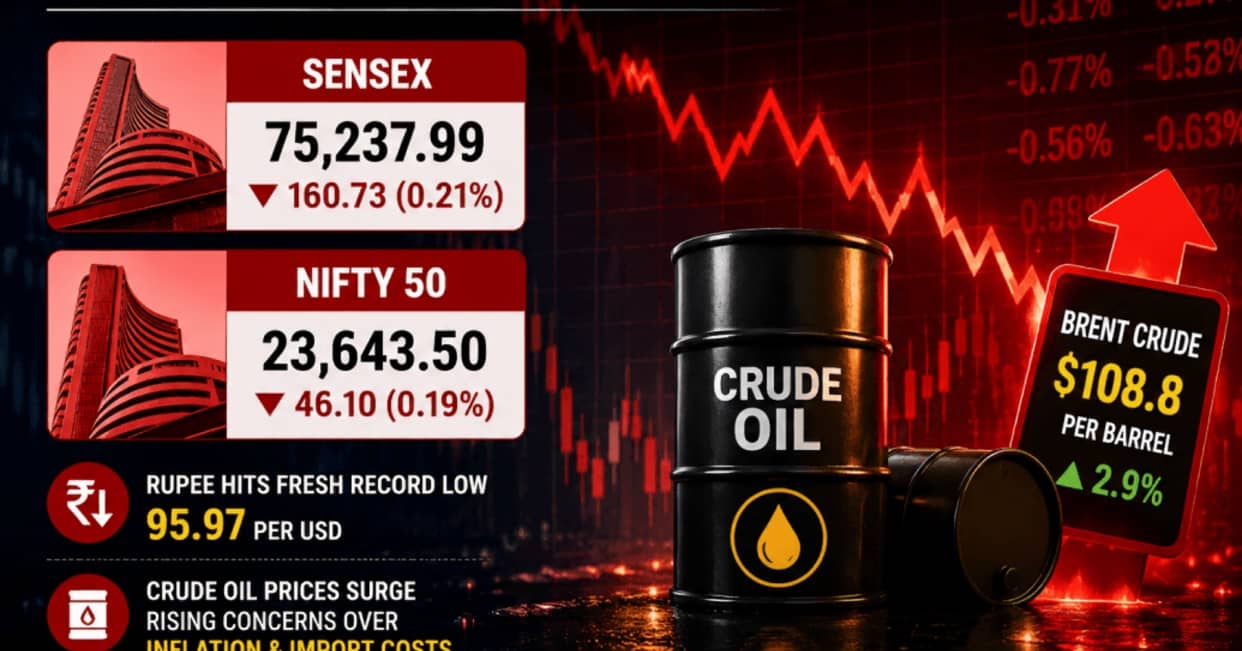
Indian stock markets ended the trading session on a weaker note as benchmark indices Sensex and Nifty closed in negative territory following a sharp rise in international crude oil prices. Investor sentiment remained cautious after Brent crude oil crossed the 98 dollar per barrel mark amid heightened geopolitical tensions involving the United States and Iran.
The increase in crude oil prices raised concerns about inflation, higher import costs, and the potential impact on corporate earnings. As India imports a significant portion of its crude oil requirements, sustained increases in global oil prices are closely monitored by investors and policymakers.
Market participants adopted a cautious approach throughout the trading session, leading to selling pressure in several sectors. Energy intensive industries, automobile manufacturers, aviation companies, paint producers, and other businesses that rely heavily on petroleum based inputs were among those closely watched by investors.
Analysts noted that rising crude oil prices generally increase operating costs for companies and may affect profit margins if higher expenses cannot be passed on to consumers. Such developments often influence investor confidence and contribute to volatility in equity markets.
The broader market also reflected cautious trading as investors assessed the possible economic impact of prolonged geopolitical uncertainty. Global financial markets have remained sensitive to developments in the Middle East, with investors closely tracking diplomatic and military developments that could influence energy supplies and international trade.
Apart from geopolitical concerns, investors also monitored movements in the United States dollar, bond yields, and global equity markets. These factors often influence foreign institutional investment flows into emerging markets, including India.
Brent crude serves as one of the most widely followed international oil price benchmarks. Any significant movement in Brent prices has implications for economies that depend heavily on imported crude oil. Higher oil prices can contribute to increased transportation costs, manufacturing expenses, and inflationary pressures across multiple sectors.
Economists believe that if elevated crude prices persist for an extended period, they could place additional pressure on India's trade balance and current account deficit. Rising fuel costs may also influence consumer spending and business operating expenses.
The energy sector remained one of the closely watched segments during the trading session. While higher crude prices can benefit upstream oil exploration companies, they may create challenges for industries dependent on fuel consumption and petroleum derivatives.
Foreign institutional investors and domestic institutional investors continued to monitor market conditions carefully as uncertainty surrounding global geopolitical developments remained high. Market experts believe that investor sentiment is likely to remain sensitive to further developments in international energy markets.
Financial analysts emphasized that short term market volatility is common during periods of geopolitical uncertainty. They advise investors to focus on long term investment strategies rather than reacting to temporary market fluctuations driven by external events.
Corporate earnings, economic indicators, inflation data, and future monetary policy decisions are also expected to influence market direction in the coming weeks. Investors will continue to evaluate how global developments interact with domestic economic conditions.
Despite the day's decline, market experts note that Indian equity markets continue to be supported by strong domestic participation, steady economic growth, and long term investment interest. However, external factors such as crude oil prices, global inflation, currency movements, and geopolitical risks remain important variables affecting market performance.
As global markets continue to respond to developments in the Middle East, investors are expected to remain cautious while closely monitoring crude oil prices and their potential impact on inflation, corporate profitability, and overall economic growth. The performance of Sensex and Nifty in the coming sessions is likely to depend on both international developments and domestic economic indicators.