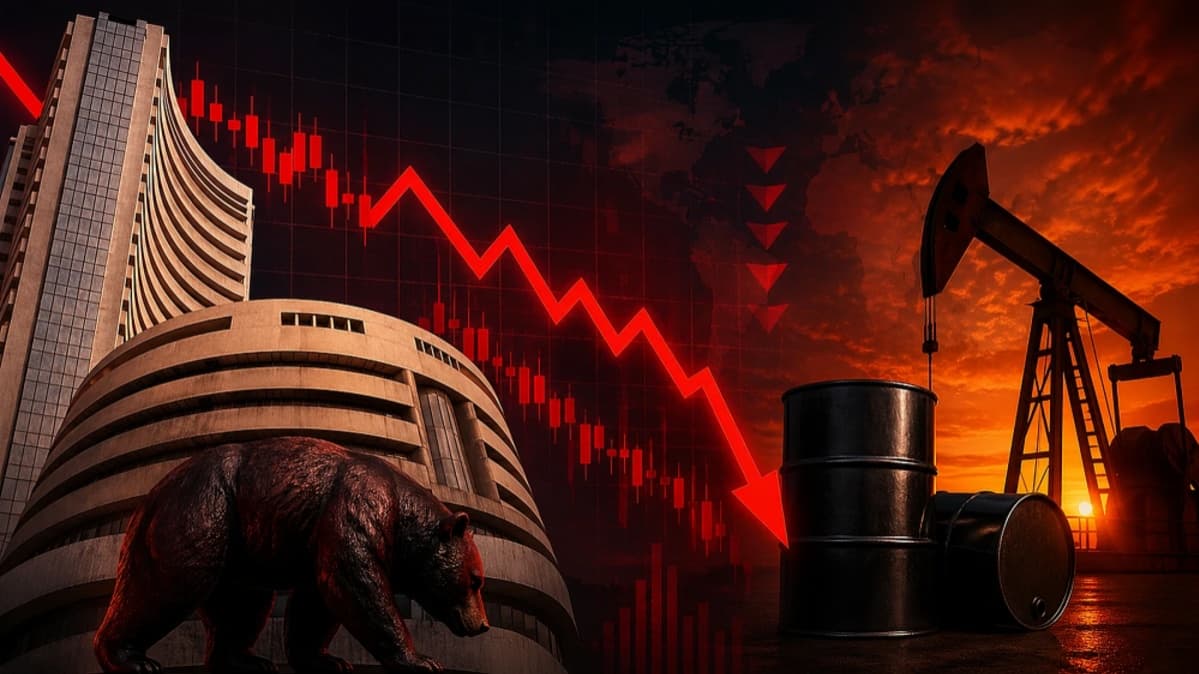

Indian stock markets experienced a broad-based sell-off as benchmark equity indices declined sharply during trading, with the BSE Sensex falling by more than 750 points. The weakness in the market reflected a combination of global and domestic factors that affected investor confidence across multiple sectors.
Market participants cited rising geopolitical tensions, uncertainty surrounding international trade policies, higher crude oil prices, a weakening Indian rupee, and increasing United States Treasury yields as the primary reasons behind the decline. The combination of these developments prompted investors to reduce exposure to equities and adopt a more cautious investment approach.
One of the major concerns influencing market sentiment was uncertainty over global trade policies, including discussions on tariffs affecting international commerce. Investors generally view trade restrictions as a risk to global economic growth because they can increase business costs, disrupt supply chains, and reduce cross-border trade activity.
Geopolitical developments also contributed to market volatility. Global investors often become cautious during periods of heightened geopolitical uncertainty, as such events can influence commodity prices, currency markets, investment flows, and overall economic outlook.
Another important factor behind the market decline was the rise in international crude oil prices. India imports a substantial portion of its crude oil requirements, making higher oil prices a significant concern for the economy. Rising energy costs can increase inflationary pressures, widen the current account deficit, and affect the profitability of companies that rely heavily on fuel and transportation.
The depreciation of the Indian rupee against the United States dollar also weighed on investor sentiment. A weaker rupee generally increases the cost of imports, particularly crude oil and other commodities, while also influencing inflation expectations. However, some export-oriented sectors may benefit from a weaker domestic currency as their overseas earnings become more valuable when converted into rupees.
Investors also monitored rising yields on United States Treasury securities. Higher US bond yields often attract global investment flows toward fixed-income assets, reducing the attractiveness of emerging market equities. As a result, foreign institutional investors may adjust their portfolios, leading to increased volatility in stock markets such as India.
The selling pressure extended across several sectors, including banking, financial services, information technology, automobiles, metals, and energy stocks. Defensive sectors generally performed relatively better, although overall market breadth remained negative during the trading session.
Market analysts emphasize that short-term corrections are a normal part of equity market cycles. Stock prices are influenced by a wide range of domestic and international developments, including corporate earnings, monetary policy decisions, inflation data, economic growth expectations, commodity prices, and geopolitical events.
Financial experts advise investors to avoid making investment decisions based solely on daily market fluctuations. Instead, they recommend focusing on long-term financial objectives, maintaining diversified investment portfolios, and evaluating company fundamentals before making investment decisions.
Going forward, market participants will closely monitor global economic developments, central bank policy announcements, corporate earnings reports, inflation trends, crude oil prices, currency movements, and foreign institutional investment flows. These factors are expected to continue influencing investor sentiment and market direction in the coming weeks.
Despite the day's sharp decline, analysts note that equity markets typically experience periods of volatility in response to changing economic conditions. Long-term market performance will depend on corporate earnings growth, macroeconomic stability, and developments in both domestic and global financial markets.