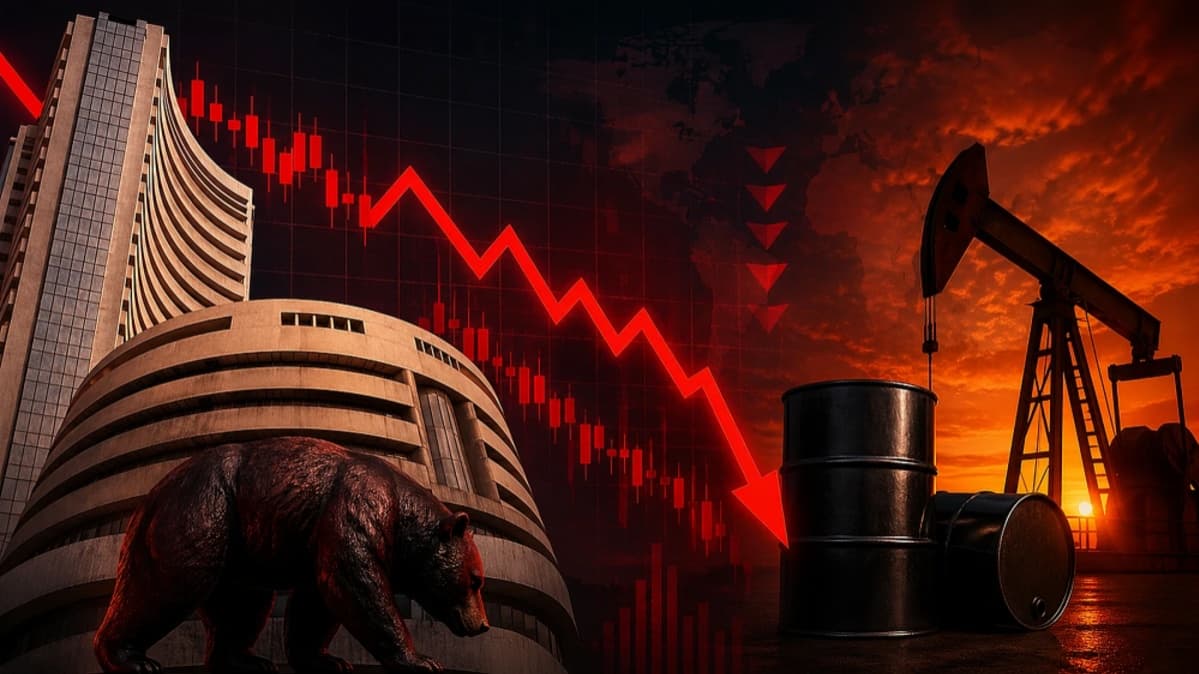
Indian equity markets faced strong selling pressure on Monday as benchmark indices recorded major losses amid global economic uncertainty and rising crude oil prices.
The BSE Sensex plunged more than 870 points during the trading session, while the Nifty 50 slipped close to the 23,930 level. Market weakness was visible across several sectors as investors reacted to international developments and growing concerns over inflation and economic stability.
Analysts attributed the decline to a combination of factors including rising crude oil prices, weak global market trends and heavy selling by foreign institutional investors. Increased geopolitical tensions in West Asia also added pressure on investor sentiment and commodity markets.
Global crude oil prices have remained volatile in recent sessions due to concerns regarding supply disruptions and geopolitical instability involving major energy producing regions. Economists note that higher oil prices can negatively affect oil importing economies such as India by increasing import costs and inflationary pressure.
Foreign institutional investors were reportedly among the major sellers during the session. Market experts explained that global investors often reduce exposure to emerging markets during periods of uncertainty and financial volatility.
The banking, information technology, automobile and financial sectors witnessed notable declines as investors moved toward safer investment options. Broader market indices including mid cap and small cap shares also experienced selling pressure during the day.
Financial analysts stated that international market weakness influenced domestic investor sentiment, especially after mixed economic signals from global economies and fluctuations in commodity markets.
Investors also remained cautious because of concerns surrounding inflation and possible policy responses from central banks. Rising energy prices can affect transportation, manufacturing and operational costs across industries, which may eventually influence corporate profitability.
Market observers explained that stock markets generally react sharply to global geopolitical developments because international trade, energy prices and foreign investment flows are closely interconnected.
Despite the decline, analysts noted that periodic corrections are common in equity markets, especially after strong rallies or periods of high valuations. Profit booking by traders and institutional investors can also contribute to temporary market weakness.
The Indian stock market has experienced increased volatility in recent months as investors monitor global economic conditions, interest rate movements and geopolitical risks. Experts continue to emphasize the importance of long term investment planning during periods of market fluctuation.
Retail investors closely tracked the market movement as benchmark indices recorded steep intraday declines. Financial advisors suggested that investors avoid panic driven decisions and focus on diversified investment strategies.
Economists believe future market direction may depend on international crude oil trends, inflation data, corporate earnings and developments in global financial markets. Any improvement in geopolitical stability or moderation in oil prices could help restore investor confidence.
The Reserve Bank of India and economic policymakers are also expected to closely monitor market and inflation developments because sustained increases in energy costs can influence broader economic growth.
Industry experts pointed out that India’s long term economic fundamentals remain supported by infrastructure growth, domestic consumption and industrial expansion despite short term market volatility.
The latest trading session highlights the sensitivity of financial markets to global developments and investor sentiment. Analysts expect continued volatility in the near term as investors respond to international events and economic indicators.