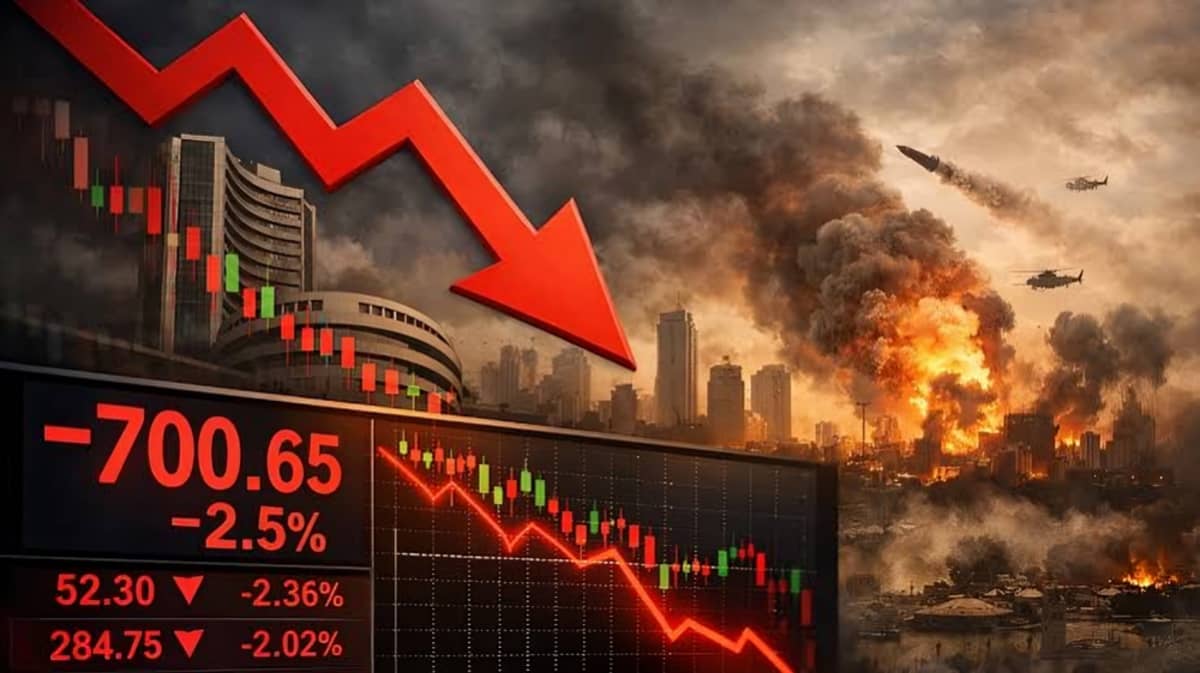

Indian equity markets faced heavy selling pressure on Wednesday, September 2, 2026, as renewed military tensions between the United States and Iran pushed crude oil prices higher and increased concerns about inflation, interest rates and global economic stability.
The BSE Sensex fell more than 700 points during intraday trading, while the Nifty 50 slipped below the 24,000 level. The sharp decline came after global markets weakened in response to the latest escalation in the Middle East. Investors became increasingly cautious as rising oil prices raised concerns about the effect of higher energy costs on inflation and economic growth.
The Sensex opened at 76,471.32, down nearly 473 points from its previous close of 76,944.28. Selling intensified shortly after the opening, with the index falling more than 700 points during early trading. The Nifty 50 opened at 23,858, down nearly 198 points from its previous close of 24,055.80.
The market decline was closely linked to developments in the Middle East. Fresh military exchanges between the United States and Iran increased fears that the conflict could continue for longer and potentially disrupt global energy supplies. Oil prices responded quickly to the uncertainty, adding another layer of concern for investors.
Brent crude moved towards 97 dollars per barrel during the session. Reuters reported that Brent was around 95.4 dollars per barrel at one point, while other market reports showed prices approaching 97 dollars. The increase was driven by concerns over potential supply disruptions linked to the escalating US Iran conflict.
Higher crude prices are particularly important for India because the country is heavily dependent on imported oil. A sustained increase in international crude prices can raise India's import bill and potentially put pressure on inflation, the current account balance and the Indian rupee.
The impact of higher oil prices was visible across several sectors of the stock market. Oil marketing companies, airlines, tyre manufacturers and paint companies faced pressure as investors assessed the possibility of higher input costs.
Airlines are particularly sensitive to crude oil movements because aviation turbine fuel is a major operating expense. A prolonged increase in energy prices can raise airline costs and affect profitability. Similarly, tyre and paint manufacturers can face pressure because petroleum derivatives are important inputs in their production processes.
Oil marketing companies also face a complicated environment when crude prices rise sharply. Higher international oil prices increase the cost of crude procurement, while retail fuel prices may not immediately move in line with global crude prices. If the gap persists, margins can come under pressure.
The broader market decline was not limited to a few companies. Reuters reported that all 16 major sectors recorded losses during the session, while the broader mid cap and small cap segments also declined. The Nifty 50 eventually ended at 23,841.40, down 0.89 percent, while the Sensex closed at 76,333.20, down 0.79 percent, after recovering some of its sharper intraday losses.
The rise in global bond yields added to the pressure on equities. Investors were concerned that higher energy prices could push inflation higher and make central banks more cautious about reducing interest rates.
US Treasury yields increased significantly during the session, with the 10 year US Treasury yield approaching a three year high. Higher US yields can make dollar denominated assets more attractive and potentially reduce investor appetite for emerging market equities.
The Indian rupee also remained under pressure. The currency closed at around 94.97 against the US dollar, little changed from the previous session after intervention by the Reserve Bank of India helped limit volatility. The central bank has been monitoring currency conditions as higher oil prices increase demand for dollars from importers.
For Indian investors, the combination of higher crude prices, geopolitical uncertainty and rising global yields has created a challenging short term environment. Foreign investor flows could also remain sensitive to movements in global interest rates and currency markets.
However, the market decline does not necessarily indicate a fundamental deterioration in India's domestic economic outlook. India's economy continues to record strong growth, supported by domestic consumption, government infrastructure spending and private sector activity.
The recent market weakness instead reflects the sensitivity of financial markets to external developments. Geopolitical conflicts can affect investor confidence rapidly, particularly when they threaten energy supplies or create uncertainty about global inflation.
The oil price movement is therefore likely to remain one of the most important factors for Indian markets in the coming sessions. If crude prices remain elevated for an extended period, investors may become more concerned about inflation and corporate earnings. If geopolitical tensions ease and oil prices retreat, some of the current market pressure could reduce.
Another important factor will be the movement of the rupee. A weaker rupee can increase the domestic cost of imported crude oil, potentially adding to inflationary pressure. At the same time, the Reserve Bank of India has significant foreign exchange reserves and has demonstrated its willingness to intervene to limit excessive currency volatility.
Investors will also watch global equity markets closely. Asian markets fell sharply on Wednesday, with South Korea's KOSPI declining more than 3 percent and Japan's Nikkei falling around 2.6 percent. The broader MSCI Asia Pacific index also recorded a significant decline.
The weakness in Asian markets added to negative sentiment in India. Global investors were simultaneously assessing the consequences of higher oil prices, rising bond yields and the possibility of tighter monetary policy.
The immediate focus for domestic investors will remain on crude oil prices, developments in the US Iran conflict, the movement of the rupee, foreign institutional investor activity and global bond yields.
The market's ability to recover from the day's intraday lows also indicates that investors continued to find buying opportunities at lower levels. However, sustained geopolitical uncertainty could keep volatility elevated.
For long term investors, individual company fundamentals remain important despite short term market fluctuations. Companies with strong balance sheets, manageable debt and stable domestic demand may be better positioned to withstand temporary external shocks.
The September 2 decline highlights how closely India's financial markets remain connected to international energy and geopolitical developments. A conflict thousands of kilometres away can affect Indian equities through crude prices, inflation expectations, currency movements and global capital flows.
The Sensex and Nifty therefore remain sensitive to further developments in the Middle East. Any significant change in the conflict, particularly developments affecting oil production or shipping routes, could influence crude prices and consequently Indian market sentiment.
For now, investors are likely to remain cautious as crude oil prices stay close to the 100 dollar threshold. The key question for the market is whether the rise in oil prices will remain temporary or develop into a prolonged energy shock.
The September 2 selloff was driven primarily by external factors rather than a sudden deterioration in India's domestic economic fundamentals. Nevertheless, continued increases in crude prices could create broader challenges for inflation, corporate costs and economic growth if they persist.
Investors should therefore monitor market developments carefully and avoid interpreting a single session's movement as a definitive indication of the longer term direction of Indian equities.