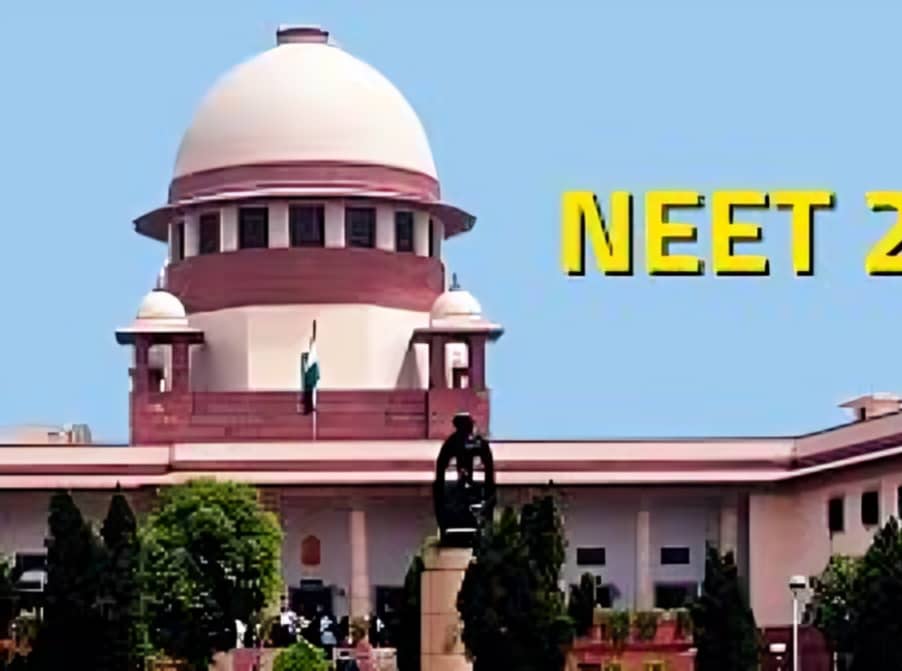
The Supreme Court has allowed a NEET UG 2026 candidate to withdraw his petition filed under Article 32 of the Constitution after he alleged that his examination score had dropped from 603 to 32. The Court permitted the candidate to pursue the matter before the appropriate High Court.
The development comes amid several legal challenges and complaints concerning the NEET UG 2026 examination process. Candidates have approached courts in different cases alleging discrepancies involving examination results, OMR sheets, marks and other aspects of the testing process.
In this particular matter, the candidate claimed that there was a substantial difference between the score he expected or was initially shown and the score subsequently reflected. According to the petition, the score was allegedly shown as 603 at one stage before being reduced to 32.
However, the Supreme Court did not adjudicate the factual correctness of the claim during the proceedings. Instead, the candidate was permitted to withdraw the Article 32 petition and seek appropriate relief before the High Court.
What Is Article 32
Article 32 of the Constitution gives individuals the right to approach the Supreme Court for enforcement of fundamental rights. The Supreme Court can issue appropriate directions, orders or writs in cases involving alleged violations of fundamental rights.
However, the availability of Article 32 does not mean that every dispute involving an examination or administrative decision will necessarily be decided directly by the Supreme Court. Depending on the circumstances, the Court may allow a petitioner to pursue an appropriate remedy before a High Court or another competent forum.
In the present matter, the candidate has been given the opportunity to approach the High Court regarding the alleged discrepancy in his NEET UG score.
The Supreme Court's Order
The key point in the Supreme Court's latest development is that the Court has not ruled that the candidate's score was actually reduced from 603 to 32. The allegation remains a matter to be examined through the appropriate legal process.
The Court's decision to allow withdrawal means that the candidate can now present his grievance before the High Court. The High Court can examine the available records and determine what further action, if any, is required.
This distinction is important because a court allowing withdrawal of a petition is different from a court accepting the allegations made in that petition.
The candidate will therefore need to establish the basis for his claim through relevant examination records, result information, communications from the examination authorities and other supporting documents.
NEET UG 2026 and Examination Disputes
NEET UG is the national-level entrance examination used for admission to undergraduate medical education in India. Because the examination involves a large number of candidates and determines eligibility for medical admissions, disputes relating to results and examination procedures can have significant consequences for students.
During the NEET UG 2026 admission cycle, several candidates have raised concerns before courts regarding different aspects of the examination and result process.
For example, the Supreme Court had earlier dealt with petitions concerning alleged discrepancies in OMR sheets. In one matter reported in August 2026, candidates alleged differences between answers they said they had marked in their original OMR sheets and copies made available by the National Testing Agency.
The courts have therefore been examining individual grievances based on the facts and evidence presented in each case.
Importance of Examination Records
In disputes involving marks, examination records are particularly important. A candidate's claim about a change in marks may require comparison of the original response record, OMR data, answer key, scoring records and the result generated by the examination authority.
The relevant examination authority may also be required to explain how the final score was calculated.
In the present case, the allegation that the score changed from 603 to 32 is significant because the difference could substantially affect the candidate's rank, eligibility and prospects for medical admission. However, the allegation itself does not establish that an error occurred.
The High Court proceedings will provide an opportunity for the candidate to present supporting material and for the concerned authorities to respond.
Possible Impact on the Candidate
A change from 603 marks to 32, if established through official records, could have a major impact on a student's NEET UG admission prospects. NEET scores are used to determine merit and eligibility for undergraduate medical admissions, making accuracy in result processing particularly important.
At the same time, examination authorities generally rely on their official records when determining final scores. A candidate challenging the result therefore needs to demonstrate the discrepancy with credible evidence.
The High Court may examine the documents placed before it and decide whether any directions should be issued to the examination authority.
No Finding of Wrongdoing
It is important to note that the Supreme Court's latest order does not establish that the National Testing Agency or any other examination authority incorrectly changed the candidate's marks.
The court has only allowed the candidate to withdraw his Article 32 petition and pursue the grievance before the High Court. The underlying allegation remains to be considered.
This distinction is especially important when reporting examination-related legal proceedings. A petition or allegation should not be presented as a confirmed irregularity unless a competent authority or court has established it.
What Happens Next
The next step for the candidate is to approach the appropriate High Court with his grievance. The petition before the High Court can include the documents and evidence supporting his claim about the alleged change in marks.
The court may then seek a response from the concerned examination authorities and examine the relevant records.
Depending on the evidence, the High Court could decide whether the candidate has established a genuine discrepancy and whether any corrective action is necessary. The court may also decline relief if the available records do not support the claim.
For other NEET UG 2026 candidates, the development serves as a reminder that examination-related disputes must be supported by official documents and pursued through the appropriate legal forum.
Candidates should also rely on official communications from the National Testing Agency and court orders rather than unverified claims circulating on social media.
The Supreme Court's decision in this case is therefore procedural rather than a final ruling on the alleged marks discrepancy. The candidate has been given permission to approach the High Court, where the claim that his NEET UG score changed from 603 to 32 can be examined in greater detail.
Until the High Court considers the matter and issues an order, the alleged score change should be treated as a claim made by the candidate and not as an established fact.