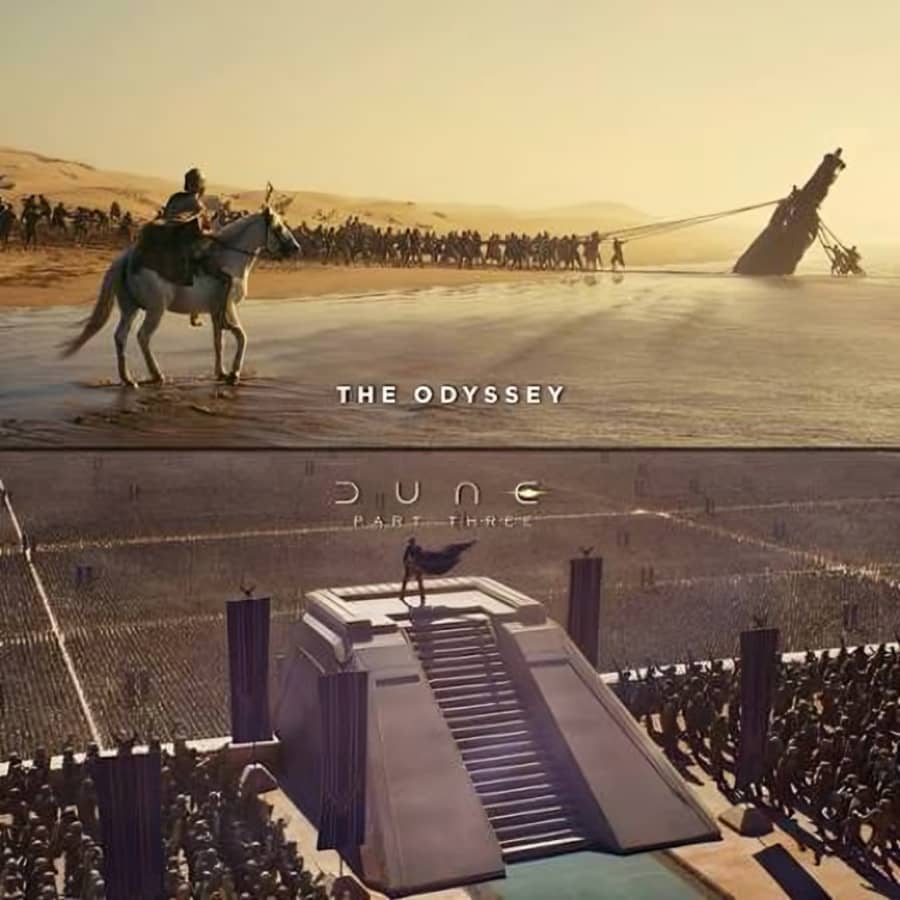

Christopher Nolan's The Odyssey and Denis Villeneuve's Dune are two ambitious cinematic projects that originate from different literary traditions, yet they share several striking thematic and mythological similarities. While one adapts an ancient Greek epic and the other is based on Frank Herbert's celebrated science fiction novel, both stories explore universal ideas that have fascinated audiences for generations.
The Odyssey is based on the ancient Greek poem traditionally attributed to Homer. The story follows Odysseus, the King of Ithaca, as he undertakes a long and dangerous journey home after the Trojan War. Along the way, he encounters mythical creatures, supernatural forces, and numerous personal challenges that test his intelligence, courage, and determination.
Dune, created by Frank Herbert, is set in a futuristic universe centered on the desert planet Arrakis. The story follows Paul Atreides, a young nobleman who gradually assumes a leadership role amid political conflict, environmental challenges, and spiritual prophecy. Although Dune is science fiction, its narrative incorporates themes that resemble myths, legends, and ancient hero stories.
One of the strongest connections between the two works is the classic hero's journey. Both Odysseus and Paul Atreides are forced to leave familiar surroundings, face extraordinary trials, develop as leaders, and ultimately transform through their experiences. This storytelling structure has appeared in myths and literature across civilizations for centuries and continues to influence modern filmmaking.
Leadership is another shared theme. Odysseus must guide his surviving companions through dangerous situations while attempting to return home. Paul Atreides faces the responsibility of leading an entire people through political turmoil and conflict. In both stories, leadership is portrayed not merely as authority but as a responsibility that demands sacrifice, wisdom, and perseverance.
Fate and destiny also play central roles. In The Odyssey, divine intervention from the Greek gods frequently shapes the course of events. Characters struggle between exercising free will and accepting the destinies assigned to them. Similarly, Dune explores prophecy, predetermined expectations, and the consequences of embracing or resisting one's destined role.
Another notable similarity is the importance of harsh landscapes. The sea in The Odyssey functions as both a physical and symbolic obstacle, representing uncertainty and survival. In Dune, the vast desert of Arrakis serves a similar purpose, becoming both a source of danger and the foundation of power, culture, and transformation.
Both stories also examine human endurance. Their protagonists repeatedly confront situations that demand patience, intelligence, and emotional strength. Rather than relying solely on physical power, success often comes through careful decision-making, adaptability, and resilience.
Film scholars have often noted that many modern science fiction stories borrow structural elements from ancient mythology. Although Frank Herbert created an original fictional universe, his work reflects themes commonly found in historical epics, religious traditions, and classical literature. Christopher Nolan's adaptation of The Odyssey directly revisits one of the oldest surviving epic narratives, while Denis Villeneuve's Dune presents similar ideas within a futuristic setting.
These thematic parallels demonstrate how ancient myths continue to influence contemporary storytelling. Despite their different settings and genres, The Odyssey and Dune both explore universal questions about leadership, sacrifice, identity, survival, and humanity's relationship with destiny. This enduring connection helps explain why audiences continue to find both stories compelling across generations.