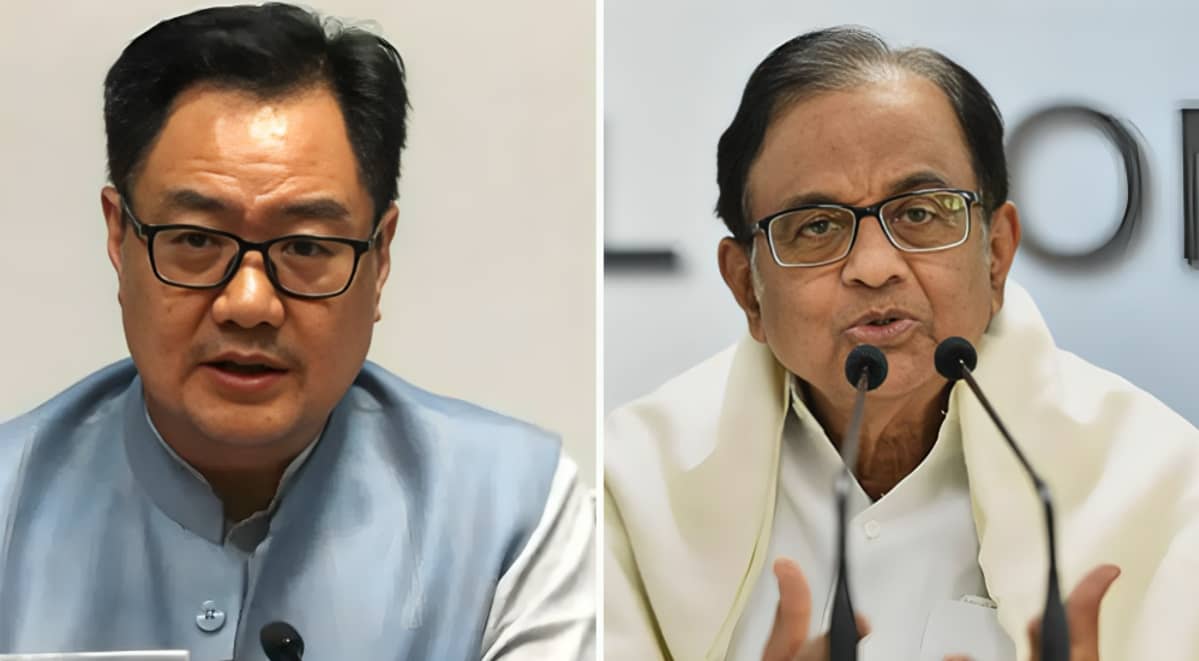
Union Parliamentary Affairs Minister Kiren Rijiju has intensified the political debate surrounding Prime Minister Narendra Modi's recent dimagi Naxal remark by accusing the Congress of moving towards what he described as a Maoist and Naxalite political position.
Rijiju made the remarks on Tuesday amid an ongoing exchange between the Bharatiya Janata Party and the Congress over comments made by Prime Minister Narendra Modi during his Independence Day address. Modi had referred to the continued presence of people with what he described as Naxal thinking and said such individuals needed to be identified and isolated.
Rijiju said the Prime Minister's reference was not aimed specifically at opposition parties. He maintained that the term dimagi Naxal was intended to describe people who support Maoist or Naxalite ideology rather than members of a particular political party.
The minister argued that the Congress itself had interpreted the Prime Minister's remarks as an attack on the party. According to Rijiju, this reaction had contributed to the current political controversy.
However, Rijiju went further by accusing the Congress of undergoing an ideological transformation. He alleged that the party was increasingly resembling a Maoist or Naxalite entity. These are political allegations made by the Union minister and have not been established as an official characterisation of the Congress party.
The controversy began after Prime Minister Narendra Modi used the expression dimagi Naxal during his Independence Day speech. The phrase has since become a major point of political debate, with opposition parties questioning its meaning and intended target.
Rijiju has sought to explain the government's interpretation of the expression. He said that the term referred to individuals who support Maoist, separatist or anti constitutional positions. He argued that the government was distinguishing between armed Naxalism and ideological support for such movements.
The minister also referred to former Prime Minister Manmohan Singh's earlier statements about Maoism and Naxalism. Rijiju said the threat posed by Maoist and Naxalite movements had previously been described as a serious internal security concern, including during the Congress led government.
According to Rijiju, the government has significantly reduced the threat posed by armed Naxalism in recent years. He nevertheless argued that ideological support for Naxalism remains an issue that needs to be addressed through political and ideological debate.
The minister's comments have added another layer to the ongoing confrontation between the ruling BJP and the Congress. The dispute comes during a period of heightened political tensions following disruptions and disagreements during the Monsoon Session of Parliament.
Rijiju also criticised the Congress leadership over the conduct of opposition members in Parliament. He questioned whether the Congress was adequately fulfilling its role as the principal opposition party and linked the political dispute to broader disagreements over the functioning of Parliament.
The Congress has been critical of the government's use of the dimagi Naxal terminology and has questioned whether the expression was being used to target political opponents and critics. The BJP, however, has maintained that the phrase was not intended to label opposition parties.
The issue has also generated discussion about the difference between armed Naxalism and ideological positions. The government has argued that while armed groups have been weakened, individuals supporting or promoting extremist ideologies can continue to influence public discourse.
Rijiju's latest statement therefore combines a defence of the Prime Minister's remarks with a direct political attack on the Congress. While he maintained that Modi's statement was not directed at opposition parties, he simultaneously alleged that the Congress was moving closer to Maoist and Naxalite ideology.
The minister also referred to positions associated with separatism and constitutional changes while explaining what the government considers to be ideological Naxalism. He argued that support for such positions should be examined separately from ordinary political disagreement.
The comments are likely to keep the political debate active as Parliament resumes discussions on several contentious issues. The BJP and Congress have continued to exchange accusations over the conduct of parliamentary proceedings, public protests and the government's policies.
For the Congress, the controversy provides an opportunity to question the language being used by senior government leaders. For the BJP, Rijiju's remarks are part of an effort to clarify the Prime Minister's statement and argue that the criticism from opposition parties is misplaced.
It is important to distinguish between political allegations and established facts in this dispute. Rijiju's claim that the Congress is becoming a Maoist party represents his political assessment and accusation. It does not establish that the Congress has formally adopted Maoist ideology or that the party is officially classified as a Maoist organisation.
Similarly, the meaning and intended application of the term dimagi Naxal remain subjects of political interpretation. Rijiju has said that the expression was not aimed at opposition parties, while the opposition has continued to question the terminology and its political implications.
The controversy illustrates the increasingly sharp political exchanges between the BJP and Congress over national security, ideology and the functioning of Parliament. It also demonstrates how remarks made during major national addresses can become the focus of extended political debate.
As the issue continues, attention is expected to remain on how both sides interpret the Prime Minister's original remarks and whether the BJP and Congress can move the discussion towards substantive parliamentary issues.
For now, Kiren Rijiju has maintained that the dimagi Naxal remark was not directed at opposition parties. At the same time, he has accused the Congress of moving towards a Maoist and Naxalite ideological position, escalating the political confrontation between the two major national parties.