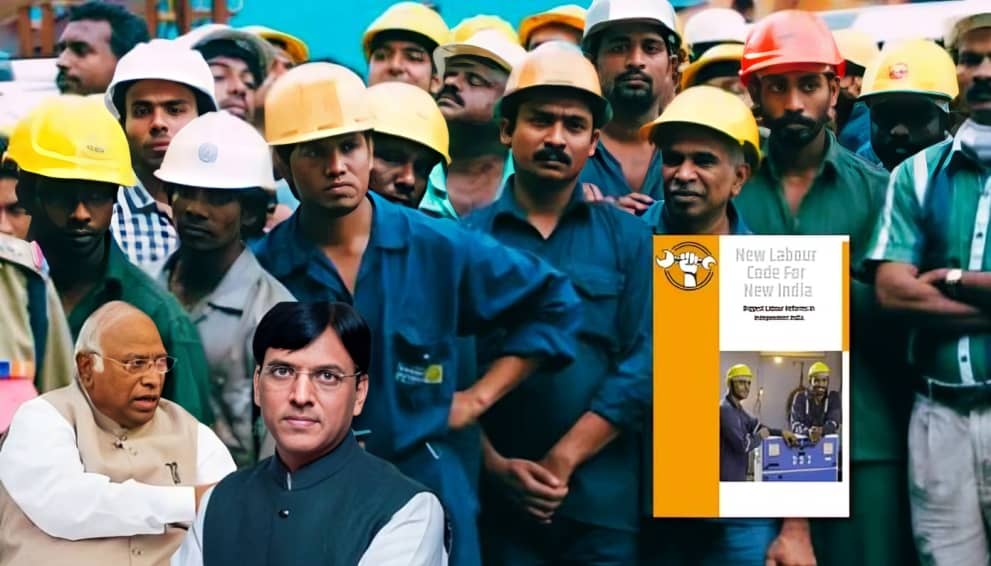

Congress president Mallikarjun Kharge has strongly criticized the labour reform measures introduced by the government led by Prime Minister Narendra Modi. Kharge alleged that the labour codes being implemented by the Centre could weaken worker protections and create uncertainty regarding employment security across multiple sectors.
Speaking on the issue, the Congress leader claimed that the labour reforms may result in what he described as a “hire and fire” environment for workers. According to him, employees could face increased job insecurity if labour regulations are relaxed without sufficient safeguards for workers’ rights.
The labour codes introduced by the Central government are part of a broader reform initiative aimed at consolidating existing labour laws into simplified legal frameworks. The government has stated that the reforms are intended to improve ease of doing business, simplify compliance procedures and encourage industrial growth and investment.
However, opposition parties and labour unions have expressed concerns about certain provisions in the proposed framework. Critics argue that some measures could reduce protections related to layoffs, working conditions, collective bargaining and dispute resolution.
Mallikarjun Kharge alleged that the reforms were being pushed forward after elections and accused the government of failing to adequately consult workers’ organizations and trade unions. He stated that labour policies should prioritize employee welfare and social security rather than focusing only on industrial flexibility.
The Congress leader also claimed that workers in both organized and unorganized sectors are already facing challenges related to inflation, wage pressures and employment uncertainty. He argued that any reforms affecting labour rights should be implemented only after extensive discussion with all stakeholders.
The Central government, meanwhile, has defended the labour codes and stated that the reforms are designed to modernize India’s labour system while balancing the interests of both workers and employers. Government representatives have argued that the existing labour law structure was complex and required simplification to improve efficiency and attract investment.
Officials have also stated that the labour codes include provisions related to minimum wages, social security and workplace safety. According to the government, the reforms aim to create a more transparent and predictable labour environment while supporting economic growth and employment generation.
Trade unions across the country have previously organized protests and demonstrations opposing certain aspects of the labour reforms. Worker organizations have demanded stronger legal safeguards, protection against arbitrary termination and greater participation in policy discussions.
Political analysts believe labour reforms are likely to remain an important issue in national political debates, especially as employment and economic conditions continue to attract public attention. The discussion has gained renewed significance amid concerns related to inflation, industrial growth and job creation.
The latest remarks by Mallikarjun Kharge have once again highlighted the sharp differences between the ruling Bharatiya Janata Party and the Congress party on economic and labour policies. Both parties are expected to continue debating the impact of the reforms in Parliament and public forums.
Experts note that labour reforms remain a sensitive issue in India because of the country’s large workforce and diverse employment sectors. Any major policy changes affecting workers often lead to extensive political and public discussion.
As debate over the labour codes continues, both the government and opposition parties are expected to intensify their outreach efforts to workers, industries and trade unions in the coming months.