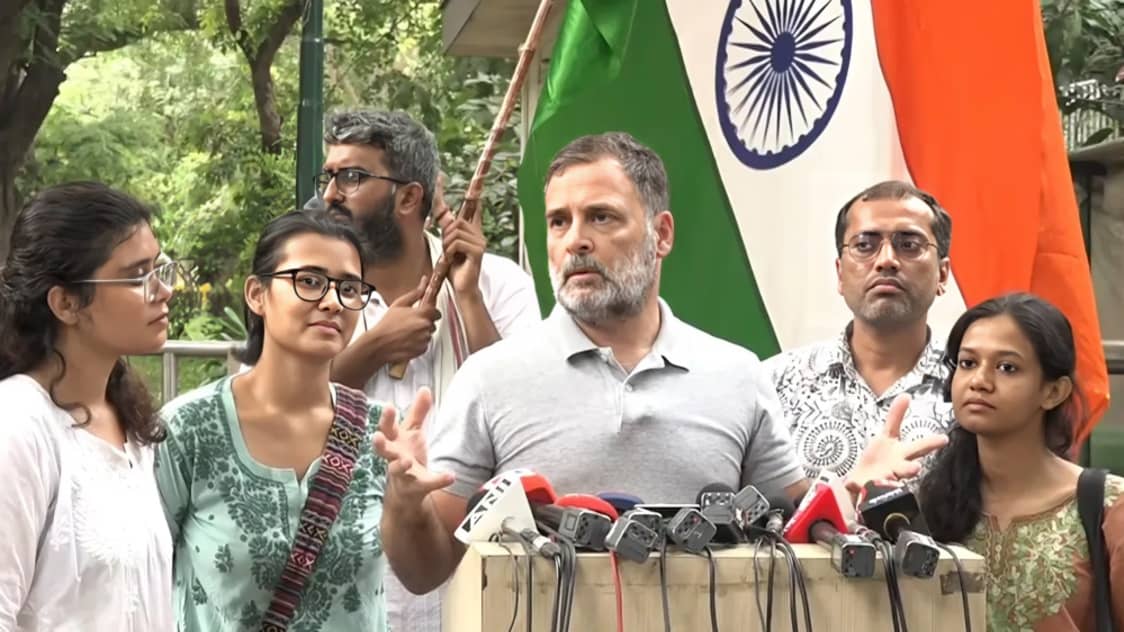

Congress leader Rahul Gandhi has strongly criticised the Central Government over its response to recent student protests, accusing the administration of taking action against young demonstrators instead of addressing their concerns. His remarks were directed at Prime Minister Narendra Modi and Union Home Minister Amit Shah during a public statement on the issue.
Rahul Gandhi alleged that students participating in protests are facing First Information Reports and restrictions on their social media accounts. According to him, young people raising concerns about education, employment, and examination-related issues should be heard rather than subjected to legal action. He also claimed that the government's approach reflects a growing disconnect with the aspirations of India's younger generation.
The Congress leader's comments come amid continuing debates over education reforms and the handling of examination-related controversies across the country. Student organisations have organised demonstrations in several places, raising concerns over issues such as examination transparency, recruitment processes, and the impact of paper leak incidents on candidates preparing for competitive examinations.
Responding to concerns surrounding examination integrity, Prime Minister Narendra Modi has stated that comprehensive reforms are necessary to eliminate paper leak incidents and strengthen the credibility of the examination system. The government has maintained that protecting honest candidates requires stricter legal measures against those involved in examination fraud.
Recently, Parliament passed legislation providing stronger legal provisions against paper leak offences. The law introduces stricter penalties for individuals and organised groups found guilty of leaking examination papers or engaging in unfair practices related to public examinations. The government has said the legislation is intended to safeguard the interests of millions of students appearing for competitive examinations every year.
According to the Central Government, the new legal framework is designed to deter organised malpractice, improve transparency, and ensure that recruitment and admission examinations are conducted fairly. Officials have argued that stronger enforcement is essential to restore public confidence in the examination process.
The political exchange has triggered reactions from both the ruling party and the opposition. Supporters of the government argue that strict legal measures are necessary to combat examination fraud and maintain the integrity of public institutions. They believe that action against criminal activities should not be viewed as a restriction on democratic rights.
On the other hand, opposition leaders have continued to question the government's handling of student concerns. They argue that while examination reforms are important, authorities should also ensure that peaceful protests and freedom of expression are respected in accordance with democratic principles.
Political analysts believe the issue is likely to remain a significant topic of debate, particularly among young voters and students. Education policy, employment opportunities, and examination reforms have become central issues in national political discussions, with different parties presenting contrasting approaches.
As discussions continue, there has been no official confirmation from the government regarding the specific allegations raised by Rahul Gandhi concerning action against individual protesters. The debate is expected to continue both inside and outside Parliament as political parties respond to developments related to student protests and education reforms.