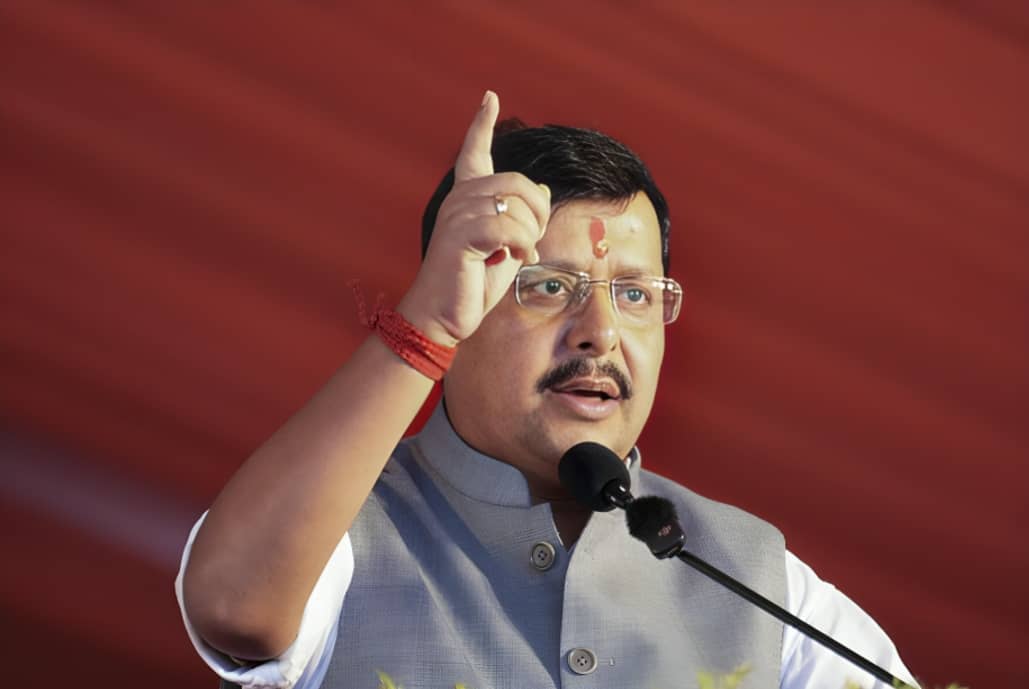
The political controversy surrounding Vande Mataram has intensified after BJP national president Nitin Nabin criticised the Congress Working Committee's decision to continue singing only the first two stanzas of the national song at party events.
The Congress Working Committee recently reaffirmed its position on the rendition of Vande Mataram. According to the party, its decision is based on a resolution adopted in 1937. The Congress has maintained that the first two stanzas should be used for its party programmes and public gatherings.
Reacting to the decision, Nitin Nabin accused Congress of formalising what he described as disrespect towards Vande Mataram. He alleged that the party was prioritising vote bank considerations over national sentiment. Nabin also used the politically charged description of Congress as the new Muslim League. These are political allegations made by the BJP president and should be understood as his political assessment rather than an independently established fact.
Nabin further argued that the decision was disrespectful to those who sacrificed their lives during India's freedom struggle. He linked Vande Mataram with the historical role played by the song in the country's independence movement and said the song represented an important part of India's national consciousness.
The Congress has taken a different position on the issue. The party has referred to its 1937 Working Committee resolution, which established the practice of using the first two stanzas for national gatherings. The Congress has continued to defend this historical position amid criticism from the BJP and other political organisations.
The controversy has also emerged against the backdrop of renewed attention to the full version of Vande Mataram. Earlier this year, the Union government issued guidelines concerning the rendition of the national song at official functions. The government has promoted the official six stanza version for specified state occasions, adding another dimension to the current political debate.
The dispute is not limited to the question of how many stanzas should be sung. It has developed into a wider political argument over nationalism, the history of the freedom movement and the role of national symbols in contemporary Indian politics.
The first two stanzas of Vande Mataram have traditionally been used for public rendition. Historical discussions before independence also addressed concerns surrounding some of the later stanzas. The 1937 Congress decision became an important reference point in determining which portions would be used at national gatherings.
The issue has now become a major point of disagreement between the BJP and Congress. BJP leaders have accused Congress of showing insufficient respect for the national song, while Congress leaders have argued that their position has historical and political precedent.
The controversy was further intensified after disagreements over the rendition of Vande Mataram during an Independence Day programme at the Congress headquarters. BJP leaders criticised the conduct of senior Congress leaders during the event, while Congress representatives offered their own explanations.
Nabin's latest remarks therefore represent another escalation in the political exchange. His comparison of Congress with the Muslim League is particularly contentious and is likely to generate further reactions from Congress leaders.
The Congress is expected to continue defending its two stanza position by referring to the historical decision of its Working Committee. The BJP, meanwhile, is likely to continue arguing that the complete national song deserves greater recognition.
The controversy also highlights the difference between party events and official government functions. While the Congress decision concerns the rendition of Vande Mataram at Congress forums, the Union government's guidelines concern specified official functions. Keeping these contexts separate is important when reporting the issue.
For readers, it is also important to distinguish between historical facts, official decisions and political allegations. Claims regarding vote bank politics, disrespect towards national symbols or comparisons with historical political organisations are statements made by political leaders and should be attributed accordingly.
The Vande Mataram debate is expected to remain a significant political issue as both major national parties present different interpretations of the song's history and its contemporary use.
The latest comments from Nitin Nabin have added to the growing political confrontation, with the BJP questioning the Congress position and Congress defending its longstanding interpretation of the 1937 resolution.