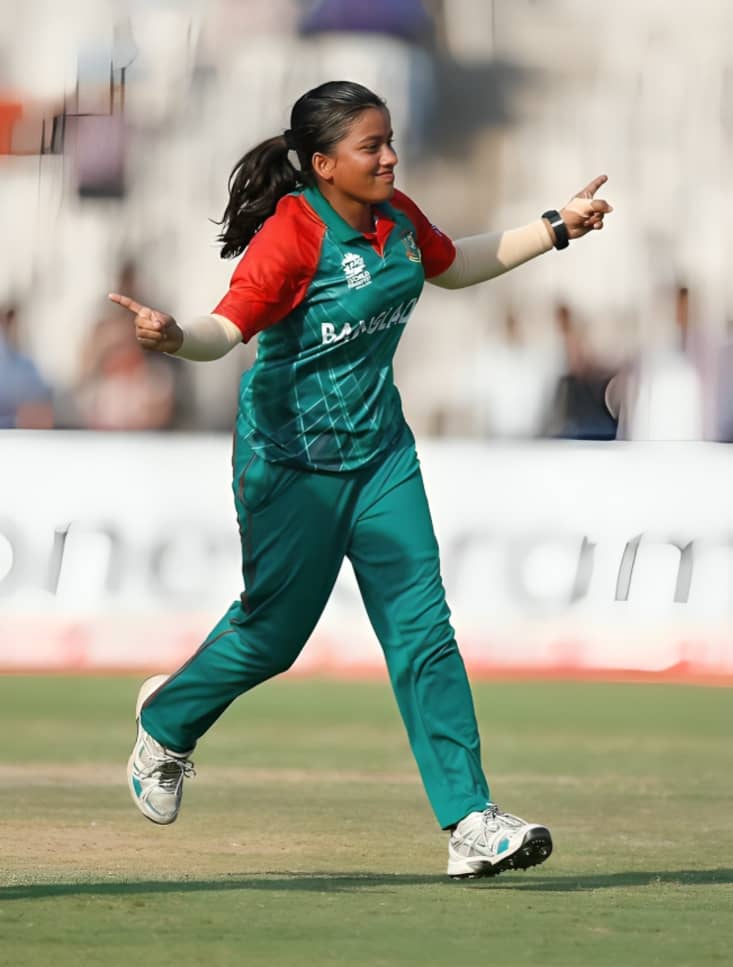
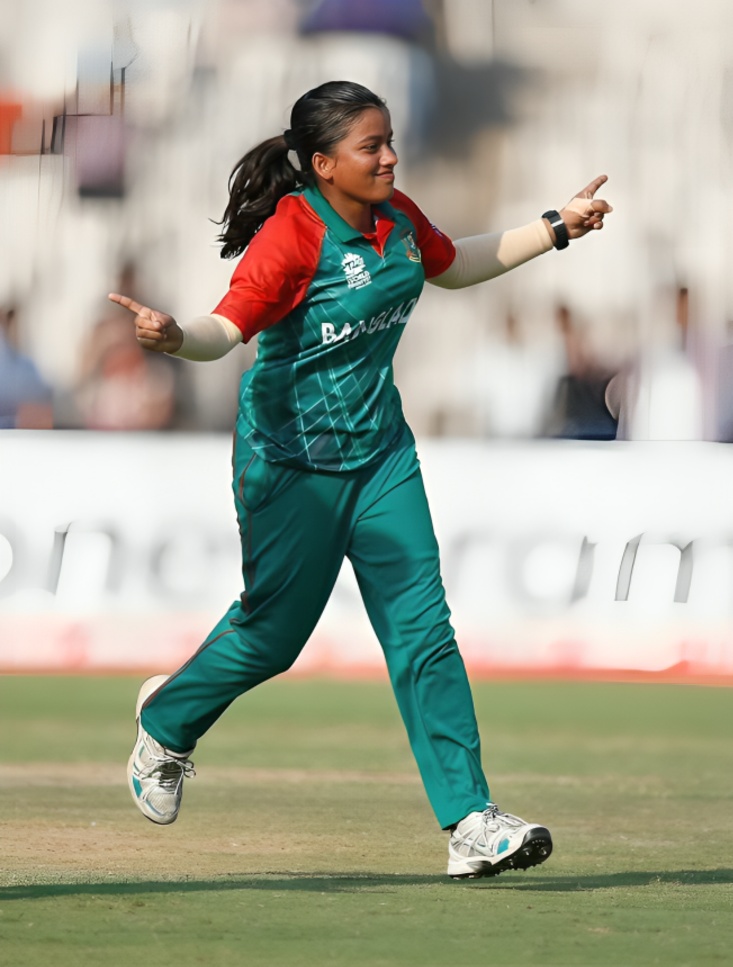
Bangladesh left arm spinner Nahida Akter has become one of the prominent figures in the country’s women’s cricket, with her journey offering an inspiring example to young girls who want to pursue the sport.
Nahida’s rise to international cricket was not straightforward. She developed an interest in cricket while growing up in Dhaka and often played with her elder brothers after school. At that stage, cricket was not initially viewed by her as a professional career. However, her growing passion for the game eventually encouraged her to pursue formal training.
One of the important turning points in her journey came when she learned that the Bangladesh Krira Shikkha Protishtan, commonly known as BKSP, was accepting female cricketers. She gathered information about the selection process and decided to attend the trials.
Her first attempt was unsuccessful. Nahida was not selected during the 2012 trial, a setback that left her disappointed. Instead of abandoning her ambition, she continued to pursue cricket and eventually secured admission to BKSP the following year.
Her family also faced criticism because of her decision to play cricket. Nahida has recalled that people questioned why a girl was spending so much time playing a sport that was often associated with boys. There were even complaints about her playing after school and pressure on her family to discourage her.
Despite those difficulties, Nahida continued to receive support from members of her family, particularly her mother and brother. That support played an important role in allowing her to continue her development as a cricketer.
At BKSP, Nahida began learning the technical aspects of cricket more seriously. Initially, she preferred batting, but her coaches identified potential in her bowling. She had to develop her bowling action from the basics and gradually became a left arm spinner.
The transformation was significant. What began as a young girl's interest in playing cricket eventually developed into an international career.
Nahida made her international debut for Bangladesh as a teenager. She played her first T20 international against Pakistan in September 2015 and made her ODI debut against the same opposition shortly afterwards. She was only 15 years old when she made her T20 international debut.
Her progress continued as she became an increasingly important member of the Bangladesh women's team.
As a slow left arm orthodox bowler, Nahida developed a reputation for accuracy, control and consistency. Her performances helped her establish herself as one of Bangladesh's leading bowling options across white ball cricket.
She was also part of the Bangladesh team that won the Women's Asia Cup in 2018, an important achievement in the development of women's cricket in the country. She later continued to play a central role in Bangladesh's international campaigns.
Nahida's importance to the team has grown considerably over the years. She has become one of Bangladesh's leading wicket takers across the limited overs formats and has also taken on a leadership role within the squad.
Her experience has increasingly been used not only for her own performances but also to help younger players develop.
During the Women's World Cup, for example, Nahida was seen guiding younger Bangladesh spinners and sharing advice about bowling grips, routines and areas to target against different batters.
This development reflects how her role has changed. The player who once needed guidance from senior cricketers is now helping the next generation of Bangladesh women cricketers.
Nahida has previously spoken about the influence of former Bangladesh captain Salma Khatun. She has credited senior players with teaching her how to adapt to different match situations and how to remain composed when conditions become difficult.
She has also spoken about learning from other successful spinners, including Bangladesh's Shakib Al Hasan and Sri Lanka's Rangana Herath. Studying experienced bowlers has helped her improve her understanding of spin bowling and match strategy.
Her career has therefore been built not only on natural ability but also on a willingness to learn.
Nahida's story is particularly significant in the context of women's cricket in Bangladesh. Although the sport has grown rapidly, young girls can still face social and financial challenges when attempting to pursue cricket.
Her own experience demonstrates how difficult the early stages can be. She has recalled facing criticism simply for playing cricket, while her family had to deal with questions and pressure from people around them.
Those experiences have helped shape her approach to the next generation.
For young girls watching Bangladesh women's cricket, Nahida represents the possibility of turning an interest in sport into an international career.
Her journey also demonstrates the importance of access to structured coaching. Without opportunities such as BKSP, talented young players may find it difficult to develop the technical skills required for international cricket.
Nahida's transformation from playing informal cricket with her brothers to becoming a specialist international spinner illustrates the value of professional training.
Her story also highlights the role of family encouragement. While social criticism could have ended her ambitions at an early stage, continued support from her family allowed her to keep pursuing cricket.
Her brother Nazim Ahmed has been particularly important in her development. Nahida has credited him with helping her strengthen both her cricketing ability and mental approach.
That mental resilience has become one of the defining features of her career.
Nahida has also spoken about the need to focus on the next delivery rather than dwelling on mistakes. For a spinner, where a single delivery can change a match, maintaining concentration and adapting to conditions are crucial.
Her approach has helped her become a dependable member of Bangladesh's bowling attack.
Her career also shows how the growth of women's cricket can create a cycle of inspiration. Senior players such as Salma Khatun inspired Nahida, and Nahida is now passing that experience to younger teammates.
That process can help Bangladesh build a stronger women's cricket system.
The message from Nahida's journey is particularly relevant for girls who may hesitate to take up cricket because of social expectations.
Her experience demonstrates that sporting ambition does not have to be limited by traditional perceptions about which sports girls should play.
The increasing visibility of women's cricket has also created more opportunities for young players to see international cricketers as role models.
Nahida's achievements provide another example of that changing landscape.
Her international career began when she was just 15, and over the years she has developed into an experienced player capable of handling pressure at major tournaments.
Her development has also coincided with the broader progress of Bangladesh women's cricket.
The Bangladesh women's team has achieved important milestones in recent years, including its historic Women's Asia Cup triumph and appearances at major international tournaments.
Players such as Nahida have been central to that progress.
For young girls, her story offers a simple but powerful lesson. Starting with limited opportunities does not necessarily prevent a player from reaching the international stage if talent is combined with determination, training and support.
The road may include rejection, criticism and setbacks, but those obstacles do not have to determine the final outcome.
Nahida's own first rejection from BKSP could have ended her cricketing ambitions. Instead, she returned and eventually earned her place at the sports institute.
That decision became one of the most important moments in her career.
Today, she is not only an experienced international cricketer but also a player who can guide younger members of the Bangladesh squad.
Her role as a mentor is especially important because younger players can benefit from the lessons she learned during her own difficult journey.
The message is also relevant beyond Bangladesh. Women's cricket across South Asia continues to grow, with more young girls looking for opportunities to participate in organised sport.
Greater access to coaching, facilities, competitions and family support can help identify and develop the next generation of players.
Nahida's career shows what can happen when those opportunities are available.
Her journey began with informal cricket and a love for the game. It developed through professional training and international competition and has now reached a stage where she is helping guide other players.
The story is therefore about more than wickets and statistics.
It is also about changing attitudes towards girls in sport.
Nahida has become a role model because she experienced many of the obstacles that aspiring young female cricketers can face. Her success demonstrates that those obstacles can be overcome.
Her message to young girls is closely connected to the wider growth of women's cricket. Every girl who picks up a cricket ball represents another potential player who could contribute to the sport's future.
The challenge for cricket administrators is to ensure that those girls have access to the facilities and coaching required to develop their abilities.
For Nahida, the journey from a young girl playing cricket with her brothers to an established Bangladesh international has been long and demanding.
Her experiences have given her a perspective that can be valuable to the next generation.
As Bangladesh women's cricket continues to develop, players such as Nahida can play an important role both on and off the field.
Her performances provide results for the national team, while her journey provides inspiration for girls who are still at the beginning of their own sporting ambitions.
The message is clear. A young girl picking up a cricket ball can be the beginning of something much bigger when she receives the opportunity, training and support to pursue her dream.
Nahida Akter's career stands as an example of how determination can turn an uncertain beginning into an international sporting journey.