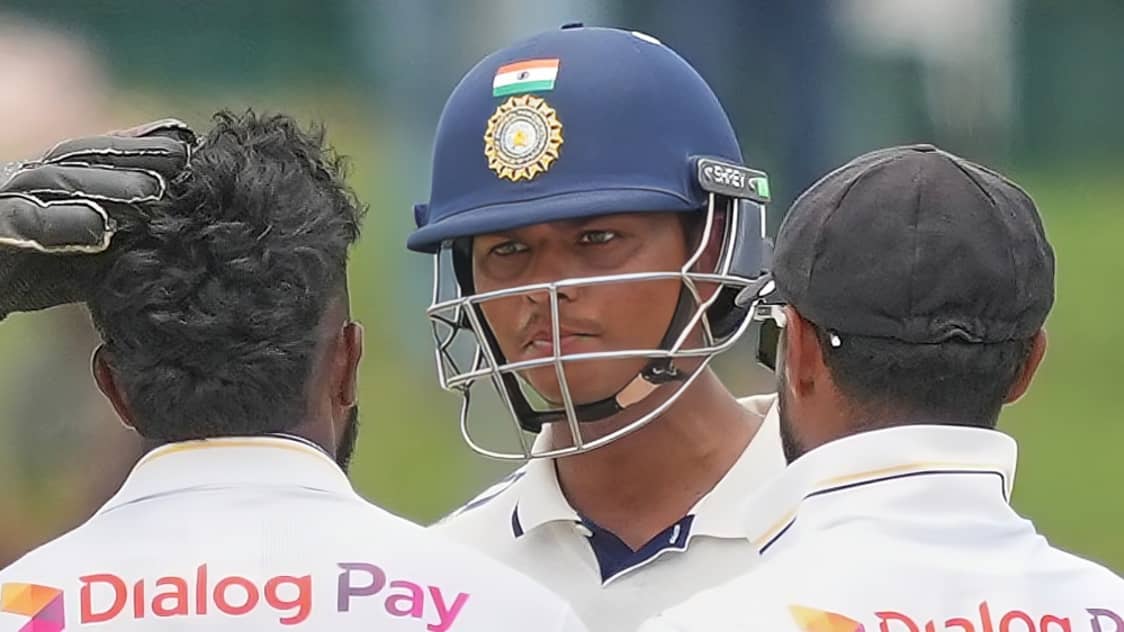
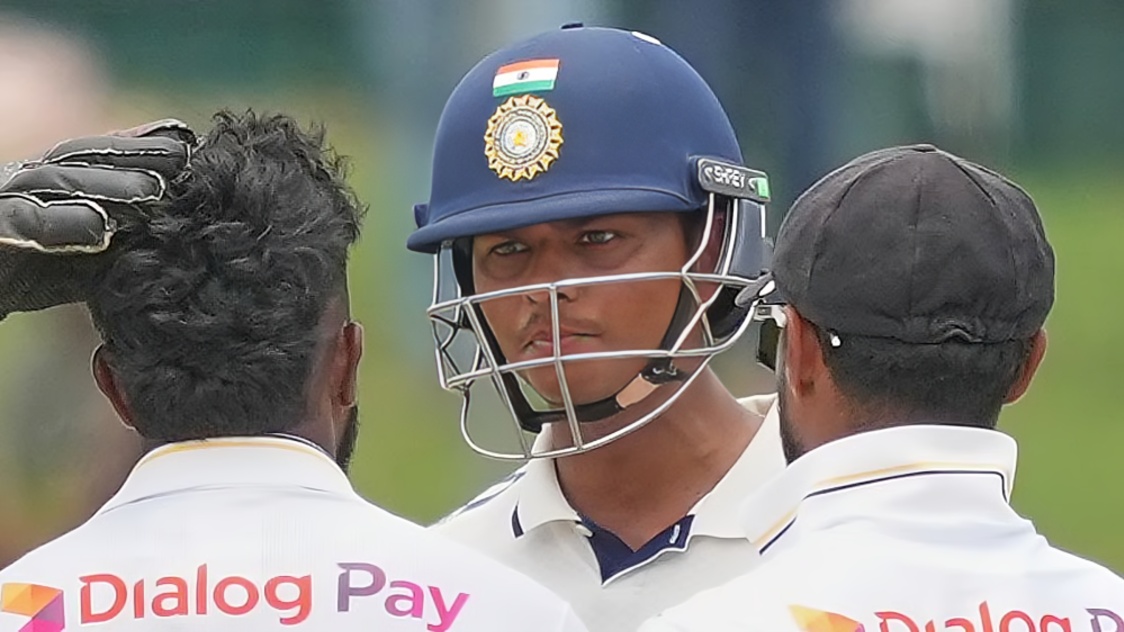
Yashasvi Jaiswal has come under scrutiny following a heated on field confrontation with Sri Lanka fast bowler Asitha Fernando during the second Test between India and Sri Lanka in Colombo.
The incident occurred during the opening day of the Test after Fernando dismissed Jaiswal for 45 runs. The Indian opener had made an aggressive start to his innings, hitting nine boundaries from 53 deliveries. However, Fernando eventually produced a delivery that moved back into Jaiswal and struck the stumps.
After the dismissal, Fernando gave Jaiswal an animated send off. Jaiswal turned around while walking towards the dressing room and returned towards the Sri Lankan bowler. The two exchanged words before the confrontation became more intense.
Jaiswal and Fernando moved close to each other, and television footage showed apparent head contact between the two players. Members of both teams quickly intervened and prevented the situation from escalating further.
The incident generated considerable discussion among former cricketers and commentators. Former India opener Wasim Jaffer strongly criticised Jaiswal's conduct and described it as unacceptable.
Jaffer's criticism focused particularly on Jaiswal's status as a young player who is increasingly viewed as a role model. According to Jaffer, players representing India at the international level have a responsibility to maintain discipline and set an appropriate example for younger cricketers.
The incident also attracted comments from several other former Indian players.
Former India batter Cheteshwar Pujara described the incident as an unpleasant sight and suggested that such physical confrontation should not take place on a cricket field. Other former players also questioned Jaiswal's decision to move towards Fernando after the dismissal.
Former India cricketer Ajay Jadeja also delivered a strong message to Jaiswal, stressing the importance of controlling emotions during international matches. His comments highlighted the difference between competitive aggression and behaviour that crosses the boundaries of sportsmanship.
The incident became even more significant because Jaiswal is one of the most promising young batters in Indian cricket.
Since making his international debut, Jaiswal has established himself as an important part of India's Test batting lineup. His aggressive style and ability to score quickly have made him one of the most closely watched young players in world cricket.
That growing profile also means that his behaviour on the field receives considerable attention.
Jaiswal later responded to criticism surrounding the incident. In a social media interaction, he suggested that people should not judge the situation without knowing what had been said during the exchange. He indicated that there was context behind the confrontation.
The Indian team management also addressed the incident.
India batting coach Sitanshu Kotak acknowledged that the situation may have developed in the heat of the moment. However, he also said Jaiswal should not have moved so close to Fernando. Kotak suggested that words exchanged during the confrontation may have contributed to the escalation.
Sri Lanka's fast bowling coach Ryan van Niekerk also described the verbal exchange as something that can occur during the intensity of a Test match, while leaving the disciplinary assessment to the match referee.
The matter was subsequently reviewed under the International Cricket Council's Code of Conduct.
The ICC confirmed that both Jaiswal and Fernando were found to have breached Article 2.12 of the Code of Conduct. The article deals with inappropriate physical contact involving players, support staff, match officials or other individuals during an international match.
Both players admitted the offence and accepted the sanctions proposed by ICC match referee Andy Pycroft. As a result, there was no requirement for a formal hearing.
Jaiswal and Fernando were each fined 25 percent of their match fees and received one demerit point. The ICC also confirmed that neither player had committed a previous offence during the preceding 24 months.
The disciplinary action brought an official conclusion to the controversy, although discussion about the incident continued among former players and cricket supporters.
For Jaiswal, the episode came during an important Test match for India.
India had already won the first Test of the series in Galle by 165 runs and entered the Colombo Test with an opportunity to secure a series victory. The second Test therefore carried significant importance for both teams.
Jaiswal's dismissal for 45 was also significant from a cricketing perspective. He had looked comfortable at the beginning of his innings and had put pressure on the Sri Lankan bowling attack.
Fernando, however, managed to find the breakthrough and ended the Indian opener's innings.
The subsequent confrontation overshadowed much of the discussion surrounding Jaiswal's batting.
For a young international player, maintaining emotional control is considered an important part of development. Test cricket can involve long periods of pressure, verbal exchanges and intense competition, but players are expected to remain within the boundaries of the game's conduct regulations.
That is the central issue raised by Jaffer's criticism.
The former opener's comments were not simply about the individual incident. They also reflected broader expectations placed on high profile Indian players.
Jaiswal has become an important figure for Indian cricket and is increasingly seen by young fans as an example to follow. Former players therefore believe that his conduct away from batting statistics is also important.
The controversy also demonstrates how quickly incidents on the field can attract global attention.
The exchange between Jaiswal and Fernando lasted only a short period, but video footage circulated widely on social media. It subsequently became one of the most discussed moments from the opening day of the Colombo Test.
The incident also had a clear disciplinary consequence.
Because the players made physical contact, the situation went beyond a normal verbal disagreement. The ICC's decision to impose fines and demerit points reinforced the importance of maintaining physical boundaries during international matches.
At the same time, there was recognition that emotions can run high during competitive cricket.
Jaiswal had just been dismissed after making a positive start, while Fernando had completed an important wicket for Sri Lanka. The intensity of the moment, combined with the verbal exchange, contributed to the confrontation.
However, former players have argued that international cricketers must learn to control such emotions.
Jaffer's criticism therefore adds to a broader conversation about the behaviour expected from young stars.
The Indian opener's response also indicates that he believes there was additional context to the incident. His comments suggested that the public did not know everything that had been said between the players before the confrontation.
Nevertheless, the ICC disciplinary decision was based on the physical contact and the applicable Code of Conduct.
The punishment was relatively limited, with both players receiving a financial penalty and one demerit point. The fact that both players accepted the sanctions meant the matter could be resolved without a formal hearing.
For Jaiswal, the incident is likely to be viewed as an important learning experience.
His cricketing ability has already made him one of India's most promising young players. The next stage of his development will involve handling pressure, expectations and challenging situations both with the bat and on the field.
The criticism from former players is therefore focused not only on the incident itself but also on the responsibilities that accompany international recognition.
As India continues its Test series against Sri Lanka, Jaiswal will be expected to put the controversy behind him and concentrate on his batting.
The second Test in Colombo remains an important match for India, who are seeking to strengthen their position in the series.
For Sri Lanka, the encounter provides an opportunity to challenge India's dominance after the visitors won the opening Test.
The Jaiswal Fernando incident has added another layer to an already competitive series.
Ultimately, the episode has highlighted the importance of sportsmanship alongside competitive intensity. Players can show passion and determination, but physical confrontations remain unacceptable under the game's rules.
Wasim Jaffer's criticism reflects that wider expectation.
The ICC's decision has now provided a formal outcome, with both players accepting responsibility and receiving identical sanctions.
For Jaiswal, the focus will now return to cricket. His performances with the bat remain central to India's plans, while his conduct on the field will continue to receive attention as his international career develops.
The incident serves as a reminder that young stars are judged not only by their runs and wickets but also by how they handle pressure and represent their teams.