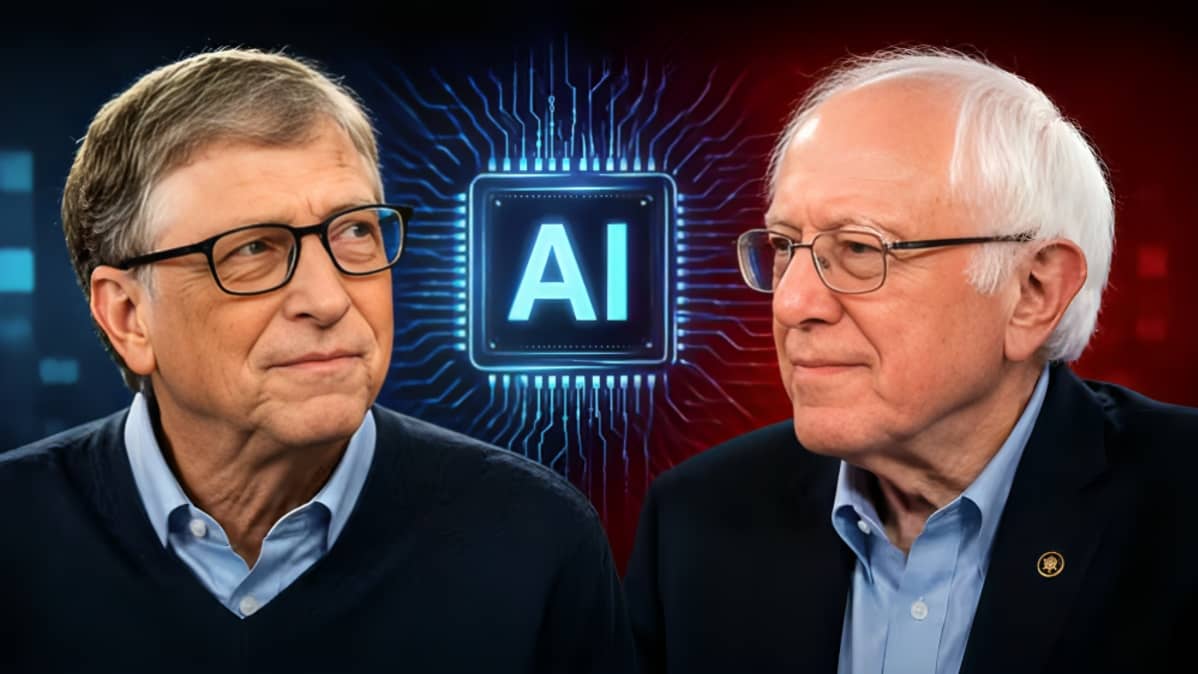
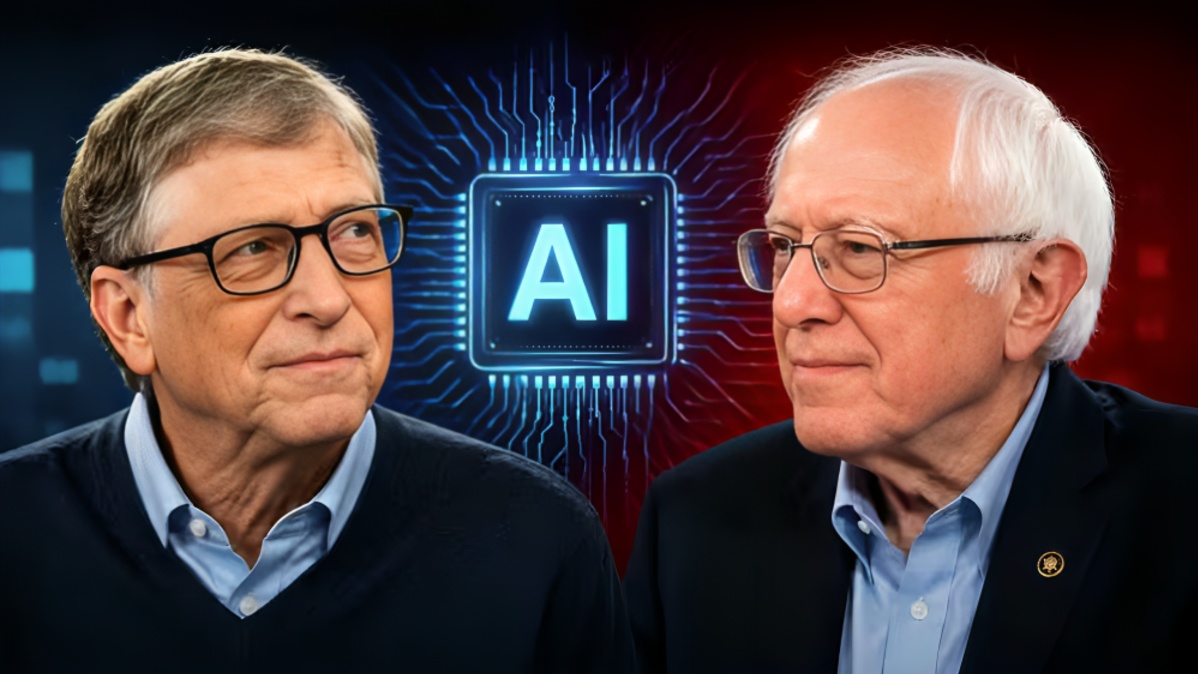
US Senator Bernie Sanders has backed Microsoft cofounder Bill Gates’ concerns about the rapid development of artificial intelligence, warning that governments should act before the technology creates deeper disruption in employment and society.
Sanders expressed his support in a post on X after Gates published a lengthy essay examining the social and economic consequences of the AI boom. Sanders said Gates was right to warn that artificial intelligence could pose a serious threat to jobs and the future of humanity. He also called on Congress to challenge the growing influence of major technology companies.
Sanders’ comments add to a series of warnings he has made about the potential risks of AI. Earlier this month, he urged major AI companies including OpenAI, Anthropic and Meta to pause development, arguing that increasingly capable systems could create risks that humans may not be able to control effectively.
His latest comments came after Gates published an essay titled The Turbulent AI Era Is Here. In the essay, Gates argued that the current technological transition could be fundamentally different from earlier waves of automation because AI can perform tasks involving human cognition.
Gates said previous industrial and technological changes unfolded over several generations and created new categories of employment. He believes AI may move much faster because it can perform increasingly sophisticated cognitive tasks and eventually operate alongside robotics in physical environments.
One of Gates’ central concerns is employment. He has warned that AI could affect both white collar and blue collar occupations, with entry level and routine professional roles potentially facing significant disruption. He also expressed concern that younger workers could have fewer opportunities to gain experience if companies increasingly use AI systems for tasks traditionally performed by junior employees
Gates does not argue that AI is entirely negative. He has also highlighted its potential benefits in healthcare, education, scientific research and other areas. His concern is that governments and societies may not be preparing quickly enough for the economic disruption that could accompany rapid adoption.
One of his proposals is the creation of what he calls Human Reserved jobs. Under this concept, governments or societies could deliberately preserve certain occupations for humans even when AI and robotics become technically capable of performing them.
Gates has suggested that areas involving human empathy and personal interaction could be candidates for such protection. He has specifically discussed healthcare and caregiving as examples where human involvement may have value that cannot easily be reproduced by machines.
Another proposal from Gates is an AI or robot tax. His argument is based partly on the way existing tax systems treat labour and capital differently. Employers generally pay payroll taxes when they hire workers, while machines can be treated as business investments. Gates believes the tax system could therefore encourage companies to replace human labour with machines.
He has suggested that taxes linked to AI usage or robotics could provide money for worker retraining and stronger social safety programmes. Gates has acknowledged that such a policy could reduce efficiency in some circumstances but argues that protecting workers and communities may justify the tradeoff.
Sanders’ position broadly overlaps with Gates’ concerns about inequality and worker displacement. The Vermont senator has consistently argued that the benefits of technological innovation should not be concentrated among a small number of powerful technology companies.
Earlier this year, Sanders introduced legislation proposing an AI sovereign wealth fund. He said the goal was to ensure that the public benefits economically from AI development rather than allowing wealth created by the technology to accrue primarily to large technology companies and their shareholders.
His latest remarks therefore fit into a broader political argument about how governments should respond to the AI revolution. Sanders believes lawmakers need to establish stronger safeguards and ensure that workers are protected as automation expands.
Gates has similarly called for greater government involvement and international coordination. He has argued that AI development is moving faster than many governments expected and that a framework is needed to address employment, cybersecurity, education and other potential risks.
Another concern raised by Gates is the effect of AI on national security. More capable systems could potentially be used by malicious actors for cyberattacks, fraud and other harmful activities. Gates has warned that governments will need to consider these risks alongside the economic opportunities created by AI.
The rapid development of advanced AI models has made the debate more urgent. Major technology companies are investing billions of dollars in computing infrastructure, data centres and AI research. These investments are intended to increase productivity and create new capabilities, but they are also increasing the economic importance of a relatively small group of companies.
This concentration is part of what worries Sanders. He has repeatedly argued that Big Tech should not be allowed to determine the future of AI without stronger democratic oversight.
Gates has a somewhat different emphasis. Rather than calling for a complete halt to technological development, he has focused on preparing society for the disruption that could follow. He has argued that governments should begin building worker support systems before large scale displacement becomes a major problem.
The two men also differ from some technology executives who argue that AI will ultimately create more jobs than it destroys. Nvidia CEO Jensen Huang, for example, has challenged Gates’ prediction and argued that AI could generate new employment opportunities on a large scale.
Current employment data also does not establish that AI has already caused a broad economy wide jobs crisis. However, researchers and economists have identified pressure in some entry level and highly automatable occupations, making the debate about future employment increasingly important.
The uncertainty is partly related to the speed at which AI capabilities are improving. Systems that once performed relatively narrow tasks can now assist with programming, writing, analysis, research and other forms of knowledge work.
As companies integrate these systems into their operations, the nature of jobs may change even when positions are not eliminated completely. Workers may increasingly be expected to supervise AI tools, verify outputs or combine human decision making with automated systems.
Gates believes this transition will require extensive retraining and a stronger social safety net. He argues that workers whose hours or wages decline should also receive support rather than focusing only on people who lose jobs entirely.
Sanders similarly argues that the wealth created by AI should be distributed more broadly. His criticism of major technology companies is connected to his wider political focus on corporate concentration, income inequality and workers’ rights.
The latest exchange between Sanders and Gates therefore reflects a growing policy debate in the United States over how to regulate AI without preventing technological innovation.
The debate also extends beyond the United States. AI systems are being developed and deployed globally, meaning that employment and economic effects are unlikely to remain confined to one country. Gates has called for international coordination, including cooperation between major powers, to address cross border risks associated with increasingly capable AI.
For governments, one of the biggest challenges is deciding when regulation should be introduced. Some policymakers argue that laws must be established before advanced systems become widespread, while others prefer to wait for clearer evidence of specific harms.
Sanders takes the position that lawmakers should act early. His August letter to AI company leaders asked them to pause development and warned that companies could face legislative action if they fail to address safety concerns.
Gates’ approach is less focused on stopping AI development and more focused on preparing society for its consequences. He has said AI can bring enormous benefits, but policymakers must address the risks at the same time.
The issue of taxation has also become increasingly prominent. If automation reduces the number of people paying payroll and income taxes, governments could face lower revenues at the same time as demand for social services rises. Gates argues that changing the taxation system could help address that imbalance.
Critics of such proposals argue that taxing AI or robots could discourage innovation and reduce productivity gains. They also point out that technological progress has historically created new occupations even when older jobs disappear.
The outcome of the current AI transition will therefore depend partly on how quickly new roles emerge and whether displaced workers can move into them. Education and retraining systems will be important in determining whether the transition produces widespread economic disruption or a more balanced adjustment.
Another issue is access to AI. Large technology companies have greater financial resources to invest in advanced systems, while small businesses and workers may have fewer resources to adopt or adapt to the technology. Policymakers may therefore face pressure to ensure that the benefits of AI are distributed more widely.
Sanders’ call for stronger oversight and Gates’ proposals for human reserved work and AI taxation represent different approaches to the same basic concern. Both argue that market forces alone may not adequately protect workers during a period of rapid technological change.
At the same time, neither argues that AI should simply be abandoned. Gates has repeatedly pointed to opportunities in healthcare, education and scientific discovery, while Sanders has described AI as a revolutionary technology whose benefits should be shared more broadly.
The debate is likely to intensify as AI systems become more capable and businesses expand their use. Questions surrounding employment, taxation, regulation, cybersecurity and corporate power will remain central to discussions among governments, technology companies and workers.
For now, Sanders’ support gives additional political visibility to Gates’ warning. It also strengthens the argument that AI policy should be addressed before technological disruption becomes too difficult to manage.
Sanders has called for Congress to confront the influence of Big Tech, while Gates has urged policymakers to build systems that can protect workers and communities. Their approaches are not identical, but both emphasise the need for preparation rather than waiting until the consequences become unavoidable.
The future impact of AI remains uncertain. The technology could generate substantial productivity gains and create new opportunities, but it could also disrupt large sections of the workforce and widen economic inequality if the transition is poorly managed.
That uncertainty explains why the warnings from Sanders and Gates have attracted attention. Their central message is that governments should begin preparing now, while there is still time to shape how artificial intelligence affects employment, economic policy and society.