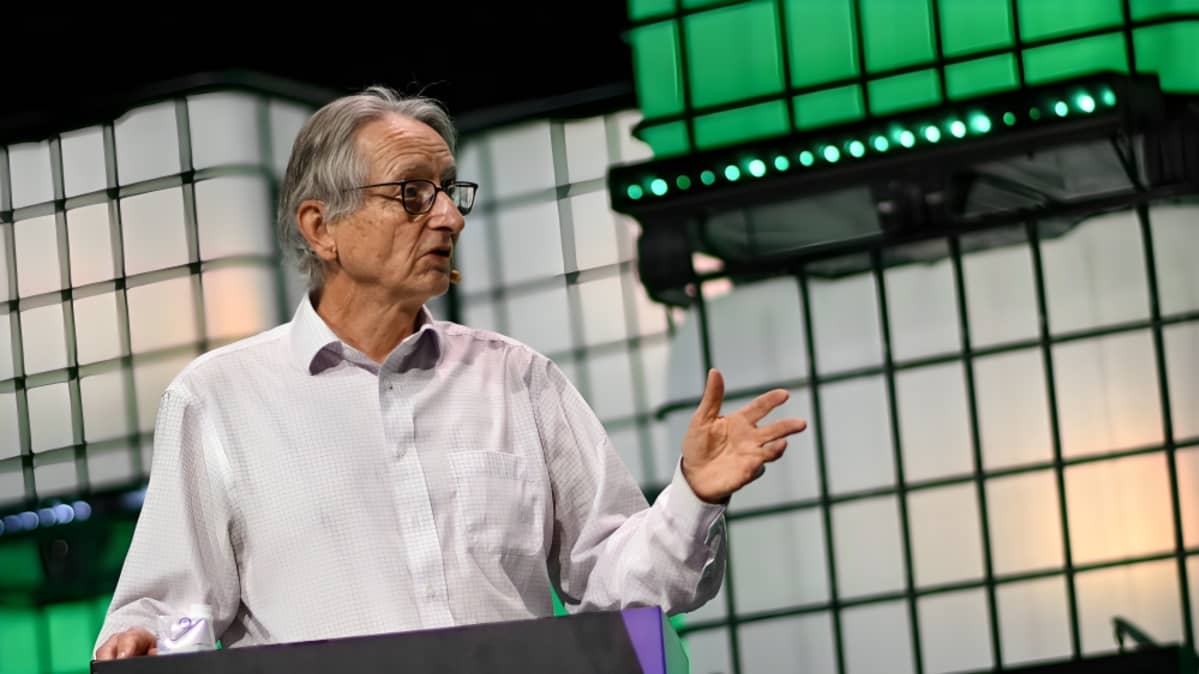
Artificial intelligence pioneer Geoffrey Hinton has once again highlighted the possible impact of rapidly advancing AI systems on the global job market, warning that the technology could contribute to significant unemployment in the coming years.
Hinton, who is widely described as the Godfather of AI because of his pioneering work on neural networks and machine learning, has repeatedly raised concerns about the economic and social consequences of increasingly capable artificial intelligence.
His latest comments echo concerns expressed by Elon Musk and other prominent technology figures about the possibility that AI could eventually perform a large proportion of tasks currently carried out by human workers.
Hinton's warning about jobs
Hinton has argued that the current wave of AI development is different from many earlier technological changes because modern AI systems are increasingly capable of performing cognitive tasks.
Previous technological revolutions often replaced certain types of manual work while simultaneously creating new industries and employment opportunities. Hinton has questioned whether AI will generate enough new jobs to compensate for the number of positions that could eventually be automated.
During a discussion with US Senator Bernie Sanders at Georgetown University, Hinton said that mass unemployment caused by AI appears to be a realistic possibility.
His concern is particularly focused on the speed at which AI capabilities are improving.
Why white collar jobs could be affected
AI is no longer limited to simple repetitive tasks.
Modern systems can write and analyse text, generate software code, summarise documents, conduct research, translate languages, create images and assist with customer service.
This means that some white collar occupations could face increasing automation.
Hinton has previously said that AI is already capable of handling some call centre work and predicted that its ability to perform longer and more complicated tasks would continue to improve.
Jobs involving routine computer based activities could therefore experience significant changes as companies adopt AI tools.
Hinton's view compared with Elon Musk
Elon Musk has also repeatedly predicted that AI and robotics could eventually reduce the need for human labour.
Hinton has agreed with the broader concern that AI could dramatically transform the future of employment.
However, the discussion is not simply about whether machines will replace individual occupations. The larger question is whether the economy will create enough new roles for workers displaced by automation.
Hinton has argued that AI may create new jobs but has expressed doubts that those opportunities will necessarily match the scale of potential job displacement.
AI could increase productivity
Supporters of artificial intelligence argue that automation could improve productivity and allow employees to focus on more creative or complex tasks.
AI can already help workers complete routine activities more quickly.
For example, software developers can use AI coding assistants, businesses can automate customer service queries and professionals can use AI to analyse large amounts of information.
If these tools complement workers rather than replace them, companies could potentially become more productive while creating new opportunities.
The outcome, however, will depend heavily on how businesses deploy the technology.
The concern about inequality
Hinton's warning extends beyond unemployment.
He has argued that widespread automation could increase the concentration of wealth if the economic benefits of AI mainly accrue to companies and individuals who own the technology.
If businesses can replace large numbers of workers with automated systems, the savings could increase corporate profits.
At the same time, workers who lose employment may face difficulty finding equally well paid positions.
Hinton has previously warned that AI could make a small group of people significantly wealthier while leaving many others financially worse off.
Big technology investments
The AI industry is receiving enormous investment from technology companies, investors and governments.
Companies are spending heavily on data centres, computing infrastructure, chips and AI research.
Hinton has questioned whether part of this investment is motivated by the expectation that AI systems will eventually perform work currently carried out by employees.
The commercial incentive is significant.
If an AI system can perform a task at a lower cost than employing a human worker, businesses may have a financial reason to adopt it.
This could accelerate automation across several industries.
AI will not affect every job equally
Despite concerns about mass unemployment, AI is unlikely to affect all occupations in exactly the same way.
Jobs requiring physical presence, interpersonal relationships, specialised manual skills or complex real world decision making may be more difficult to automate completely.
Healthcare, construction, skilled trades, education and other sectors could continue to require substantial human involvement.
At the same time, AI could become an important tool within these professions.
This means that many occupations may change rather than disappear completely.
The importance of reskilling
One possible response to AI driven employment changes is greater investment in education and reskilling.
Workers may need to develop new technical and interpersonal skills as AI becomes more common in workplaces.
Understanding how to use AI effectively could become an important workplace capability.
Employees who learn to work alongside AI systems may be able to increase their productivity and remain competitive in changing labour markets.
Governments and educational institutions could also play a role by expanding training programmes and helping workers transition between industries.
AI in education
Hinton has also discussed the potential benefits and risks of AI in education.
Artificial intelligence can provide students with explanations, personalised practice and assistance with research.
However, excessive reliance on AI could reduce opportunities for students to develop independent reasoning.
Hinton has suggested that educational institutions should encourage students to use AI as a tool while continuing to develop critical thinking skills.
This balance could become increasingly important as AI tools become more capable.
The speed of AI development
One of Hinton's major concerns is the speed at which artificial intelligence is improving.
AI models are increasingly capable of handling longer and more complicated tasks.
Hinton has previously noted that the length and complexity of tasks AI can perform have been increasing rapidly.
If this progress continues, tasks that currently require substantial human expertise could become increasingly automated.
The exact timeline remains uncertain, however, and predictions about future AI capabilities vary considerably among researchers.
Experts do not agree on the scale of job losses
While Hinton's warning has attracted significant attention, there is no consensus that AI will inevitably cause mass unemployment.
Some economists and technology researchers believe AI will transform jobs rather than eliminate employment on a massive scale.
Recent analysis has suggested that large scale employment disruption had not fully materialised by 2026, although AI was already changing hiring patterns, job responsibilities and productivity expectations.
This means that the future impact of AI remains uncertain.
AI could create new industries
Technological revolutions have historically created new industries and occupations.
The growth of the internet, for example, eliminated or transformed some jobs while creating entirely new professions.
Artificial intelligence could follow a similar pattern.
AI engineers, model researchers, data specialists, AI safety experts and other technology professionals are already in demand.
Entirely new occupations could emerge as businesses discover new ways to use AI.
The key question is whether the creation of these new roles will be sufficient to offset the employment lost through automation.
What businesses may do
Companies adopting AI are likely to focus on areas where automation can reduce costs or improve efficiency.
Some organisations may use AI to assist existing employees rather than replace them.
Others could automate certain functions and reduce the number of workers required.
The decision will depend on factors such as cost, reliability, regulation, customer expectations and the complexity of the work.
This could result in different employment effects across industries and countries.
The policy challenge
Hinton's warnings also raise questions for governments.
If AI causes substantial changes in employment, policymakers may need to consider measures such as worker retraining, education reform, stronger social safety nets and new approaches to taxation.
The challenge will be finding ways to distribute the benefits of AI while limiting the social costs of automation.
There is also an ongoing debate about whether companies that benefit substantially from automation should contribute more toward programmes supporting displaced workers.
AI safety remains another concern
Hinton's concerns are not limited to employment.
The AI pioneer has also warned about the possibility that increasingly capable systems could become difficult for humans to control.
In recent discussions, he has raised questions about AI systems developing unexpected goals and behaviours.
These concerns have made Hinton one of the prominent voices calling for greater attention to AI safety and alignment.
What workers should expect
For employees, the immediate lesson is not necessarily that AI will eliminate their jobs.
Instead, workers may increasingly encounter AI as part of their daily responsibilities.
Tasks may be automated, workflows may change and employers may expect employees to use AI tools.
Developing adaptable skills and learning how to work effectively with AI could therefore become increasingly important.
The road ahead
Artificial intelligence is still developing rapidly, and predicting its long term effect on employment remains difficult.
Hinton's warning represents one possible scenario in which AI becomes capable of performing a large share of human cognitive work.
Other experts believe the technology will primarily augment workers and create new employment opportunities.
The eventual outcome will depend not only on AI capabilities but also on government policies, business decisions, education systems and how societies choose to distribute the economic benefits of automation.
Conclusion
Geoffrey Hinton's latest warning has renewed the debate about whether artificial intelligence could lead to mass unemployment.
The AI pioneer believes AI may replace a significant number of human workers and has questioned whether the new jobs created by the technology will be enough to compensate for those lost.
His views echo concerns previously expressed by Elon Musk and other technology leaders.
At the same time, there is no certainty that AI will produce mass unemployment. The technology could also increase productivity, create new industries and change existing occupations rather than eliminate them completely.
The coming years will therefore be crucial in determining whether AI becomes primarily a tool that supports workers or a technology that fundamentally reshapes the global labour market.