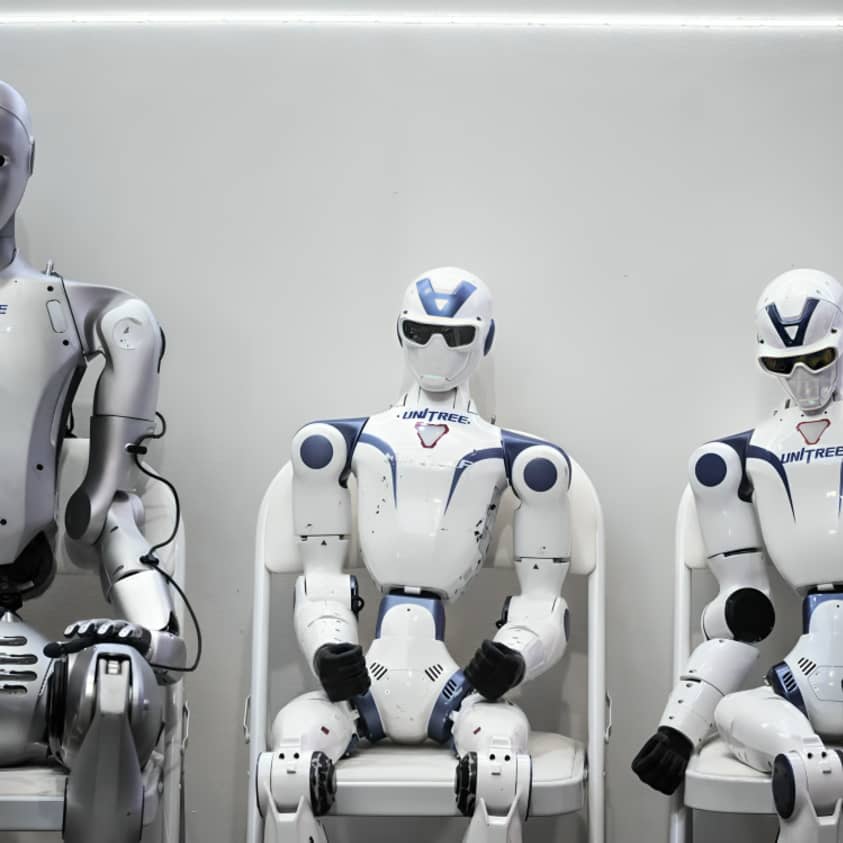
Humanoid robots could be approaching an important turning point in their development, according to Unitree Robotics founder and Chief Executive Officer Wang Xingxing. He believes the industry could eventually experience a breakthrough comparable to the transformation brought by ChatGPT in generative artificial intelligence.
Wang made the comments while speaking at the World Robot Conference in Beijing on August 20. He said the robotics industry is moving toward what he described as a ChatGPT moment for embodied intelligence. In this context, embodied intelligence refers to artificial intelligence systems that can understand their surroundings and perform physical tasks in the real world.
The Unitree chief described a future in which a humanoid robot could be placed inside an unfamiliar environment, including a household, and successfully complete approximately 80 percent of the tasks it encounters. The robot would be expected to understand relatively simple voice or text instructions and translate them into physical actions.
Such a development would represent a significant change from the capabilities of many humanoid robots available today. Current machines can perform impressive demonstrations involving walking, running, dancing, lifting objects and other controlled movements. However, performing a wide range of unpredictable household tasks remains considerably more difficult.
A home is an especially challenging environment for a robot. Rooms can have different layouts, objects can be placed in unexpected locations and tasks may change from one situation to another. A robot would need to recognise objects, understand instructions, plan movements and respond safely when circumstances change.
Wang believes that reaching the ability to operate reliably in such unfamiliar environments could trigger rapid growth across the robotics industry. He compared the potential impact with the way advances in large language models accelerated interest in artificial intelligence.
However, the prediction does not mean that humanoid robots are immediately ready to perform most household work. Wang has also acknowledged that robotics software continues to lag behind advances in hardware. Reuters reported that he estimated the necessary software breakthrough could still be between two and ten years away.
One of the biggest challenges is developing what researchers call world models. These systems are intended to help robots understand physical environments, predict what may happen next and determine how their actions will affect objects around them.
Another challenge is reliability. A robot operating in a factory can often work within a controlled environment where tasks and object locations are predictable. A household is much less structured. A robot may have to deal with children, pets, furniture, fragile objects, stairs, spills and constantly changing conditions.
The cost of humanoid robots is another factor that could influence their adoption. Industry analysts and companies are working to reduce manufacturing costs while improving batteries, motors, sensors, computing systems and artificial intelligence software.
The comments from Wang come at a particularly important time for China's robotics industry. China has become a major centre for humanoid robot development and manufacturing, with companies competing to move robots from demonstrations into practical commercial applications. Reuters reported that China delivered more than 40,000 humanoid robots in the first half of 2026 and accounted for a very large share of global shipments.
Unitree itself has attracted considerable attention for its humanoid and quadruped robots. The company recently made its stock market debut in Shanghai, with its shares experiencing a sharp rise on the first trading day. The listing has further highlighted investor interest in the potential future of physical artificial intelligence.
At the World Robot Conference, companies displayed robots designed for industrial work, household assistance, entertainment and research. The event demonstrated how quickly the industry is developing, but it also showed the gap between impressive demonstrations and dependable everyday applications.
Experts continue to emphasise that humanoid robots must demonstrate practical value before widespread commercial adoption becomes possible. Robots need to perform useful tasks consistently, safely and economically if they are to become common in workplaces and homes.
The idea of an 80 percent household task capability therefore remains a future target rather than a current reality. Achieving it would require significant progress in artificial intelligence, robotics hardware, batteries, sensors, training data and safety systems.
If the technology reaches that stage, humanoid robots could potentially assist with cleaning, carrying objects, organising household items and other routine activities. They could also be used in workplaces where repetitive or physically demanding tasks need to be performed.
The development could eventually change the relationship between people and machines. Instead of operating robots through complicated controls, users could give instructions in ordinary language and allow the robot's AI system to determine how to complete the requested task.
For now, however, the industry remains in a development and testing phase. Wang's prediction highlights the direction in which companies such as Unitree are heading, but the timeline for reaching a genuine ChatGPT moment in robotics remains uncertain.
The next major challenge will be proving that humanoid robots can move beyond demonstrations and perform useful tasks reliably in the unpredictable environments where people actually live and work.