Sarvam AI Partners With Defence Ministry to Develop AI Applications for Indian Armed Forces
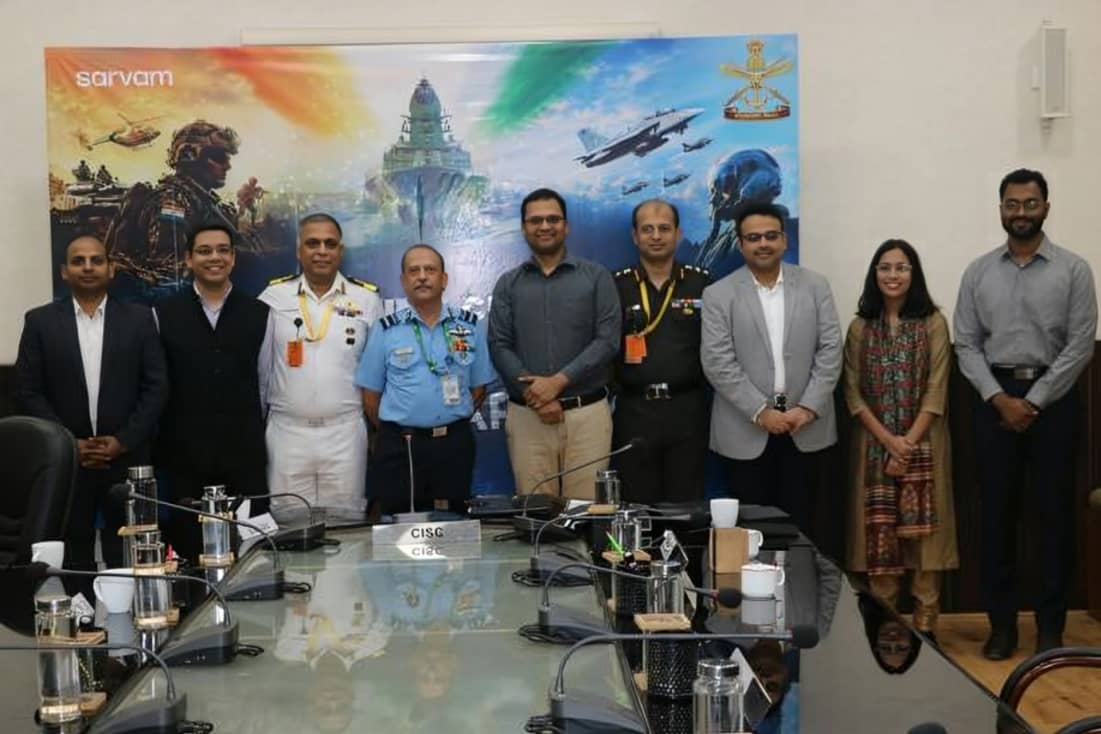
Indian artificial intelligence company Sarvam AI has signed a memorandum of understanding with Headquarters Integrated Defence Staff under the Ministry of Defence to develop AI applications for the Indian Army, Indian Navy and Indian Air Force. The agreement establishes a framework for projects that could support military operations, training and decision-making across the three services.
The partnership reflects India’s broader efforts to strengthen domestic capabilities in artificial intelligence and reduce dependence on foreign technologies for critical defence requirements. Under the agreement, Sarvam AI will design, develop and deploy AI applications tailored to the operational and training needs of the armed forces. The company will also provide technical support for the projects.
AI Applications for Three Armed Forces
The agreement covers the Indian Army, Navy and Air Force, along with joint, tri-service and integrated organisations operating under Headquarters Integrated Defence Staff. The headquarters will facilitate coordination and engagement for projects undertaken across the participating services.
The framework is intended to help the armed forces explore AI tools that can process information, support planning and improve access to relevant data. Instead of limiting the initiative to a single application, the agreement provides a broader structure for developing multiple projects according to the requirements of different military organisations.
The services are expected to have access to shared foundation models, agentic AI infrastructure, and geospatial and perception systems. Foundation models can be adapted for different tasks, while agentic infrastructure can support AI systems that carry out sequences of tasks. Geospatial technology processes information associated with locations, and perception systems help interpret inputs such as images and sensor data.
Sharing these capabilities could allow the services to apply lessons from one project to other areas. It may also help establish a common technological foundation for selected applications across the armed forces.
Focus on Decision Support and Target Acquisition
Decision support is one of the key areas identified under the agreement. AI-based decision-support tools can help organise large volumes of information and present relevant data to personnel responsible for assessing operational situations. Such tools may assist with analysis and planning, although their usefulness will depend on their design, testing and suitability for military environments.
Target acquisition is another stated focus. In military contexts, this involves identifying and locating potential targets using available information and surveillance inputs. AI systems may help process relevant data more efficiently, but operational use requires careful assessment of accuracy, reliability and the risks associated with incorrect identification.
The partnership will also focus on data fusion across the sensor-to-shooter process. Data fusion combines information from multiple sources, such as sensors and surveillance systems, to provide a more comprehensive picture of a situation. The sensor-to-shooter process refers to the stages connecting the detection and assessment of a target with a potential operational response.
Integrating information from different sources can be technically complex. Systems must be able to handle differences in data formats, quality, speed and reliability. The effectiveness of any resulting application will depend on how well it works with existing defence systems and how consistently it performs under demanding conditions.
Human Oversight and Secure Infrastructure
Human oversight will be retained over operational decisions, according to reports on the agreement. This is an important consideration when developing AI for defence applications, where errors can have serious consequences. AI systems may help analyse information or provide recommendations, but operational decisions require appropriate human judgement, accountability and established procedures.
The agreement also emphasises the development of AI capabilities in India and their deployment on sovereign infrastructure. Sovereign infrastructure refers to computing and technology systems operated under the relevant domestic control and security requirements. For defence organisations, protecting sensitive information and maintaining control over critical systems are important considerations.
The arrangement forms part of India’s wider effort to develop indigenous defence technology. Domestic AI capabilities could give defence organisations greater control over technology development, system integration and future improvements. However, the practical benefits will depend on the capabilities delivered through individual projects and how effectively they are integrated into existing operations.
Sarvam AI’s Role in Defence Technology
The work will be undertaken by Chanakya, Sarvam AI’s division focused on national security and defence. The division will use the company’s AI technology stack, including foundation models such as Sarvam 105B, according to published reports.
Sarvam AI co-founder Pratyush Kumar said the company was committed to building AI in India for Indian requirements and described working with the three armed services as an honour. The collaboration places the company’s AI development capabilities within a national security context, where performance, reliability and data protection are particularly important.
The agreement is an umbrella framework for several projects rather than a public announcement of a single finished product. The specific applications, their deployment schedules and their individual outcomes will depend on the work carried out by Sarvam AI and the participating defence organisations.
Significance for India’s Indigenous AI Efforts
The partnership comes as India places greater emphasis on developing domestic artificial intelligence for strategically important sectors. Defence applications can require specialised technology because they involve sensitive data, complex operating environments and high expectations for reliability.
A shared AI framework could help the Army, Navy and Air Force explore common technological capabilities while allowing individual projects to address the needs of each service. Potential advantages include improved information processing, support for training and more efficient analysis of data from different sources. These benefits should be assessed against actual project results rather than assumed in advance.
Important challenges remain. Military AI systems must be tested for accuracy, security, resilience and compatibility with existing infrastructure. They also need safeguards against unreliable outputs, manipulated data and cyber threats. Clear procedures for human supervision and accountability will remain essential as applications are developed and evaluated.
The memorandum of understanding between Sarvam AI and Headquarters Integrated Defence Staff marks a step towards exploring indigenous AI applications across India’s armed forces. Its significance will ultimately depend on how the planned projects are implemented, tested and adopted. By focusing on decision support, target acquisition, data fusion and training, the initiative seeks to expand India’s domestic defence technology capabilities while retaining human oversight over operational decisions.