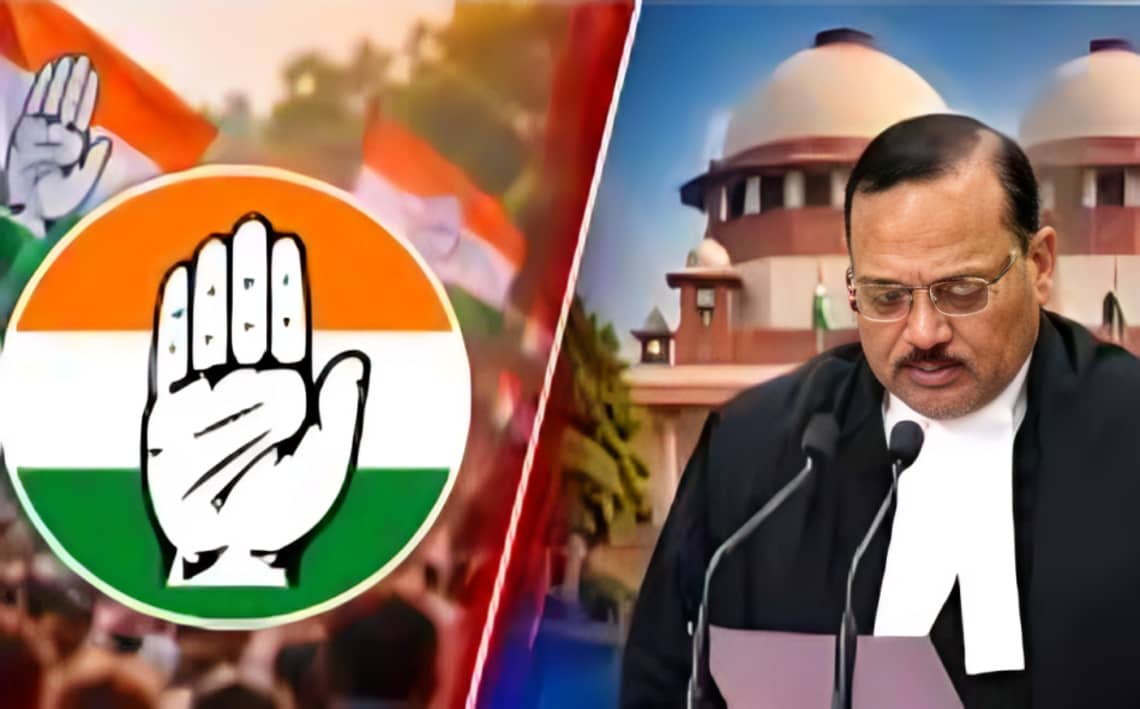
The Supreme Court of India has issued contempt notices to all office-bearers of the Kerala Pradesh Congress Committee (KPCC) over a controversial social media post targeting Chief Justice of India Surya Kant. The post, which appeared on the official X account of the Congress party's Kerala unit in October, called for the Chief Justice's resignation and triggered criticism.
A bench comprising Justices Aravind Kumar and Vipul M Pancholi issued the notices on November 6, 2026. The court asked the KPCC office-bearers, including its president and secretary, to explain why contempt proceedings should not be initiated against them.
The proceedings arise from a writ petition filed by advocate Vineet Jindal, who sought action over the publication of the controversial message. The court is examining whether the post crossed the limits of permissible political criticism and interfered with the administration of justice.
The Supreme Court emphasised that the Constitution is supreme and that no individual or political organisation can claim to be above it. It also observed that the independence of the judiciary cannot be treated as a matter of political convenience.
Supreme Court's Observations on Judicial Independence
During the hearing, the bench made strong observations about the importance of protecting the independence and authority of the judiciary.
The judges stated that judicial decisions are open to criticism, including strong criticism. However, freedom of expression cannot be used as a means of intimidation or interference with the administration of justice.
The court also said that the authority of the judiciary comes from the Constitution and the rule of law rather than political approval or endorsement. It cautioned that judicial restraint should not be mistaken for institutional weakness.
The bench observed that any established attempt to undermine the authority of the court must be dealt with firmly, irrespective of the position or identity of the person or organisation involved.
These observations came while the court was considering whether the social media post warranted examination under its contempt jurisdiction.
The court clarified that it had not expressed a final opinion on the merits of the allegations. The notices are intended to obtain explanations from the concerned office-bearers before the matter proceeds further.
Controversial Post on the Official Kerala Congress X Account
The controversy began on October 12, 2026, when a message appeared on the official X account of the Indian National Congress's Kerala unit.
The post directly addressed Chief Justice of India Surya Kant and called for his resignation, stating that a replacement would be found if law and order was not his responsibility.
The message quickly attracted attention on social media and drew criticism from several quarters, including members of the legal community. Critics argued that the language was inappropriate and could be seen as an attempt to question the authority and independence of the judiciary.
The post was subsequently deleted by the Kerala Congress unit.
The controversy developed into a legal issue after advocate Vineet Jindal sent a complaint to the Chief Justice of India on October 13. The complaint was later registered as a writ petition on October 30.
The petition sought the court's intervention and raised questions about whether the message amounted to contempt of court. The Supreme Court is now examining the matter under its constitutional and statutory powers.
Congress Says Post Was Published Without Leadership Approval
During the Supreme Court hearing, the lawyer representing the Kerala Pradesh Congress Committee submitted that the controversial post had been published without the knowledge, consent or approval of the party's office-bearers.
The counsel informed the bench that the message had been removed after it came to the leadership's attention. The court was also told that the party had tendered an unconditional apology.
Justice Aravind Kumar made an observation that the court would examine whether the apology had come from the pen or from the heart. The remark indicated that the court wanted to assess the sincerity of the apology rather than treat its submission as automatically resolving the matter.
KPCC president Sunny Joseph had earlier issued a statement saying that the post did not represent the party's official position. He said it had been published without consultation with the state leadership.
Joseph also stated that the individual responsible for the publication had been removed from the position and that the party did not question the impartiality of the judiciary.
The Congress has therefore maintained that the post was unauthorised and that action was taken after the incident came to light. However, the Supreme Court will independently examine the circumstances and the responsibility, if any, of the party office-bearers.
Supreme Court Seeks Assistance in Examining Contempt Issue
The bench indicated that it would seek assistance from senior advocates to examine the legal questions involved in the case.
Senior advocates Arvind Datar and Siddharth Agarwal were identified to assist the court as amicus curiae. An amicus curiae is a person appointed by a court to provide independent legal assistance on issues that require detailed consideration.
The bench also sought the assistance of Attorney General R Venkataramani.
The legal assistance is expected to help the court examine whether the facts justify proceedings for civil contempt or criminal contempt under the Contempt of Courts Act, 1971.
The court also referred to Article 129 of the Constitution, which recognises the Supreme Court as a court of record and gives it the power to punish for contempt of itself.
The distinction between criticism of a judicial decision and conduct that interferes with the administration of justice is central to the issue. The court will have to consider the content, context and circumstances of the post before deciding whether further action is warranted.
Difference Between Judicial Criticism and Contempt of Court
The case has brought renewed attention to the relationship between freedom of expression and the authority of the judiciary.
In a democracy, citizens, political parties and public representatives can express disagreement with court judgments and judicial decisions. Such criticism is an important part of public debate and accountability.
However, the law also provides safeguards to protect the administration of justice from conduct that may intimidate judges, obstruct judicial proceedings or undermine the authority of courts.
The Contempt of Courts Act, 1971, provides the legal framework for dealing with civil and criminal contempt. Criminal contempt broadly concerns publications or actions that scandalise or tend to scandalise a court, prejudice judicial proceedings or interfere with the administration of justice.
Whether a particular social media post falls within these legal definitions depends on its content and surrounding circumstances. The Supreme Court will examine the facts before deciding whether contempt proceedings should be initiated.
The notices issued to the Kerala Congress office-bearers do not amount to a finding that they are guilty of contempt. They are being given an opportunity to respond to the allegations.
Political and Legal Implications of the Case
The case has attracted attention because it involves a national political party's state unit and a public statement directed at the country's Chief Justice.
It also raises questions about the responsibility of political organisations for content published through their official social media accounts. Although the KPCC has claimed that the post was unauthorised, the court is seeking explanations from all office-bearers.
The proceedings may also have implications for how political parties manage their official digital platforms and verify content before publication.
For political organisations, social media accounts are important channels for communicating with supporters and responding to public issues. At the same time, statements published through official accounts can carry institutional significance, making editorial oversight and accountability important.
The Supreme Court's observations underline that freedom of expression and judicial independence must be considered within the constitutional framework.
What Happens Next?
The Supreme Court has issued notices seeking explanations from the Kerala Pradesh Congress Committee's office-bearers. The party representatives will have an opportunity to respond to the allegations and explain the circumstances surrounding the post and the apology.
The court will consider those responses along with the assistance provided by the appointed legal experts and the Attorney General.
The bench has not yet made a final determination on whether civil or criminal contempt proceedings should be initiated. The matter is expected to be taken up again on December 15, 2026.
Until then, the central questions remain whether the post crossed the legal limits of political criticism, whether it interfered with the administration of justice and whether the apology and subsequent action taken by the party are sufficient in the circumstances.
The latest order marks an important step in the legal examination of the controversy, but the final outcome will depend on the Supreme Court's assessment of the responses and the applicable law.