China Tracks US Warship Near Disputed South China Sea Shoal as Taiwan Reports Separate Maritime Standoff
Beijing, October 20, 2026: China’s military has said it deployed naval forces to monitor a United States warship near the disputed Sabina Shoal in the South China Sea, while Taiwan separately reported a maritime standoff involving a Chinese Coast Guard vessel near the Pratas Islands. The incidents highlight continuing tensions over maritime claims, military activity and control of strategically important waters in the region.
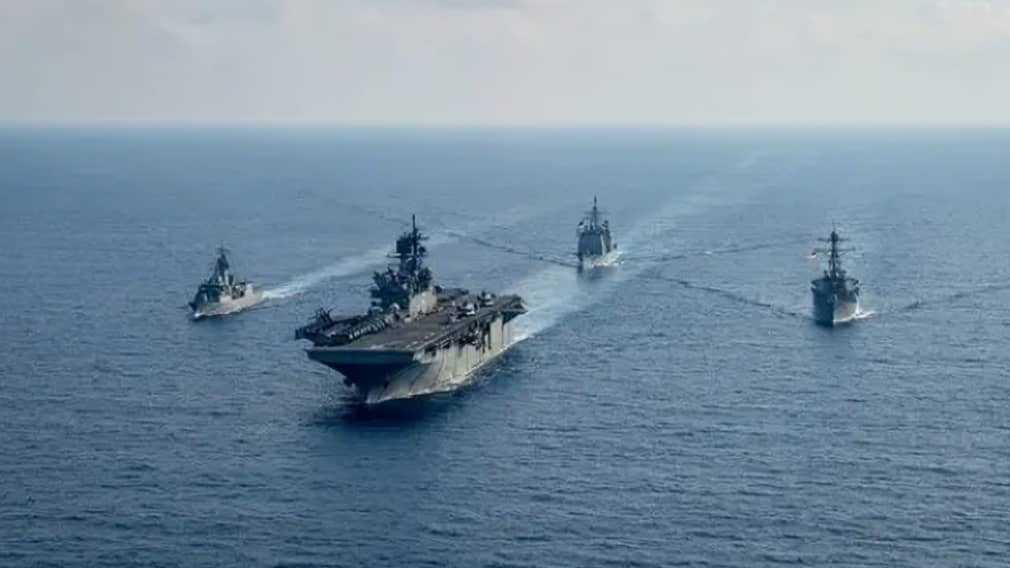
China’s Southern Theatre Command said the USS Charleston entered waters adjacent to Sabina Shoal in the Spratly Islands without approval from the Chinese government. Beijing described the operation as an infringement of its claimed sovereign rights and said it could threaten maritime security and regional stability.
The command said Chinese naval forces had been dispatched to track and monitor the American vessel. It also called on the United States to stop such activities.
The US Navy had not immediately responded to a request for comment, according to Reuters. Washington generally describes comparable operations as freedom of navigation activities intended to challenge maritime claims it considers inconsistent with international law.
Dispute over Sabina Shoal
Sabina Shoal is located in the Spratly Islands, an area of the South China Sea subject to overlapping territorial claims. China and the Philippines both claim the shoal, while the wider Spratly Islands are also contested by other regional governments.
China claims much of the South China Sea, a major international shipping route that connects important Asian markets and carries significant volumes of global trade. Brunei, Malaysia, the Philippines, Taiwan and Vietnam also have overlapping claims in parts of the waterway.
The competing claims have led to repeated confrontations involving naval vessels, coast guard ships and fishing boats. Governments in the region have accused one another of operating in waters they regard as their own, while diplomatic efforts to reduce tensions have continued.
The latest incident involving the USS Charleston comes amid recent friction between China and the Philippines near Sabina Shoal. According to the Philippine Coast Guard, a Chinese Coast Guard vessel rammed a Philippine boat during a refuelling mission near the shoal in September. China blamed the Philippine side for the collision.
The competing accounts illustrate the difficulty of establishing responsibility during maritime incidents in disputed waters. They also underline the risk that a confrontation involving coast guard or military vessels could escalate if either side misjudges the other’s actions.
Why US naval activity matters
The United States has repeatedly emphasised freedom of navigation and access to international waters in the Indo-Pacific. Washington has conducted naval operations in areas where it disputes excessive maritime claims, although the US Navy had not immediately confirmed the purpose of the USS Charleston’s reported activity in this particular incident.
China, by contrast, maintains that foreign military operations in waters it claims must respect its sovereignty and security interests. Beijing has frequently criticised US naval activity near disputed features, arguing that such operations increase regional instability.
The two countries have significant economic ties but remain divided over security, trade, Taiwan and maritime influence in the Indo-Pacific. Encounters between their military forces can therefore carry broader diplomatic significance, even when no physical confrontation takes place.
The Philippines’ mutual defence treaty with the United States adds another strategic dimension to disputes near Sabina Shoal. A serious incident involving Philippine and Chinese forces could raise questions about Washington’s security commitments and increase pressure on the countries to respond.
Taiwan reports a separate standoff
In a separate incident on October 20, Taiwan’s Coast Guard said a Chinese Coast Guard vessel had entered restricted waters near the Pratas Islands, which are administered by Taiwan. The islands lie between southern Taiwan and Hong Kong, in the northern part of the South China Sea.
Taiwan said it dispatched its Coast Guard vessel Taichung to warn the Chinese ship away. According to the Taiwanese authorities, both vessels broadcast messages asserting their respective positions during the encounter, which was reported to be continuing at the time.
Taiwan’s Coast Guard said the Chinese vessel challenged the legitimacy of Taiwan’s official name, the Republic of China. The Taiwanese vessel responded by asserting Taiwan’s status as a sovereign and independent country.
China claims Taiwan as part of its territory, while Taiwan has its own government and security forces. Beijing has not ruled out the use of force to bring the island under its control, and maritime encounters around Taiwan remain politically sensitive.
China’s Taiwan Affairs Office did not immediately respond to a request for comment on the latest standoff, Reuters reported.
Previous tensions near the Pratas Islands
The confrontation followed another dispute in the area. On October 14, China warned Taiwan to “bear the consequences” after Taiwan’s Coast Guard used a water cannon against a Chinese fishing boat near the Pratas Islands.
Taiwan said the fishing boat had entered restricted waters and ignored warnings. Beijing criticised Taiwan’s actions, while Taiwanese officials described their response as normal law enforcement.
The islands are relatively lightly defended, and Taiwan’s Coast Guard is responsible for security in the area. The repeated encounters have raised concerns about the potential for further maritime friction.
Implications for regional stability
The two incidents involve separate disputes, but both demonstrate how maritime activity can become a source of tension between China and other governments in the region. The South China Sea is important not only for territorial claims but also for commercial shipping, fishing, energy resources and regional security.
For now, the reported incidents have centred on monitoring, warnings and competing statements rather than a confirmed direct military clash between China and the United States. However, the continued presence of naval and coast guard vessels in contested waters increases the importance of communication and procedures designed to prevent accidents.
Diplomatic engagement, clear communication between vessels and respect for applicable international law will be important in limiting the risk of escalation. The latest developments are likely to remain under close observation by governments across the Indo-Pacific as they assess the implications for maritime security and regional stability.