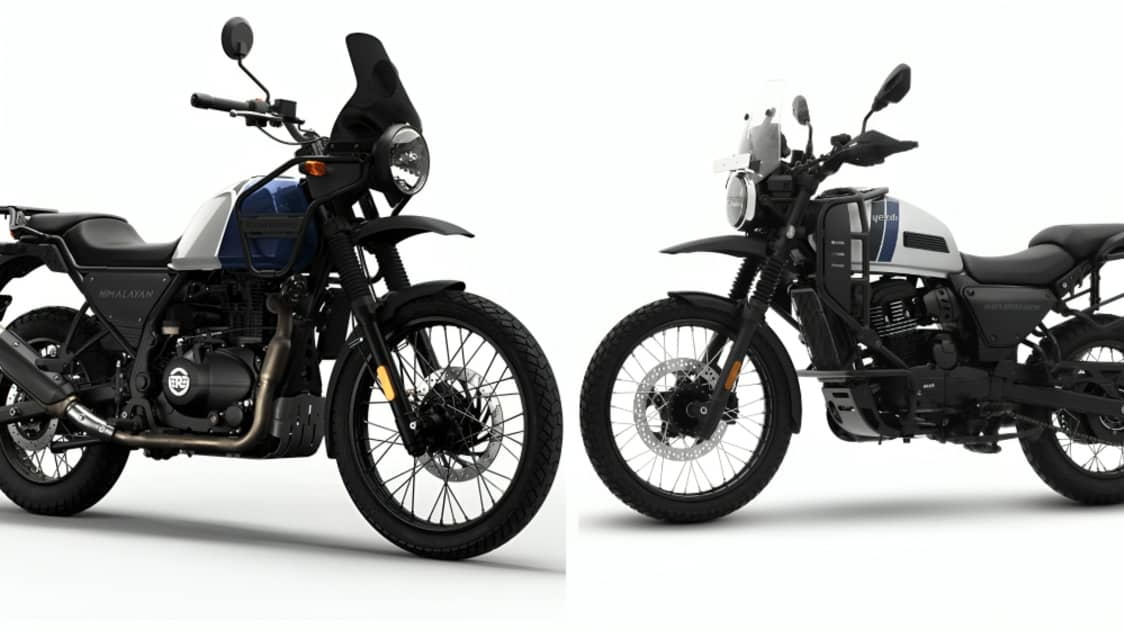
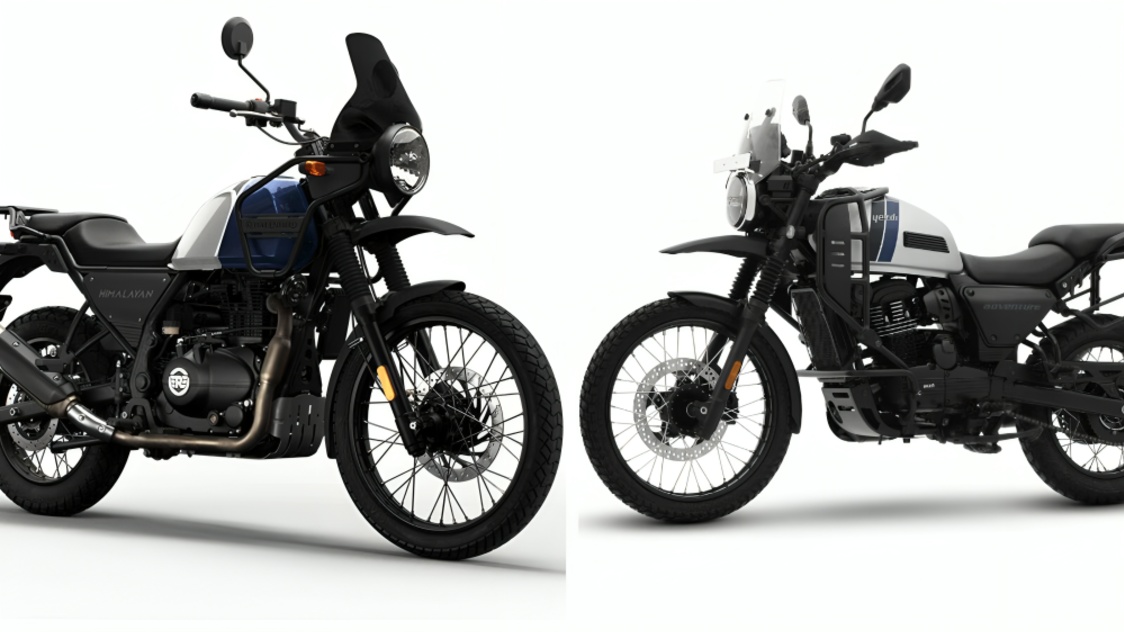
The Royal Enfield Himalayan 440 and Yezdi Adventure are two motorcycles competing in India's mid-size adventure touring segment. Both are designed to handle a combination of city riding, highway touring and off-road conditions, but they approach the segment differently in terms of engine characteristics, equipment, ergonomics and pricing.
The Royal Enfield Himalayan 440 was launched in India at Rs 2.29 lakh ex-showroom. It represents a return to the original Himalayan's basic adventure touring philosophy while receiving a larger 443cc engine, a six speed gearbox and updated equipment. The Yezdi Adventure, meanwhile, is positioned at a lower starting price, with the current range beginning at around Rs 2.05 lakh ex-showroom.
Engine specifications are one of the biggest differences between the two motorcycles. The Himalayan 440 uses a 443cc single cylinder engine with air and oil cooling. It produces 25.4hp at 6,250rpm and 34Nm of torque at 4,000rpm. The engine is paired with a six speed gearbox. Its larger displacement and stronger torque figure are intended to provide a relaxed character, particularly for low speed riding and touring.
The Yezdi Adventure uses a smaller 334cc single cylinder liquid cooled engine. According to the manufacturer's current specifications, it produces 29.6PS and 29.8Nm of torque and is paired with a six speed transmission. On paper, the Yezdi therefore produces more peak power than the Himalayan 440, despite having a smaller engine displacement.
The difference in engine characteristics could influence the buying decision. The Himalayan 440 has a stronger torque figure, while the Yezdi Adventure has a higher peak power output. Riders who prioritise relaxed touring and low speed tractability may find the Himalayan's engine characteristics appealing, while those looking for a more power-focused setup may prefer the Yezdi.
Both motorcycles use six speed gearboxes. This gives them an additional ratio compared with some older adventure motorcycles and should help make highway riding more manageable. However, actual performance, cruising comfort and fuel efficiency will depend on riding conditions, rider weight, luggage and riding style.
Dimensions and ergonomics are another important area of comparison. The Himalayan 440 has a 15 litre fuel tank, 220mm of ground clearance and an 800mm seat height. Its reported kerb weight is 199kg. The Yezdi Adventure has a 15.5 litre fuel tank, 220mm of ground clearance and an 815mm seat height. Its listed weight is 187kg, although the manufacturer and industry sources use different weight measurement contexts, so the figures should not be treated as a direct like for like comparison without checking the exact specification.
The Himalayan's 800mm seat height is one of its major advantages for riders who are concerned about accessibility. It is 15mm lower than the Yezdi Adventure's 815mm seat height. This difference can be useful when manoeuvring the motorcycle at low speeds or when stopping on uneven surfaces.
Both motorcycles have 220mm of ground clearance, which is useful for negotiating rough roads, broken surfaces and moderate off-road sections. The Himalayan uses a 21 inch front wheel and 17 inch rear wheel, while the Yezdi also uses a 21 inch front wheel with a 17 inch rear wheel. This wheel arrangement is common among adventure motorcycles because the larger front wheel can help the motorcycle deal with uneven terrain.
The braking hardware is broadly comparable, although there are some differences. The Himalayan 440 gets a 300mm front disc and a 240mm rear disc. The Yezdi Adventure uses a larger 320mm front disc along with a 240mm rear disc. Both motorcycles use disc brakes and ABS.
Suspension systems on both motorcycles follow the traditional adventure bike layout, with telescopic front forks and a linkage-mounted rear monoshock. The Yezdi Adventure's rear monoshock comes with seven-step preload adjustment, giving riders some scope to alter the setup according to load and riding conditions.
Wheel and tyre configuration is another important difference. The Himalayan 440 comes with wire-spoke wheels, while the Yezdi Adventure also uses spoke wheels as standard. However, Yezdi offers cross-spoke tubeless wheels as an option on relevant variants for an additional Rs 20,000. This can be particularly useful for riders who frequently undertake long-distance touring because tubeless tyres can offer practical advantages in the event of a puncture.
Features are an area where the Yezdi Adventure has a clear advantage on paper. The motorcycle offers traction control and multiple riding modes, including Road, Rain and Off-Road settings. It also offers an adjustable windscreen and instrument cluster. These electronic features provide riders with additional control over the motorcycle's behaviour in different riding conditions.
The Yezdi's updated 2026 version also gets twin LED headlights, updated LED tail lamps, revised colours and traction control. The manufacturer lists three ABS modes associated with Rain, Road and Off-Road riding conditions. These features make the Yezdi Adventure a technology-focused option in this comparison.
The Himalayan 440 takes a simpler approach. It comes with a Tripper navigation pod for turn-by-turn navigation, a USB Type-C charging port and LED lighting. The focus is more on essential touring functionality rather than offering a large collection of electronic riding aids.
Pricing is another important consideration. The Himalayan 440 has a straightforward price of Rs 2.29 lakh ex-showroom, while the Yezdi Adventure is available at a lower starting price of around Rs 2.05 lakh. Depending on the variant, the Yezdi can cost around Rs 2.30 lakh for its tubeless version. Prices can vary by location, variant and manufacturer updates, so buyers should confirm the latest ex-showroom and on-road prices before making a purchase.
The price difference gives the Yezdi an advantage for buyers who want to enter the adventure motorcycle segment at a lower initial cost. It also offers a broader feature package, particularly in terms of electronic rider aids. However, the Himalayan 440's lower seat height, larger engine displacement and stronger torque output could make it attractive to riders who prioritise accessibility and relaxed touring characteristics.
For highway touring, both motorcycles have features that make them suitable for longer rides. The six speed gearboxes on both models are useful for highway travel, while the adventure-oriented suspension and 21 inch front wheels provide additional versatility when the road surface deteriorates.
For off-road riding, the Yezdi's selectable riding modes and traction control give it an equipment advantage. The Himalayan 440, however, retains the traditional adventure motorcycle formula and provides 220mm of ground clearance, spoke wheels and a relatively accessible seat height. Real-world off-road performance will ultimately depend on tyres, suspension setup, rider skill and terrain rather than specifications alone.
The choice between the two motorcycles therefore depends largely on the buyer's priorities. The Himalayan 440 may appeal to riders looking for a simple, torque-focused adventure motorcycle with a lower seat height and strong touring credentials. The Yezdi Adventure may be more suitable for buyers who want additional electronic assistance, higher peak power and a lower entry price.
The comparison also highlights how competitive India's adventure motorcycle segment has become. Manufacturers are increasingly offering features such as riding modes, traction control, navigation, adjustable suspension and tubeless spoke wheels in this category.
Neither motorcycle can be considered the universal winner because their strengths are different. The Himalayan 440 has advantages in engine displacement, torque and seat accessibility, while the Yezdi Adventure offers more electronic features and a lower starting price. The Yezdi also has the option of cross-spoke tubeless wheels on selected variants, which can be attractive to serious touring riders.
Overall, the Royal Enfield Himalayan 440 and Yezdi Adventure offer two different approaches to adventure touring. The Himalayan 440 focuses on a larger engine, usable torque, accessible ergonomics and straightforward equipment. The Yezdi Adventure counters with a smaller but more powerful engine, additional rider aids and a more feature-rich package.
For potential buyers, a test ride remains important because factors such as seat comfort, engine response, riding position, clutch feel, suspension behaviour and low-speed balance cannot be fully judged from specifications. The final decision should also take into account the local dealer network, service support, insurance costs, accessories and intended usage.
As of September 2026, the Himalayan 440 starts at Rs 2.29 lakh ex-showroom, while the Yezdi Adventure starts at around Rs 2.05 lakh. Both motorcycles offer 21 inch front wheels, 220mm ground clearance and six speed gearboxes, but their engines, features and ergonomics create meaningful differences for buyers.