India Approves E100 Ethanol Fuel for Certified Flex Fuel Vehicles, Revises Motor Vehicle Rules
Government Updates Motor Vehicle Regulations
The Indian government has amended the Central Motor Vehicles Rules, 1989, to formally recognise E100 ethanol fuel for vehicles specifically designed and certified to operate on high ethanol blends. The regulatory change, notified by the Ministry of Road Transport and Highways in October 2026, creates a clearer framework for manufacturers developing flex fuel vehicles capable of running on nearly pure ethanol.
The amendment incorporates E100 alongside E85 in relevant vehicle emission standards and testing provisions. It also revises certain technical references and vehicle classification requirements, including an increase in the applicable gross vehicle weight threshold from 3,000 kg to 3,500 kg.
The move supports India's efforts to expand the use of alternative fuels in the transport sector and reduce dependence on imported crude oil. However, the new provisions do not permit every petrol vehicle on Indian roads to use E100. The fuel is restricted to vehicles specifically designed and certified by their manufacturers for this purpose.
What Is E100 Ethanol Fuel?
E100 refers to fuel consisting almost entirely of ethanol. Ethanol is an alcohol-based fuel that can be produced from agricultural crops and other biomass feedstocks, depending on the production process.
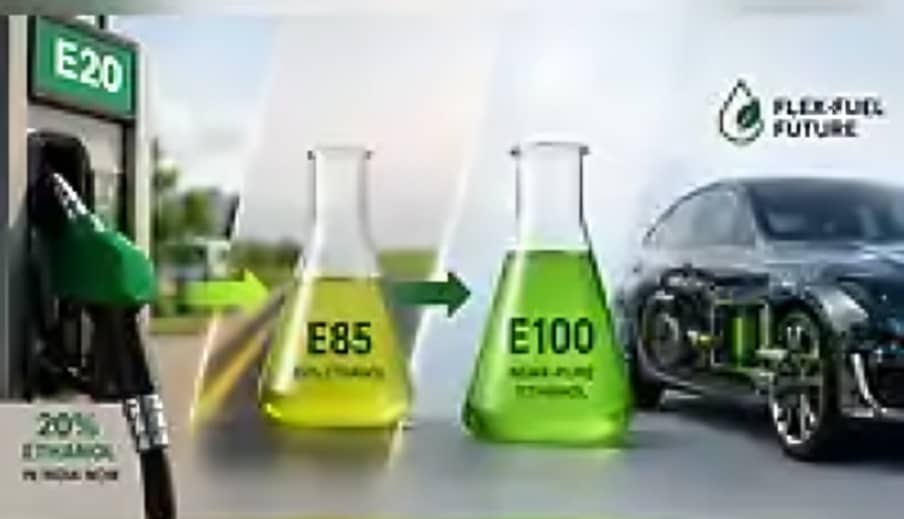
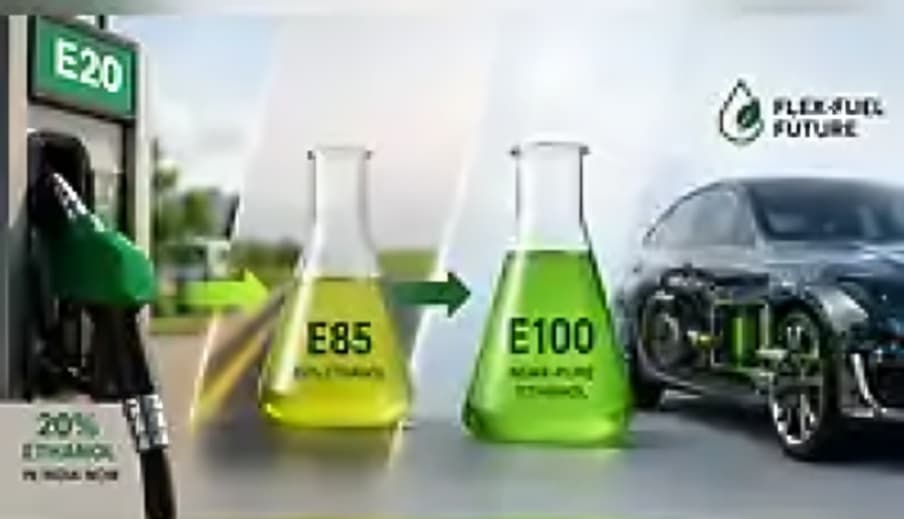
The number following the letter E indicates the ethanol proportion in the fuel blend. E20 contains 20 per cent ethanol and 80 per cent petrol, while E85 contains approximately 85 per cent ethanol. E100 represents the highest ethanol concentration recognised under the new provisions.
India has already expanded the use of E20 petrol as part of its broader ethanol-blending programme. The recognition of E100 extends the regulatory framework to vehicles engineered to operate on substantially higher ethanol concentrations.
However, ethanol has different properties from conventional petrol, including its energy content and interactions with certain fuel-system materials. Vehicles intended to use high ethanol blends therefore require suitable engine calibration, fuel-system components and manufacturer certification.
Which Vehicles Can Use E100?
The most important clarification in the amended rules is that E100 is not approved for unrestricted use in conventional petrol vehicles.
The Ministry of Road Transport and Highways has specified that E85 and E100 fuel should be used only in vehicles designed by original equipment manufacturers as flex fuel vehicles.
Flex fuel vehicles are engineered to operate on a range of approved ethanol and petrol blends. Depending on the model and its certification, this range may extend from lower ethanol blends to E85 or E100.
Ordinary petrol cars and vehicles designed only for E20 are not automatically compatible with E100. Using a fuel that exceeds a vehicle's approved ethanol limit could create compatibility and performance problems.
The amendment also does not require existing vehicle owners to modify their cars or switch to higher ethanol blends. Drivers should continue using the fuel grades specified by their vehicle manufacturers.
Before filling up with a higher ethanol blend, owners should check the vehicle handbook, fuel compatibility label and official manufacturer guidance. The new regulations create a route for eligible vehicles to use E100; they do not change the fuel requirements of all existing vehicles.
What Has Changed in the Motor Vehicle Rules?
The government has updated several provisions in the Central Motor Vehicles Rules, including references to E85 in relevant emission standards and testing requirements. These references now recognise either E85 or E100 where applicable.
The amendment provides a regulatory basis for testing and certifying vehicles designed to operate on nearly pure ethanol. This is important for manufacturers that want to introduce flex fuel models without relying on an unclear or incomplete regulatory framework.
Another change concerns the gross vehicle weight threshold specified in the relevant emission standards. The limit has increased from 3,000 kg to 3,500 kg for the vehicle classifications covered by the amendment.
The notification also makes changes to technical references relating to ethanol blends, biodiesel and other alternative fuel systems. These revisions are part of the wider update to the rules governing vehicle emissions and fuel-related requirements.
The amendments followed a draft notification issued earlier in 2026, which invited public objections and suggestions before the final rules were notified.
Impact on Car Manufacturers
The revised rules could make it easier for vehicle manufacturers to develop and introduce flex fuel models capable of operating on higher ethanol concentrations.
Manufacturers must still ensure that their vehicles meet the relevant technical, safety and emission requirements. Regulatory recognition of E100 does not automatically approve every model for sale or use with the fuel.
Maruti Suzuki India has previously presented a flex fuel version of the Wagon R designed to operate on ethanol-petrol blends ranging from E20 to E100. Other automakers have also explored alternative fuel technologies as India looks to broaden its transport energy options.
The final rollout of E100-compatible vehicles will depend on manufacturers' product plans, testing and certification, pricing and customer demand. The availability of compatible fuel will also be an important factor in determining how quickly the technology can gain wider acceptance.
Can E100 Reduce India's Dependence on Imported Oil?
India imports a substantial share of the crude oil it consumes, making transport fuel an important economic and energy security issue. Expanding the use of domestically produced ethanol could help reduce petrol consumption and limit some demand for imported petroleum products.
Ethanol production can also create demand for agricultural feedstocks and support investment in biofuel manufacturing. The actual economic benefits, however, will depend on production costs, feedstock availability, fuel distribution and consumer adoption.
The environmental impact of ethanol also depends on how it is produced. Although replacing some fossil fuel use with biofuel may reduce lifecycle greenhouse gas emissions in certain circumstances, the outcome varies according to feedstock, production methods, land use and transport requirements.
Therefore, E100 should not automatically be described as completely emission-free or as guaranteeing lower overall emissions in every situation. Its benefits need to be assessed across the fuel production and vehicle-use lifecycle.
Fuel Availability Remains an Important Factor
The regulatory amendment is a significant step towards enabling E100-compatible vehicles, but it does not itself guarantee widespread availability of the fuel at petrol stations across India.
A broader rollout would require an appropriate supply chain, fuel storage and distribution arrangements, and retail outlets capable of supplying compatible ethanol fuel. Automakers and fuel suppliers would also need to coordinate their plans to make the technology practical for customers.
For motorists, the key consideration remains whether their vehicle is certified for the fuel available to them. A change in government regulations does not mean that drivers should experiment with higher ethanol blends in vehicles designed for conventional petrol or E20.
What Happens Next?
The amended rules provide a formal regulatory framework for E100-compatible flex fuel vehicles in India. The next stage will depend on vehicle launches, certification, fuel availability and consumer acceptance.
For now, the distinction between conventional petrol cars and certified flex fuel vehicles remains essential. E100 is permitted only for vehicles specifically designed and approved to use it, while existing petrol and E20 vehicles must continue following their manufacturers' fuel specifications.
The decision marks another step in India's alternative fuel policy, but its wider impact will depend on how quickly compatible vehicles and reliable fuel distribution become available to consumers.