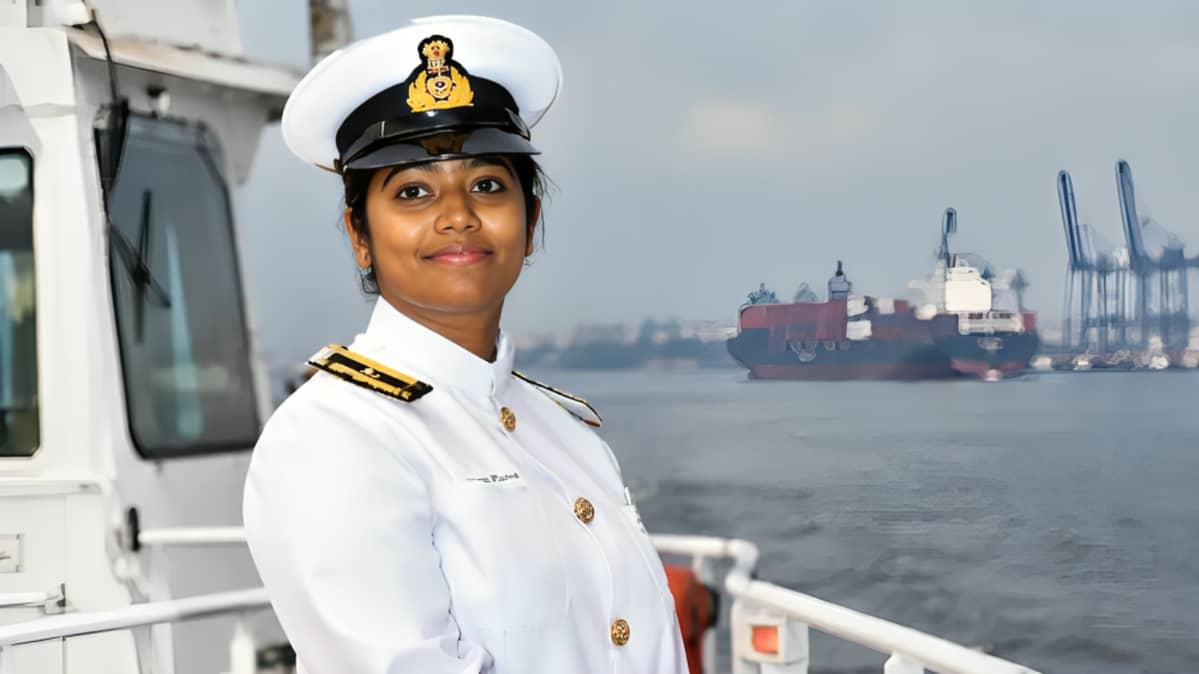
Reshma Nilofer Visalakshi’s journey to becoming India’s first woman marine pilot is a story of determination, specialised training and persistence in a profession traditionally dominated by men. Her achievement has become an important milestone for women in India’s maritime sector and has demonstrated that professional opportunities at sea can extend beyond conventional gender boundaries.
Reshma, who is originally from Chennai, entered the maritime field at a time when relatively few women were choosing careers at sea. Her interest in the sector grew after she came across an opportunity to join a specialised marine technology programme. According to reports, nearly 4,000 candidates appeared for the talent examination, while around 300 were selected for the five year programme. Reshma was among those selected.
She completed her maritime education at AMET University in Kanathur, near Chennai. The training environment was overwhelmingly male dominated, with only a small number of female students. Her academic years provided her with technical knowledge and helped prepare her for the demanding conditions of a career in shipping and navigation.
Following her education, Reshma gained practical experience at sea. She sailed on vessels with multinational crews and developed the skills required to work as a professional maritime officer. Her early sea experience became an important foundation for the next stage of her career.
Her career took a significant turn when she joined the Kolkata Port Trust as a junior officer and pilot trainee. Becoming a marine pilot requires extensive knowledge of local waterways, navigation, ship handling, tides, currents and port operations. The responsibility is particularly demanding in areas where large vessels have limited room to manoeuvre.
Reshma underwent several years of specialised training before qualifying as a river pilot. Reports have described the Hooghly as a particularly challenging waterway because of its bends, sandbars, changing conditions and navigational complexities. A river pilot must understand these local characteristics and guide vessels safely towards the port.
Her work involved travelling by pilot vessel to meet larger ships and then boarding those vessels to assist with navigation and berthing. She has handled vessels connected with the Navy, Coast Guard, Merchant Navy and commercial shipping. During her training period, she also navigated the Indian Coast Guard vessel ICGS Rajkiran.
In 2018, Reshma became a qualified river pilot, marking a significant moment in the history of India’s maritime industry. She was subsequently recognised as the country’s first woman marine pilot. The Government of India has also officially identified her as India’s first woman Marine Pilot.
Her achievement was not simply a professional milestone. It also represented a breakthrough in a sector where women have historically had limited representation, particularly in operational roles involving navigation and ship handling.
Reshma has spoken about the challenges women face in maritime careers, including questions about their ability to work in demanding environments and concerns surrounding long and irregular working schedules. Her experience reflects the wider difficulties faced by women attempting to enter and advance in traditionally male dominated areas of the shipping industry.
Despite these challenges, she continued to build her career and take on responsibilities that required extensive technical expertise and confidence. Her journey has also made her an advocate for greater participation of women in maritime professions.
Her achievements have received national recognition. She was awarded the Nari Shakti Puraskar and has been recognised by the Government of India for her pioneering contribution to the maritime sector.
Reshma’s career continues to be associated with efforts to encourage more women to consider opportunities in shipping, navigation and other maritime professions. Her story demonstrates that entry into a highly specialised field can be achieved through education, practical experience, continuous training and determination.
Her journey from being one of thousands of applicants to becoming India’s first woman marine pilot illustrates the importance of creating opportunities for women in specialised technical professions. It also highlights the changing nature of India’s maritime industry, where women are increasingly taking on professional and leadership responsibilities.
A more recent milestone further underlined this change. In April 2026, the Directorate General of Shipping highlighted that MV Sindhu became the first Indian flag vessel to sail with both a female Master, Captain Meera Uppadhaya, and a female Pilot, Reshma Nilofer Visalakshi, on the bridge. The event was described as an important milestone for gender inclusion in Indian shipping.
Reshma Nilofer Visalakshi’s story therefore extends beyond the achievement of becoming the first woman marine pilot. It represents a gradual shift in India’s maritime workforce and provides an example for young women considering careers that have traditionally been viewed as male dominated. Her experience shows that specialised education, extensive training and professional commitment can help overcome barriers and create new possibilities in the maritime sector.