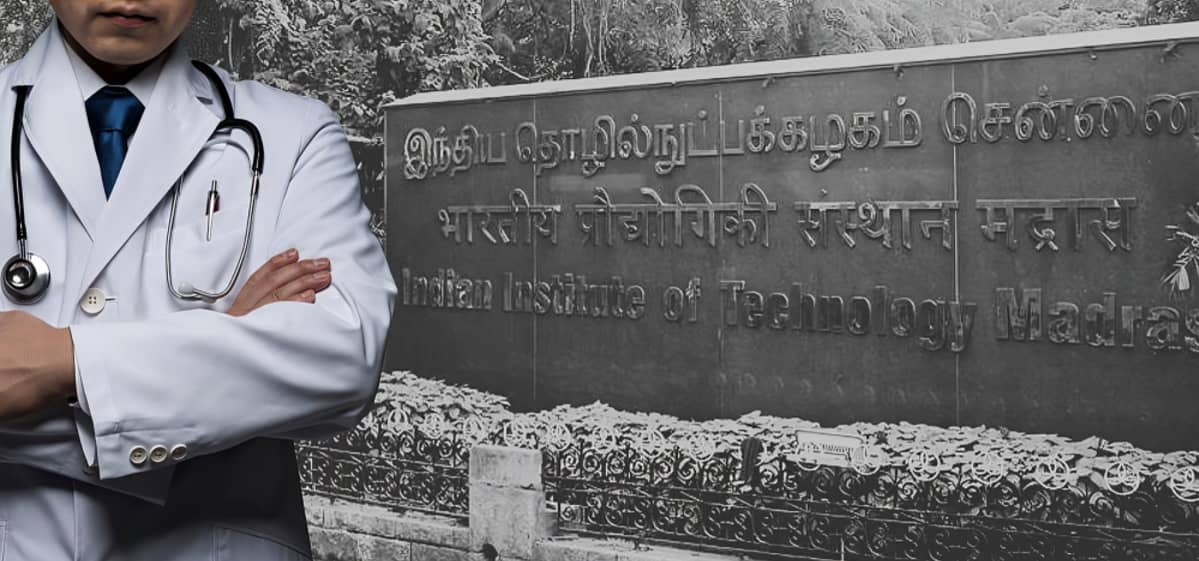
IIT Madras is preparing to expand its academic activities into medical education with plans to establish a School of Medical Sciences.
The proposed school is expected to offer medical programmes including MBBS, MD and PhD courses. IIT Madras Director Professor V Kamakoti has confirmed the institute's intention to enter medical education and develop an academic environment that combines medicine with engineering and technology.
The proposal represents a significant expansion for an institute that has traditionally been known for engineering, science, technology and research.
Proposed medical programmes
The planned School of Medical Sciences is expected to cover undergraduate, postgraduate and research education.
The proposed MBBS programme would be aimed at training medical students to become practising doctors. MD programmes would provide opportunities for postgraduate medical education, while PhD programmes would focus on advanced research.
However, these programmes cannot begin immediately. IIT Madras will need to complete the necessary regulatory procedures and obtain approvals from the National Medical Commission before launching recognised medical degree courses.
Teaching hospital will be important
A major requirement for establishing an MBBS programme is appropriate clinical training infrastructure.
IIT Madras is therefore planning to develop a teaching hospital and the associated medical infrastructure required for medical education.
A teaching hospital would allow students to receive practical clinical training alongside classroom education. It would also provide a platform for medical research and collaboration between doctors, engineers and scientists.
The institute will need to ensure that the proposed infrastructure meets the standards required by the relevant medical education regulations before students can be admitted to the proposed programmes.
IIT Madras already has a medical sciences department
The proposed medical school is not IIT Madras's first step into healthcare education.
The institute established its Department of Medical Sciences and Technology in 2023. The department currently offers a four year BS programme in Medical Sciences and Engineering and supports research programmes in medical science and technology.
The existing academic model focuses on combining medical knowledge with engineering and technological expertise.
Students are exposed to areas such as medical imaging, artificial intelligence in healthcare, medical devices, drug discovery and physiological research.
Connecting medicine and engineering
One of the main objectives of the proposed expansion is to bring medical education and engineering closer together.
Modern healthcare increasingly depends on technology, including artificial intelligence, medical imaging, advanced devices, data analysis and digital health systems.
IIT Madras already has expertise in these technological areas. A dedicated medical school could potentially create opportunities for doctors, engineers and researchers to work together on healthcare challenges.
The proposed structure could therefore create an interdisciplinary environment rather than treating medicine and technology as separate academic fields.
Existing research ecosystem
IIT Madras's Department of Medical Sciences and Technology has already developed connections with several medical institutions.
The department's academic model includes collaborations with institutions such as Voluntary Health Services, Sankara Nethralaya, MGM Healthcare, MIOT International and Sri Ramachandra Institute of Higher Education and Research.
Such collaborations could provide an important foundation for clinical training and medical research as IIT Madras considers expanding its medical education activities.
Focus on physician scientists
IIT Madras has also developed programmes aimed at combining clinical medicine with scientific research.
Its Department of Medical Sciences and Technology offers a PhD pathway for doctors interested in becoming physician scientists. The programme is designed to encourage clinicians to work on research problems that can benefit from engineering and technological expertise.
The proposed School of Medical Sciences could further strengthen this approach by creating a broader academic ecosystem covering medical education and research.
Regulatory approval remains essential
The announcement should not be interpreted as confirmation that IIT Madras has already started an MBBS or MD programme.
The proposed courses will require the necessary approvals before they can be launched.
The National Medical Commission regulates medical education standards and recognition of medical qualifications in India. Its current regulations include rules covering postgraduate medical education, recognition of medical qualifications and standards for medical education.
Therefore, the proposed school remains subject to the required regulatory process.
Potential impact on medical education
If the plan receives the necessary approvals and becomes operational, IIT Madras would enter a new area of higher education.
The initiative could create opportunities for students interested in both medicine and technology.
The institute's existing strength in engineering and scientific research could also support the development of technology driven medical research.
This could include areas such as medical devices, artificial intelligence, medical imaging, biotechnology and digital healthcare.
A different model for medical education
The proposed initiative could give IIT Madras an opportunity to develop a medical education model that is closely integrated with engineering.
Traditional medical education focuses primarily on clinical sciences and patient care. IIT Madras's proposed approach could add a stronger technology and research component to the academic environment.
The combination could potentially encourage students and researchers to develop new solutions for healthcare delivery.
Importance of clinical infrastructure
Despite the technological expertise available at IIT Madras, medical education requires substantial clinical infrastructure.
An MBBS programme requires access to clinical departments, laboratories, teaching facilities and patient care services.
A teaching hospital would therefore be an essential part of the proposed medical school.
The institute will need to develop or establish the required facilities in accordance with applicable regulations before a medical programme can begin.
Opportunities for research
The proposed school could also strengthen medical research at IIT Madras.
The institute already has research capabilities in engineering, artificial intelligence, materials science and other technological disciplines.
Combining these capabilities with clinical expertise could lead to research projects focused on healthcare technologies and medical innovation.
Researchers could potentially work on areas ranging from medical devices and diagnostic technologies to computational medicine and drug discovery.
What students should know
Students should note that the proposed MBBS, MD and PhD programmes are not yet equivalent to officially available admission programmes at IIT Madras.
Admission details, seat numbers, eligibility criteria and course commencement dates would depend on the institute's formal announcements and the required approvals.
Students should therefore rely on official IIT Madras and National Medical Commission announcements before making decisions about admissions.
Broader significance
The proposed expansion reflects a growing trend of engineering and technology institutions becoming more involved in healthcare research.
Healthcare increasingly requires collaboration between multiple disciplines.
Engineers develop medical devices and software, scientists work on diagnostics and drug discovery, while doctors provide clinical knowledge and patient care.
An institution combining these areas could potentially support new forms of interdisciplinary education and research.
Future plans
The next major steps for IIT Madras will involve developing the proposed medical school, planning the necessary infrastructure and completing the regulatory process.
The institute will also need to establish the teaching hospital and clinical facilities required for medical education.
Only after the necessary approvals and infrastructure requirements are completed can the proposed medical degree programmes move towards implementation.
Conclusion
IIT Madras is planning to establish a School of Medical Sciences that could offer MBBS, MD and PhD programmes, marking a major expansion of the institute's academic activities.
The proposal builds on IIT Madras's existing Department of Medical Sciences and Technology, which already combines medicine, engineering and technology through undergraduate and research programmes.
However, the proposed medical school is still subject to regulatory requirements. IIT Madras will need the necessary National Medical Commission approvals and appropriate clinical infrastructure, including a teaching hospital, before recognised medical degree programmes can begin.
If implemented, the initiative could create a new interdisciplinary academic environment in which medical education, engineering, technology and healthcare research operate closely together.