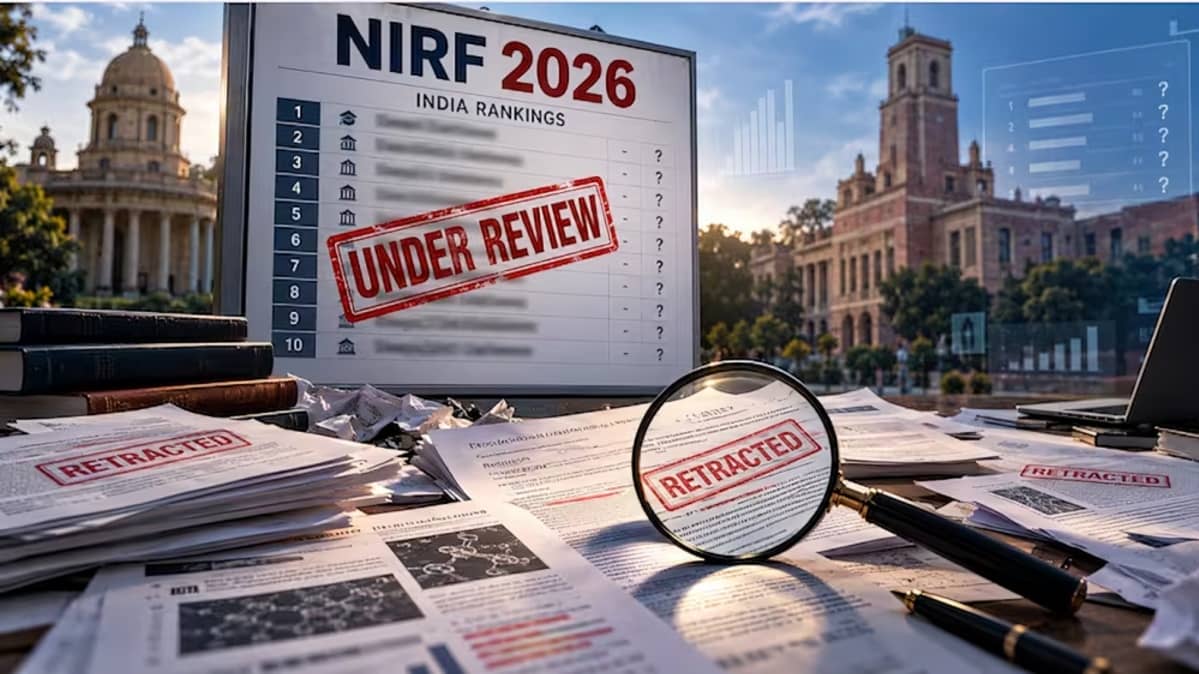
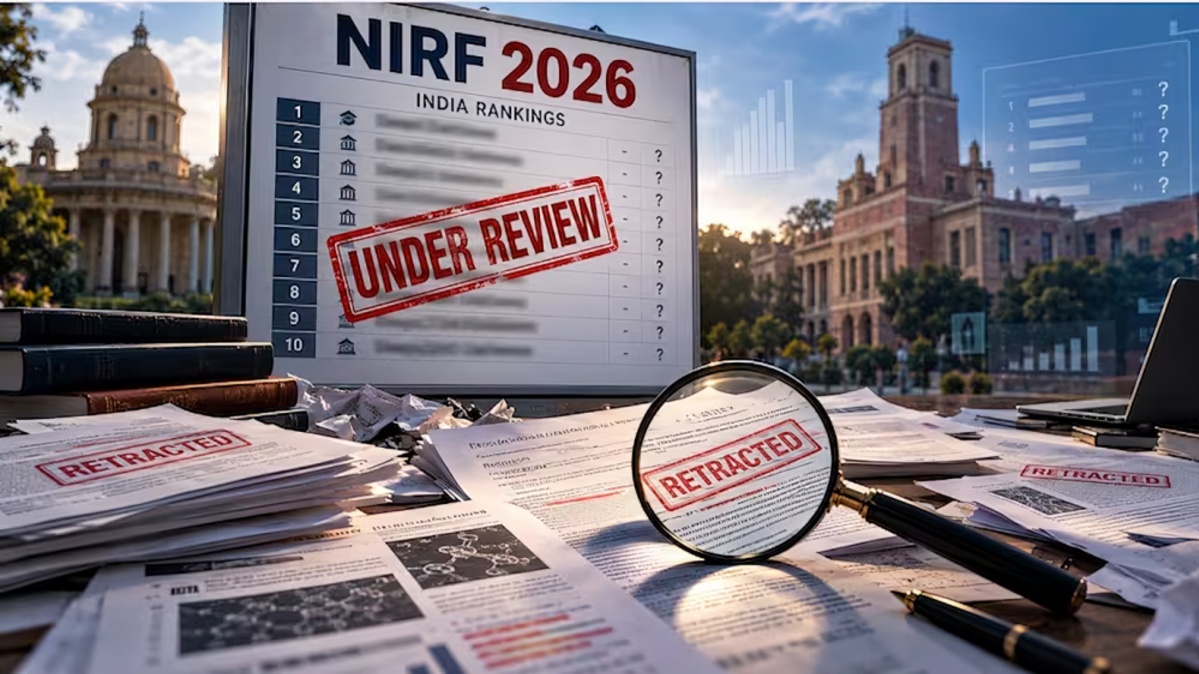
The National Institutional Ranking Framework Ranking 2026 has been delayed amid increased scrutiny of research data submitted by higher education institutions across India.
The NIRF rankings are normally released during the year as an important reference for students, parents, educators and policymakers evaluating colleges, universities and other higher education institutions. However, the 2026 rankings have not yet been announced, with the assessment process reportedly taking longer because of additional examination of research related information.
One of the major issues under scrutiny this year is the presence of retracted research papers in institutional submissions. Several such papers have reportedly been flagged during the ongoing assessment, prompting closer examination of the research records of participating institutions.
The National Board of Accreditation, an autonomous body under the Ministry of Education that conducts the NIRF ranking exercise, is reportedly examining the cases identified during the assessment.
According to reports, institutions associated with retracted research papers are being scrutinised and warned as part of the assessment process. Negative marking is also expected to be applied where applicable under the existing NIRF methodology.
The issue is significant because Research and Professional Practice is one of the major parameters used to assess institutions under the NIRF framework. The rankings also consider Teaching, Learning and Resources, Graduation Outcomes, Outreach and Inclusivity, and Perception.
The NIRF 2025 methodology introduced a negative marking mechanism related to retracted research publications and citations. The measure was intended to ensure that the research output reported by institutions is evaluated more carefully and that retracted publications do not unfairly contribute to an institution's ranking performance.
The current scrutiny is reportedly examining whether institutions have submitted research publications that were subsequently retracted. The authorities are also looking at the circumstances surrounding such cases before determining their impact on the ranking assessment.
Reports indicate that the NBA is considering stronger action against institutions that repeatedly face problems involving retracted research papers. One proposal reportedly under consideration is the possibility of debarring repeat offenders from participating in future NIRF rankings.
However, the possible debarment should not be treated as a final decision at this stage. Reports describe it as a measure being considered as authorities review the current assessment process.
The issue has drawn attention because research integrity has become an increasingly important concern within India's higher education system. Institutions compete closely for positions in NIRF rankings, and research performance is an important component of their overall scores.
According to data from Retraction Watch cited in recent reports, India recorded 887 research paper retractions in 2025. This placed India second globally behind China, which recorded 1,701 retractions during the same period.
A research paper may be retracted for several reasons. These can include plagiarism, fabricated or manipulated data, duplicate publication, ethical concerns, problems with the peer review process or serious errors that affect the reliability of the research.
Importantly, a retraction does not necessarily mean that a researcher or institution has committed deliberate misconduct. Research papers can also be withdrawn when authors or journals identify genuine errors, methodological problems or other issues after publication.
This distinction is important when assessing institutional research records. The presence of a retracted publication alone should therefore not automatically be interpreted as proof of academic fraud or research misconduct.
The NIRF assessment process uses research information submitted by participating institutions along with data obtained from relevant external sources. The introduction of negative marking for retracted papers in the 2025 methodology represented a move towards greater scrutiny of the reliability of research output used in ranking calculations.
The 2026 NIRF data submission process was conducted earlier this year. The official NIRF portal states that data submission for India Rankings 2026 began on January 6, 2026, and closed on March 16, 2026. The rankings are now awaiting completion of the assessment process.
The delay has created additional interest among higher education institutions because the NIRF rankings are widely followed across India. Students often use the rankings as one of several factors when comparing institutions, while colleges and universities use their positions to assess their performance against peer institutions.
The 2025 NIRF methodology already included penalties linked to retracted research publications. The current assessment is reportedly taking a closer look at the issue, with authorities examining whether institutions have repeatedly been associated with retracted publications.
If stricter measures are ultimately introduced, repeat offenders could potentially face greater consequences in future ranking exercises. However, any such action would depend on the final decision of the authorities responsible for the NIRF process.
The development also highlights the importance of research integrity for universities and other higher education institutions. Institutions seeking stronger positions in national rankings may need to ensure that their research data, publication records and institutional submissions are accurate and properly verified.
For students waiting for the NIRF Ranking 2026, the Ministry of Education has not yet announced a final release date. Until the assessment is completed and the rankings are officially published, institutions should not claim a particular NIRF 2026 position based on unofficial information.
The final rankings are expected to cover multiple categories, including overall institutions, universities, colleges, engineering, management, pharmacy, medical, law, architecture and planning, agriculture and allied sectors, research institutions, innovation and other categories.
The delay therefore reflects not only the additional scrutiny of research publications but also the broader effort to verify information before the 2026 rankings are finalised.
The latest development reinforces the growing importance of credible research in India's higher education sector. As the NIRF assessment continues, the treatment of retracted publications and the possible action against repeat offenders are expected to remain important issues in the finalisation of the 2026 rankings.
Students and institutions are advised to rely on the official NIRF and Ministry of Education announcements for the final ranking release date and any confirmed changes to participation or penalty rules.