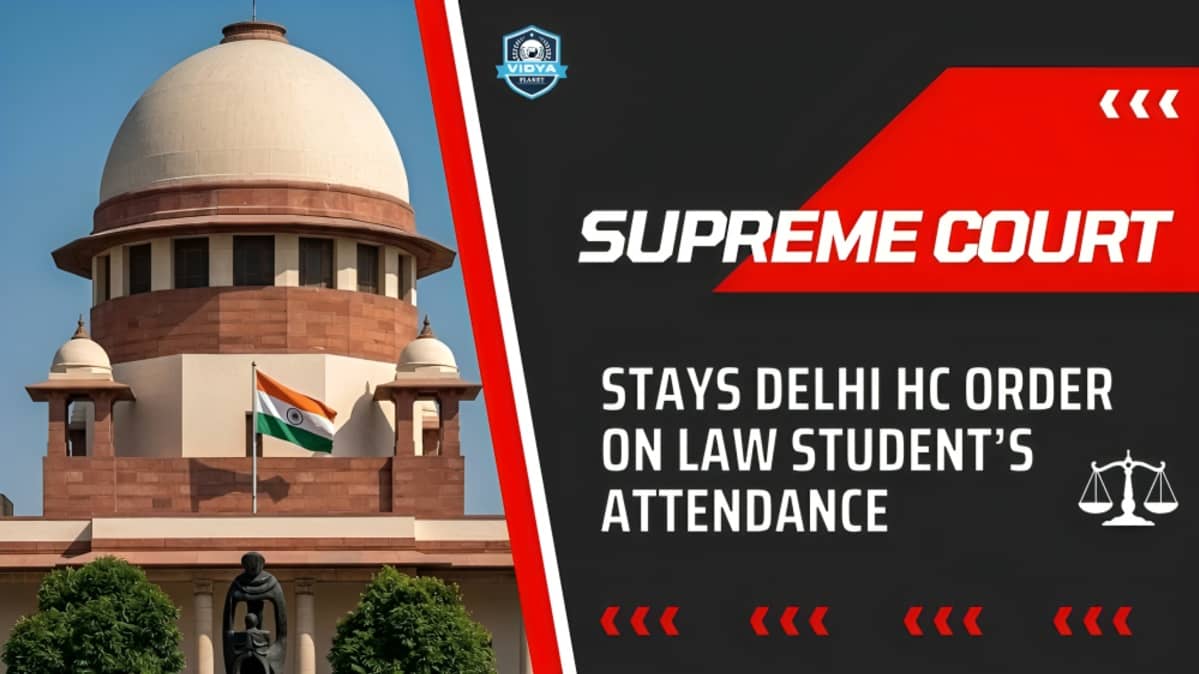
The Supreme Court has reserved its judgment on a significant legal dispute concerning attendance requirements for law students and their eligibility to appear for examinations.
The case relates to petitions challenging a November 3, 2025 judgment of the Delhi High Court concerning the enforcement of minimum attendance requirements in legal education. The High Court had issued directions stating that law students should not be prevented from appearing in examinations, pursuing further academic activities or progressing in their careers solely because of insufficient attendance.
The Delhi High Court's judgment had also examined whether law colleges and universities could impose attendance requirements beyond the minimum standards prescribed by the Bar Council of India. The issue gained wider attention because the proceedings arose from a suo motu case concerning the death of a law student.
The High Court had expressed concern about enforcing attendance requirements in a manner that could cause excessive mental pressure or affect a student's academic future. It also directed the Bar Council of India to reconsider the mandatory attendance framework applicable to three year and five year LLB programmes.
The judgment became the subject of legal challenges before the Supreme Court. The Bar Council of India and other institutions questioned the effect of the High Court's directions, particularly the portion dealing with the consequences of attendance shortages.
On May 26, 2026, the Supreme Court stayed the operation of paragraph 249 of the Delhi High Court judgment. That paragraph contained directions preventing recognised law colleges and universities from detaining students from examinations or further academic progression solely because of inadequate attendance.
The Supreme Court clarified that the stay would operate prospectively. This meant that the Court had to subsequently consider the position of students whose academic sessions were already underway when the Delhi High Court delivered its judgment.
In July 2026, the Supreme Court provided one time protection to a specific group of law students. It directed that students whose academic session was ongoing when the Delhi High Court judgment was delivered on November 3, 2025, should not be prevented from appearing in the final examinations for that academic session solely because of attendance shortages.
The Court also provided that students who had been unable to take their final examinations, either completely or partially, could appear in supplementary examinations for that academic session.
The Supreme Court described the relief as a one time measure. The decision was linked to the uncertainty created after the Delhi High Court judgment and the subsequent legal developments concerning attendance requirements.
The Court noted that some students had acted under a bona fide belief that attendance shortages would not prevent them from appearing in examinations during the ongoing academic session.
The latest proceedings concern the broader legal question of how attendance requirements should be applied to law students and the extent to which students can be denied examination opportunities because they have not met minimum attendance standards.
On October 6, 2026, a bench comprising Justices Vikram Nath, Augustine George Masih and Sandeep Mehta heard the pending petitions and reserved its judgment. The bench also permitted the parties to file written submissions within two weeks.
The Supreme Court's eventual decision is expected to clarify the legal position surrounding mandatory attendance requirements for law students and the authority of educational institutions to prevent students from appearing in examinations because of attendance shortages.
The matter has implications for recognised law colleges, universities and institutions across the country. It also involves the regulatory role of the Bar Council of India in determining standards for legal education.
The Delhi High Court had earlier stated that law colleges should not prescribe attendance requirements above the minimum percentage established under the Bar Council of India's regulations. It had also suggested that legal education should take into account activities such as moot courts, seminars, debates, model Parliament programmes and attendance at court proceedings as part of broader academic development.
The dispute has therefore raised questions beyond classroom attendance, including the balance between maintaining academic discipline and ensuring that attendance rules do not unnecessarily disrupt a student's education.
For students, the outcome of the Supreme Court case could be important because a final ruling may establish clearer standards regarding when attendance shortages can affect examination eligibility and academic progression.
However, until the Supreme Court delivers its final judgment, the legal position should not be interpreted as a blanket exemption from attendance requirements for all law students.
The Supreme Court has already clarified that the special protection granted in July 2026 was a one time measure for students whose academic sessions were ongoing when the Delhi High Court delivered its November 2025 judgment.
The latest hearing does not itself remove existing attendance requirements. The final legal position will depend on the judgment that the Supreme Court is expected to pronounce after considering the petitions and written submissions.
Law students and institutions are therefore expected to follow the applicable rules and court directions currently in force until the Supreme Court issues its final decision.
The case remains closely watched by law students, universities, colleges and legal education authorities because the final judgment could have a significant impact on attendance policies and examination eligibility across legal education institutions in India.