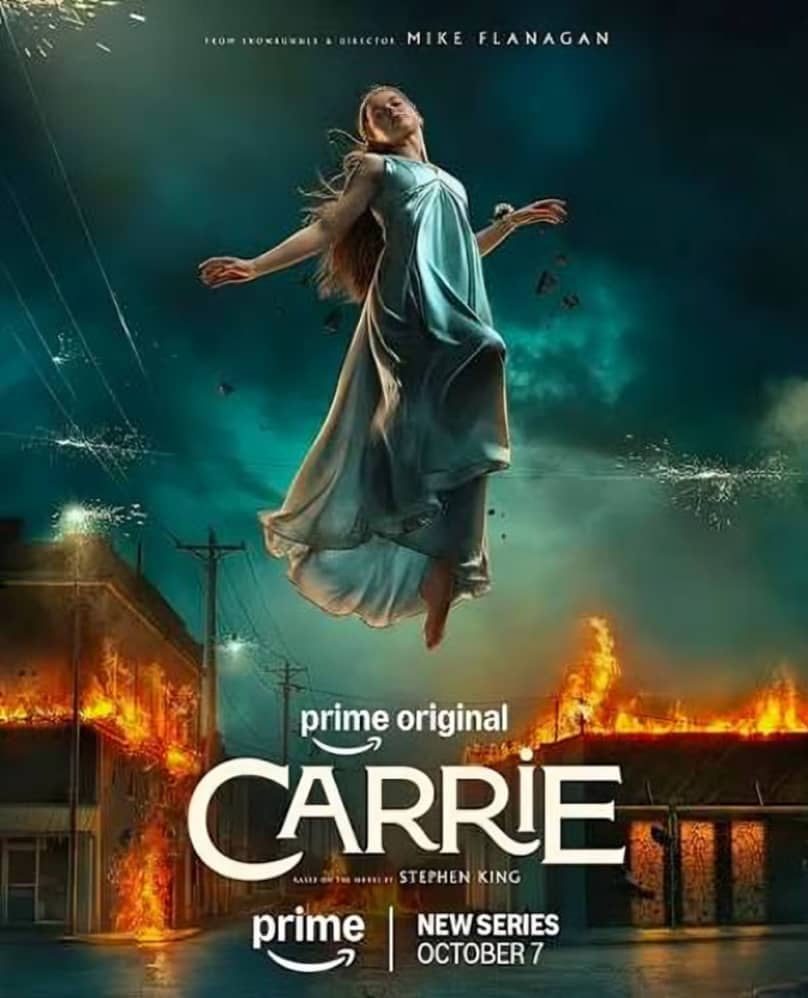
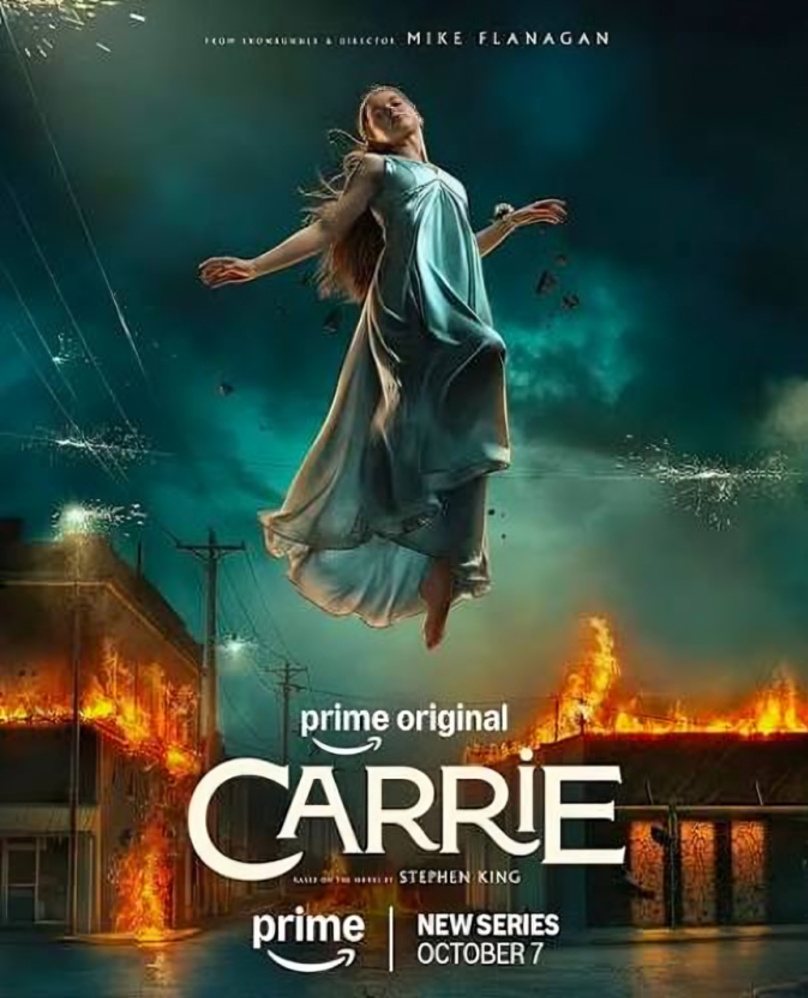
Carrie has remained one of Stephen King’s most recognizable horror stories since the publication of his debut novel in 1974. The story of a socially isolated teenager whose supernatural abilities emerge alongside years of humiliation has already received several adaptations. The best known remains Brian De Palma’s 1976 film starring Sissy Spacek. Now, Mike Flanagan has taken the story into television with an eight episode Prime Video series that attempts to explore Carrie from a contemporary perspective.
The new series stars Summer H Howell as Carrie White and Samantha Sloyan as her mother Margaret. The story begins with Carrie living an extremely isolated life under the control of her parents. After her father’s sudden death, she is pushed into the unfamiliar environment of public high school. There, she faces bullying, social pressure and the complicated relationships that come with adolescence. At the same time, her telekinetic abilities begin to emerge.
One of the biggest differences in Flanagan’s version is its focus on the modern social environment. Instead of treating bullying as something that ends when a student leaves the school building, the series examines how social media can extend humiliation and harassment into every part of a teenager’s life. Online attention, viral posts and public judgment become additional sources of pressure for Carrie.
This change gives the story a contemporary relevance. The central themes of isolation, cruelty and the consequences of bullying remain connected to King’s original work, but the new series places them within a world where a teenager’s experiences can quickly become public through digital platforms. Reuters reported that Flanagan specifically wanted to address issues including cyberbullying, social media pressure and active shooter drills in schools.
The series also gives greater attention to the people surrounding Carrie. Rather than presenting every character in simple terms, Flanagan attempts to explore their motivations and personal struggles. This includes Carrie’s mother Margaret, whose controlling behavior becomes an important part of Carrie’s isolation.
Summer H Howell’s performance has been one of the strongest aspects highlighted by several reviews. Critics have noted the emotional depth of her portrayal and the way the series allows Carrie to develop over a longer narrative than a traditional feature film. The expanded format gives Flanagan more time to explore Carrie’s personality, relationships and gradual transformation.
The eight episode structure also allows the series to move beyond the familiar story beats known from previous adaptations. Amazon describes the series as a reinvention of the classic novel that examines kindness, cruelty and the complicated process through which Carrie’s identity develops.
However, the expanded approach may not satisfy every fan of King’s original novel or De Palma’s 1976 film. Some critics have argued that the series spends so much time exploring contemporary social issues and supporting characters that the central horror becomes less intense.
A review from Vulture, for example, argued that the adaptation moves away from the visceral horror and psychological intensity of the original story. The review suggested that the emphasis on empathy and broader social themes sometimes makes Carrie less disturbing than the character was in King’s novel.
Other reviews have been more positive. The Los Angeles Times praised the performances of Summer H Howell and Samantha Sloyan while describing the series as a modern expansion of King’s story. The Independent also described the adaptation as a contemporary version that remains relevant to modern audiences.
The difference in critical reactions highlights what makes this adaptation unusual. Flanagan is not simply attempting to recreate the 1976 film. Instead, he is using the basic framework of Carrie to examine how teenage cruelty has changed in the digital age.
For audiences who already know the story, this approach can provide a different experience because the suspense does not depend entirely on discovering what happens to Carrie. The series instead spends more time examining why the characters behave as they do and how Carrie’s environment shapes her transformation.
At the same time, viewers expecting constant scares may find that the series places greater emphasis on psychological drama and character development. The Times of India noted that the adaptation offers layered character work and a timely examination of teenage cruelty, while also observing that the scares do not always land with the same force.
The series is also notable because it represents the first television series adaptation of King’s Carrie. All eight episodes were released on Prime Video on October 7, 2026. The cast includes Summer H Howell, Samantha Sloyan, Siena Agudong, Alison Thornton, Joel Oulette, Josie Totah, Amber Midthunder and Matthew Lillard. Mike Flanagan serves as showrunner, writer and director of several episodes, while Stephen King is an executive producer.
Overall, Mike Flanagan’s Carrie is designed less as a straightforward remake and more as a reinterpretation of a familiar horror story. Its strongest elements are its contemporary setting, expanded character development and focus on the changing nature of teenage bullying.
Whether that approach works for individual viewers may depend on what they expect from a Carrie adaptation. Fans looking for the raw psychological horror of King’s original novel may find the modern expansion less frightening, while viewers interested in a character driven interpretation may appreciate the additional depth.
The central question is therefore not simply whether Flanagan’s Carrie is scary enough. It is whether the story can still connect with audiences after decades of adaptations. By moving Carrie into the social media era, the series attempts to show that the fear surrounding teenage isolation and cruelty can take new forms while retaining the emotional foundation of King’s original story.