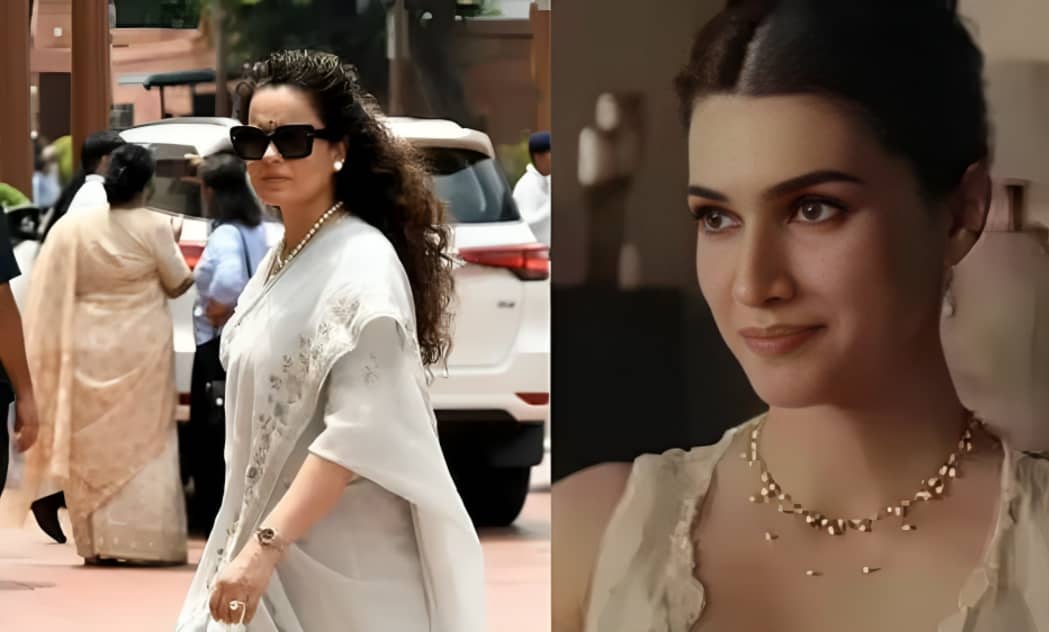
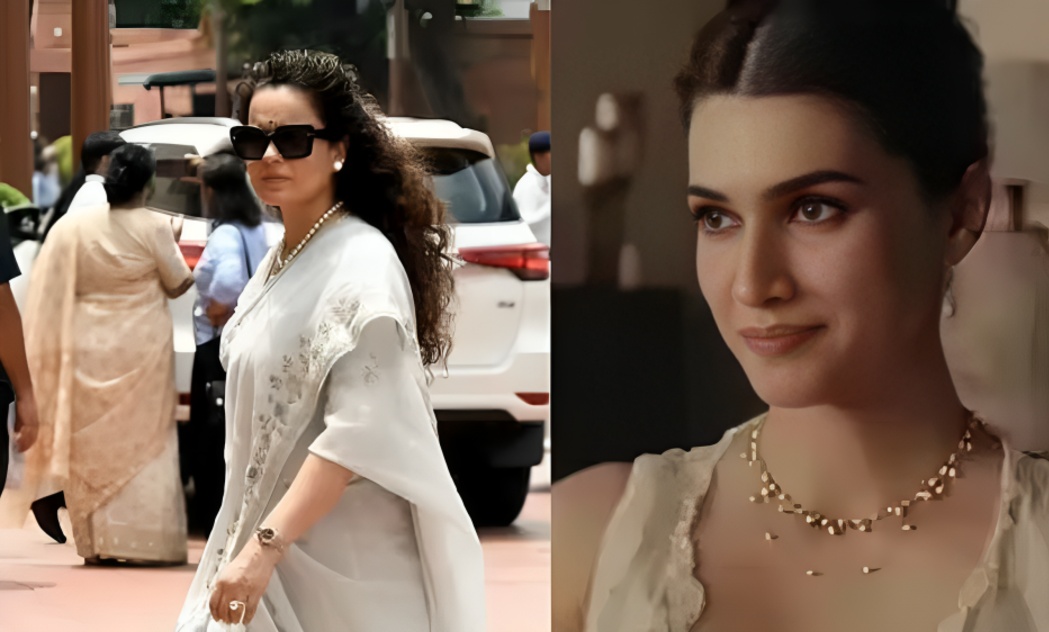
Actor and BJP MP Kangana Ranaut has once again reacted to the controversy surrounding Kriti Sanon’s Raksha Bandhan advertisement. The dispute began after a jewellery brand released a festive campaign featuring Kriti Sanon, with some viewers questioning the styling and presentation used in the advertisement.
The campaign was created around Raksha Bandhan, a festival traditionally associated with the bond between brothers and sisters. In the advertisement, Kriti appeared in an Indo Western outfit featuring a bralette style blouse, a cape like layer and a draped skirt. Some social media users criticised the choice of styling and questioned whether it was suitable for a campaign connected with the traditional festival.
Kangana Ranaut was among the prominent personalities who criticised the advertisement. In an Instagram post, she questioned why a woman would choose such an outfit while tying Rakhi to her brother. She also described the advertisement as appearing deliberately provocative.
The comments quickly became part of a larger discussion about clothing, culture and the representation of Indian festivals in advertising. The debate was not limited to the advertisement itself, with social media users expressing different views about whether clothing should be connected to cultural values.
Kriti Sanon subsequently responded to the criticism through an Instagram Story. Although she did not directly name Kangana, her statement was widely understood as a response to the criticism surrounding the advertisement.
Kriti argued that the essence of a festival lies in the emotions and meaning associated with its traditions rather than the clothes worn by an individual. She questioned why women continue to face scrutiny over their clothing and said cultural values should not be judged by a woman’s neckline or appearance.
The actress also addressed criticism surrounding another part of the advertisement in which she tied a Rakhi to a dog. She explained that Raksha Bandhan represents a bond of protection and that she and her sister also celebrate that bond with each other.
The controversy gained further political attention after Congress leader and Leader of Opposition in the Lok Sabha Rahul Gandhi expressed support for Kriti Sanon. Gandhi shared her statement and said that women should be free to decide what they wear, what they do and where they go. He also urged people to stop trolling women for exercising their freedom.
Rahul Gandhi’s intervention added a political dimension to what had initially been an entertainment and advertising controversy. His comments prompted further reactions from supporters and critics of both sides.
Kangana Ranaut has now responded again, questioning Kriti Sanon’s explanation and expressing disagreement with the arguments made in defence of the advertisement. According to reports, Kangana said her criticism was not simply about Kriti personally but also about how Indian festivals are presented in commercial campaigns.
Kangana has maintained that festivals such as Raksha Bandhan carry cultural and traditional significance. Her latest comments focus on the argument that advertising campaigns connected to such festivals should take the nature of those traditions into consideration.
The disagreement between the two actresses has therefore developed into a broader debate about personal choice, cultural representation and commercial advertising.
The controversy also highlights the changing nature of festive advertising in India. Brands increasingly use contemporary fashion, celebrity endorsements and modern visual concepts to connect traditional festivals with younger audiences. However, such campaigns can sometimes generate criticism when viewers feel that the presentation does not match their understanding of cultural traditions.
The jewellery advertisement eventually became controversial enough for the brand to withdraw it from circulation. The company said that it respects Indian culture, traditions and festivals and decided to remove the advertisement following the backlash.
The withdrawal did not end the discussion. Instead, the issue continued through statements from Kriti Sanon, Kangana Ranaut and Rahul Gandhi.
Kriti’s response focused primarily on individual freedom and the argument that clothing should not be used as a measure of a woman’s cultural values. Her statement also questioned the broader social tendency to tell women what they should or should not wear.
Kangana’s position has been different. She has argued that there is a distinction between ordinary fashion choices and the manner in which clothing is used in a campaign representing a traditional festival.
The disagreement has consequently created two contrasting perspectives. One side focuses on individual freedom and the right to choose clothing, while the other focuses on cultural sensitivity and the responsibility of brands when representing traditional occasions.
Rahul Gandhi’s support for Kriti added another dimension to this discussion. His statement framed the issue around women's freedom and criticised the practice of policing women's choices. His intervention also prompted political reactions from the BJP and others.
Kangana, who is both an actor and a BJP parliamentarian, has frequently expressed strong opinions on cultural, social and political issues. Her comments on the Raksha Bandhan advertisement have therefore received attention beyond the entertainment industry.
Kriti Sanon, meanwhile, has become one of the prominent Hindi film actresses of her generation. Her recent projects have continued to keep her in the public spotlight, and the advertisement controversy has added another major topic of discussion around her.
The dispute has also raised questions about how celebrities should respond when advertisements they appear in face criticism. Actors are often the public face of commercial campaigns, which means their personal image becomes closely associated with the advertising message.
In this case, the disagreement has centred not on the jewellery product itself but on the visual presentation of Raksha Bandhan and the choice of clothing used in the campaign.
The debate also reflects a larger conversation taking place across Indian social media about tradition and modernity. Festivals continue to have deep cultural significance for millions of people, while advertising and entertainment increasingly use contemporary fashion and presentation styles.
Finding a balance between these two approaches can be challenging for brands.
The Raksha Bandhan advertisement controversy demonstrates how quickly a commercial campaign can become a national discussion when it involves a major celebrity and a culturally significant festival.
Kangana’s initial comments attracted significant attention, while Kriti’s response shifted the conversation towards women's autonomy and cultural identity. Rahul Gandhi's intervention then brought the issue into the political sphere.
The subsequent withdrawal of the advertisement by the jewellery brand added another major development to the controversy. The company stated that the decision was made out of respect for Indian culture and traditions.
Despite the advertisement being removed, the debate has continued because the central questions involve broader social issues. The controversy has prompted discussion about whether clothing should be linked to cultural identity, whether brands should exercise additional caution when advertising around festivals and how much freedom celebrities should have in making personal fashion choices.
Kangana’s latest response indicates that she does not agree with Kriti’s explanation. Her criticism continues to focus on the cultural context in which the advertisement was presented.
Kriti, on the other hand, has maintained that cultural values come from within a person and should not be determined simply by clothing. Her response has received support from people who believe that women should not be subjected to public judgement based on their appearance.
The disagreement between the two actresses has therefore moved beyond a simple discussion about a commercial. It has become a debate involving fashion, cultural traditions, women's freedom and the responsibilities of advertisers.
For audiences, the controversy has also demonstrated the influence of social media in shaping public conversations around entertainment and advertising. A short promotional video can quickly reach millions of people, attract criticism and lead to responses from celebrities and political leaders.
The episode is likely to remain part of the entertainment and social media conversation for some time, particularly because the issue involves three high profile public figures and a major Indian festival.
At present, the key development is that Kangana Ranaut has again criticised the response given by Kriti Sanon following the backlash over the Raksha Bandhan advertisement. Kriti has defended her position, while Rahul Gandhi has publicly supported her right to make personal choices. The jewellery brand has also withdrawn the advertisement following the controversy.
The dispute ultimately highlights the continuing tension between traditional cultural expectations and contemporary approaches to fashion and advertising. As brands increasingly attempt to present festivals through modern campaigns, the response to this controversy could influence how future festive advertisements are designed and presented to Indian audiences.