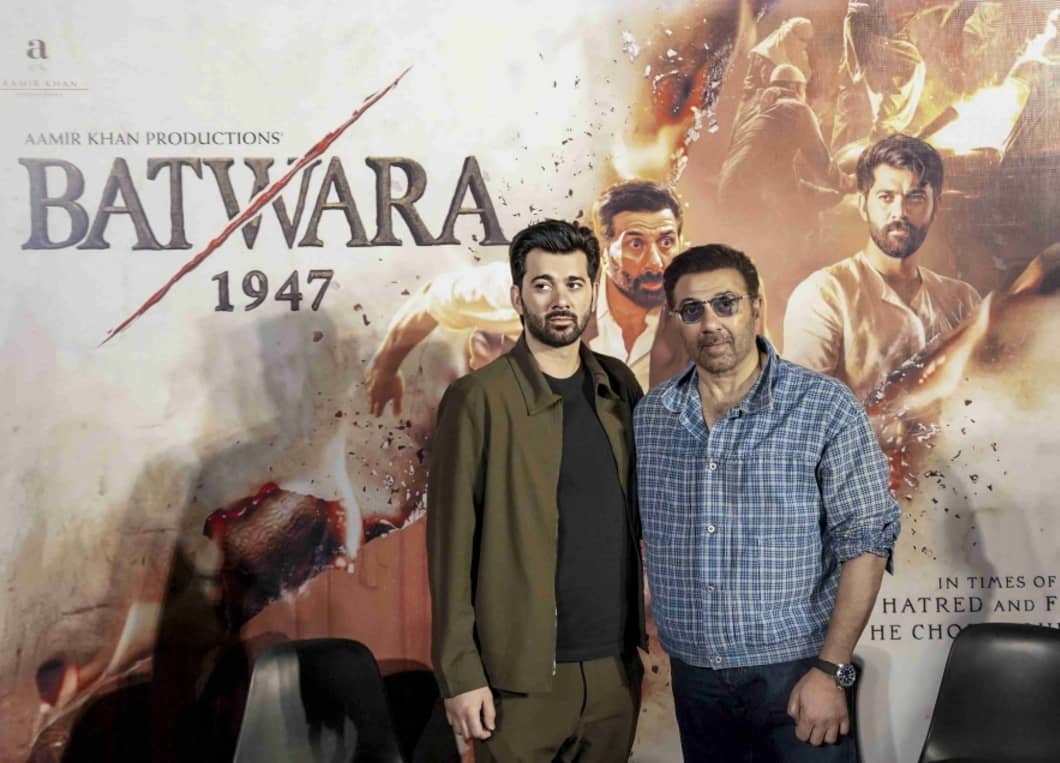

Batwara 1947 is a historical drama that revisits one of the most significant and painful chapters in the history of the Indian subcontinent. Directed by Rajkumar Santoshi and featuring Sunny Deol, the film is set against the backdrop of the Partition of India in 1947.
The movie seeks to approach the Partition not only as a major political event but also as a human tragedy that affected millions of ordinary people. The division of British India into India and Pakistan resulted in large scale displacement, communal violence and the separation of families and communities. Batwara 1947 attempts to bring these human experiences to the centre of its narrative.
The film is inspired by the acclaimed Hindi play Jis Lahore Nai Vekhya, O Jamya E Nai written by playwright Asghar Wajahat. The play has been widely recognised for its treatment of Partition through the lives of people caught in circumstances beyond their control.
The story explores themes of displacement, uncertainty, identity and human relationships during a period of enormous social upheaval. Rather than concentrating exclusively on political decisions and historical personalities, the film attempts to examine how Partition transformed the lives of ordinary citizens.
Rajkumar Santoshi returns to a period drama with Batwara 1947, bringing his experience in dealing with socially relevant subjects to a story rooted in India's modern history. His collaboration with Sunny Deol also marks the reunion of two prominent names from Hindi cinema.
Sunny Deol has previously appeared in films dealing with patriotism, national identity and historical themes. His presence in a Partition based film adds another layer of familiarity for audiences who associate him with stories centred on national sentiment and social conflict.
The film's setting also makes its release particularly significant. With Independence Day approaching, public interest in India's freedom struggle and the events surrounding independence traditionally increases. Stories connected with the country's history often receive greater attention during this period.
However, Batwara 1947 appears to take a broader approach by looking at the consequences of independence and Partition from the perspective of people who experienced the upheaval directly. The film aims to explore how political decisions can affect families, communities and individuals.
The Partition of 1947 remains a subject of extensive historical discussion. Millions of people crossed newly created borders during the mass migration that followed Partition. Many families were separated, homes were abandoned and communities that had lived together for generations were disrupted.
Cinema has frequently explored these experiences through personal stories. Films and plays about Partition have helped audiences understand the emotional and social consequences of the historical event beyond conventional accounts of political negotiations.
The source play Jis Lahore Nai Vekhya, O Jamya E Nai is particularly known for using human relationships to examine communal tension and coexistence. Its adaptation into a feature film provides an opportunity to bring the story to a wider audience.
Batwara 1947 therefore combines historical context with a personal narrative. Its focus on ordinary people allows the film to examine questions of belonging, humanity and resilience during a period marked by violence and uncertainty.
The reunion of Rajkumar Santoshi and Sunny Deol is another important aspect of the project. Their collaboration is expected to attract audiences familiar with their earlier work while also drawing attention to the film's historical subject.
The film's Independence Day release window further connects its subject with the national mood surrounding August 15. At a time when patriotic sentiment and interest in India's history are particularly visible, a film examining both independence and Partition can encourage audiences to reflect on the complex human story behind the country's freedom.
Batwara 1947 ultimately seeks to present Partition through the experiences of people rather than viewing it only as a political boundary drawn on a map. By focusing on displacement, violence, uncertainty and human relationships, the film attempts to revisit history through an emotional and personal perspective.
With a recognised director, a prominent lead actor and a story adapted from an acclaimed play, Batwara 1947 is positioned as a historical drama that aims to connect India's past with contemporary audiences.