Prahaar Movie Review: Rajkummar Rao and Lalit Prabhakar Deliver an Intense Courtroom Drama
Prahaar: The Untold Story of Ujjwal Nikam brings one of the most significant criminal trials in modern Indian history to the big screen. Directed by Avinash Arun, the Hindi biographical courtroom drama stars Rajkummar Rao as public prosecutor Ujjwal Nikam, who played a prominent role in the prosecution of Ajmal Kasab, the sole surviving gunman captured during the 26/11 Mumbai terror attacks.
Lalit Prabhakar portrays Kasab, while the supporting cast includes Wamiqa Gabbi, Sikandar Kher, Jaideep Ahlawat, Ashish Vidyarthi and Ritvik Sahore. Rather than concentrating only on the events of the November 2008 attacks, the film focuses on the legal proceedings that followed, the challenges faced by the prosecution and the importance of establishing guilt through the judicial process.
Released in theatres on October 16, 2026, the film has received generally positive responses for its performances and courtroom sequences. However, some reviewers have argued that its focus on the trial leaves aspects of Nikam’s personal life and character insufficiently developed.
Story: The legal battle after the Mumbai attacks
The film introduces Ujjwal Nikam as an experienced public prosecutor known for his determination and sharp courtroom arguments. His professional responsibilities take on greater significance after the terrorist attacks that struck Mumbai on November 26, 2008.
The attacks targeted several locations across the city, including Chhatrapati Shivaji Terminus, hotels and other public places. The assault continued for several hours and resulted in the deaths of civilians and security personnel. Kasab was captured alive, making his prosecution a major legal and national issue.
In Prahaar, Nikam is assigned the task of prosecuting Kasab. The case requires the prosecution to present evidence and establish the accused’s guilt through the judicial process, despite intense public anger and demands for swift punishment.
The film depicts the courtroom as a place where evidence, testimony and legal arguments must take precedence over public emotion. Its central conflict lies in the challenge of securing justice while following the procedures required by the law.
Sikandar Kher plays Abbas Kazmi, the defence lawyer who represents Kasab in the film. His role introduces the opposing legal perspective, creating confrontations that allow the screenplay to explore the adversarial nature of a criminal trial.
The narrative moves between courtroom exchanges, aspects of Kasab’s detention and recreations of the attacks. This structure gives the film a different perspective from stories that focus primarily on the night of the tragedy itself.
Rajkummar Rao’s performance as Ujjwal Nikam
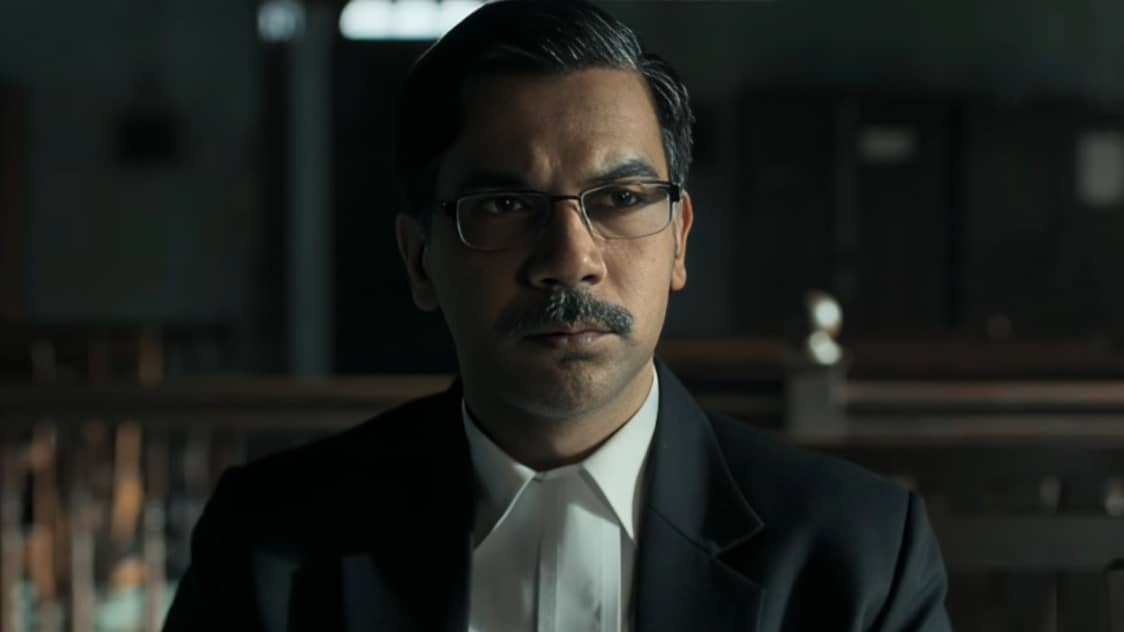
Rajkummar Rao carries much of the film through his portrayal of Nikam. The character is presented as a determined prosecutor who believes that the case must be built carefully rather than rushed to satisfy public demands.
Rao’s performance relies on controlled dialogue delivery, courtroom intensity and the character’s persistence in pursuing the prosecution. Rather than depicting Nikam only as a larger-than-life hero, the film attempts to show the demands of preparing a case that carries enormous national significance.
Several reviews have praised Rao for bringing sincerity and credibility to the role. His courtroom scenes provide the film with much of its dramatic momentum, particularly when the prosecution faces challenges in presenting its case.
However, some critics have pointed out that the screenplay gives limited attention to Nikam’s inner conflicts and family life. While his professional determination is clearly established, the personal consequences of handling such a high-profile trial could have been explored in greater depth.
These limitations do not entirely diminish Rao’s performance, but they affect how fully the film develops its central character.
Lalit Prabhakar’s portrayal of Ajmal Kasab
Lalit Prabhakar plays Ajmal Kasab, the captured gunman whose prosecution forms the central legal conflict. The role is particularly challenging because the character is connected to a tragedy that remains deeply painful for survivors, victims’ families and the wider public.
The film attempts to show the legal proceedings surrounding Kasab without relying exclusively on graphic recreations of the attacks. His courtroom presence and interactions with the legal system provide a different way of revisiting the events.
Prabhakar’s performance has attracted attention from reviewers, with some praising the unsettling quality and restraint of his portrayal. His scenes with Rao help establish the tension between the prosecution and the accused.
At the same time, depicting a real individual connected to a terrorist attack requires care. Showing aspects of an accused person’s behaviour or circumstances does not diminish the gravity of the crimes or remove responsibility for them. The legal story remains centred on the evidence and proceedings that established Kasab’s guilt.
Courtroom drama and the pursuit of justice
The film’s principal strength lies in its emphasis on legal procedure. The prosecution could not rely solely on public outrage or the scale of the tragedy. It had to establish the case through evidence, witnesses and arguments presented in court.
This aspect gives Prahaar relevance beyond its biographical subject. It highlights the principle that even cases involving extreme violence must be handled through established legal procedures.
The courtroom scenes also explore the tension between demands for immediate punishment and the need to ensure that a verdict is reached through a fair process. By focusing on the trial, the film presents justice as a process requiring preparation, evidence and legal scrutiny.
The direction by Avinash Arun keeps much of the narrative centred on the proceedings and the people involved. Reviews have praised the film’s ability to sustain tension during important courtroom sequences, although some have found that the narrative loses focus when it shifts towards personal and family subplots.
A more detailed exploration of the legal strategy and the challenges faced by the prosecution might have made the film even stronger.
Direction, pacing and supporting performances
Avinash Arun approaches the subject as a courtroom drama rather than a conventional action film. The emphasis is on arguments, testimony and the legal battle following a national tragedy.
The supporting cast includes Wamiqa Gabbi as a member of Nikam’s family, along with Jaideep Ahlawat and Ashish Vidyarthi in significant roles. Their performances help establish the wider professional and personal environment surrounding the central character.
The film’s recreation of the attacks and its transitions between the courtroom and other settings provide context for the trial. However, the pacing has drawn mixed reactions. Some reviewers have found the courtroom sequences compelling but felt that the screenplay does not fully explore the personal cost of Nikam’s work.
The result is a film that remains focused on an important legal case but occasionally misses opportunities to develop its characters more deeply.
Historical context: What happened after 26/11?
The November 2008 Mumbai attacks killed more than 160 people and injured hundreds. Kasab was captured alive, tried in India and convicted in 2010. His death sentence was upheld through the judicial process, and he was executed on November 21, 2012.
Nikam’s role as public prosecutor in the case brought him national attention. The trial became an important example of the legal response to a major terrorist attack.
Prahaar revisits this history through a dramatised account of the prosecution. As with other biographical films, scenes and dialogue may be adapted for storytelling. Viewers should distinguish dramatic interpretation from the historical court record.
Final verdict
Prahaar: The Untold Story of Ujjwal Nikam offers a courtroom-centred perspective on the legal proceedings that followed the 26/11 Mumbai terror attacks. Rajkummar Rao’s portrayal of Nikam and Lalit Prabhakar’s performance as Kasab provide the film with its central dramatic tension.
The film’s emphasis on evidence, legal procedure and the pursuit of justice gives it a clear focus. However, its limited exploration of Nikam’s personal life and some uneven narrative transitions prevent it from becoming a fully rounded biographical portrait.
For viewers interested in courtroom dramas, legal history and films based on major events in India, Prahaar offers an engaging account of a landmark prosecution. Its strongest moments come when the courtroom becomes the centre of the story and the importance of due process takes precedence over the demand for immediate retribution.