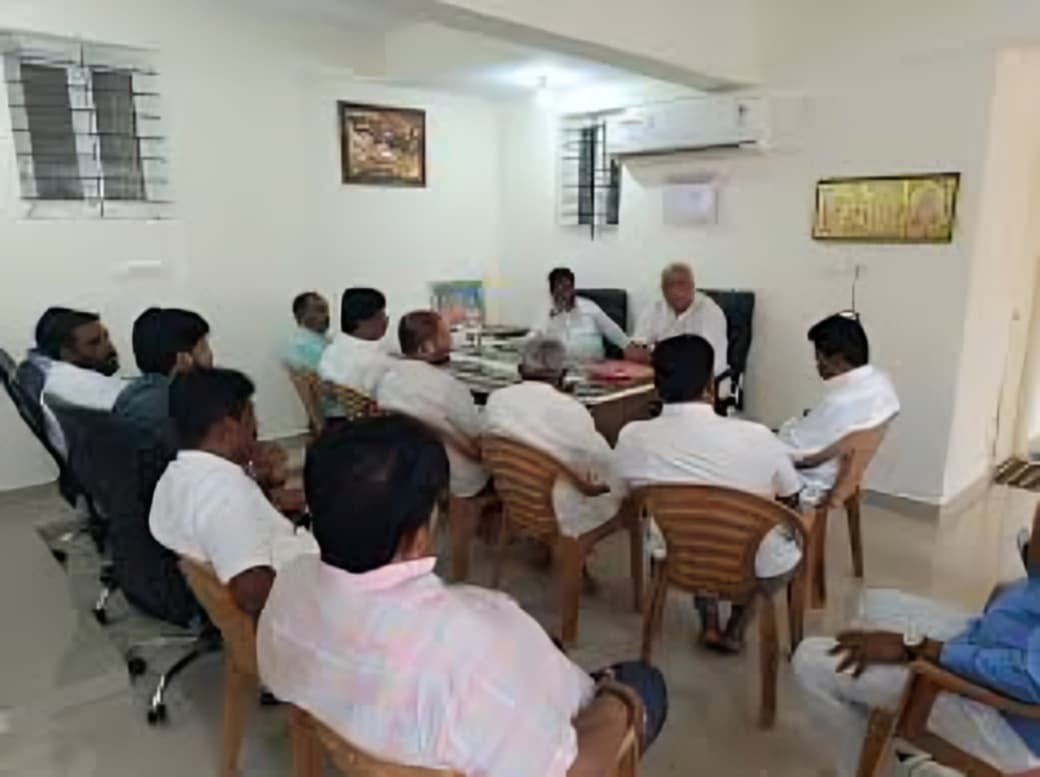
A comprehensive technical workshop on Makkacholam (Pearl Millet) cultivation was recently organized at the Kanchipuram Agriculture Department office in collaboration with the Tamil Nadu Agricultural University’s All India Coordinated Research Project. The event brought together agricultural experts, officials, and farmers to discuss and explore the potential of Makkacholam as an alternative crop in Kanchipuram.
The session began with a welcome address by Vijayalakshmi, an Agriculture Department official, followed by an introductory speech by Murugan, the Assistant Director of Agriculture. Rajkumar, the Collector's Personal Assistant, delivered an insightful speech on the economic benefits of Makkacholam cultivation.
Dr. Sivakumar, Professor and Head of the Department of Small Grains at Tamil Nadu Agricultural University, Coimbatore, presided over the event. He highlighted the increasing demand for Makkacholam in industries such as poultry feed, biscuit production, and ethanol manufacturing. He also explained the ideal soil conditions, sowing techniques, and varieties of Makkacholam that are best suited for cultivation in the region.
In his speech, Murugan emphasized that farmers in Kanchipuram should explore Makkacholam as a viable alternative crop. He cited the example of a farmer in Othukkadu village, who successfully grew Makkacholam, along with other farmers in nearby districts like Namakkal, who are cultivating it on a large scale.
Rajkumar, the Collector's PA, also shed light on how the Kanchipuram district, rich in water bodies, offers ample opportunity for profitable Makkacholam farming. He mentioned that the growing demand for Makkacholam, particularly in industries such as poultry feed and ethanol, has opened up significant economic potential for farmers in the region.
The workshop also included presentations by Dr. Srinivasan, Associate Professor in the Department of Entomology, on pest control methods for Makkacholam, and Dr. Kathirvelan, Associate Professor in Agronomy, who discussed the ideal sowing and crop management techniques.
Dr. Sivakumar concluded by stressing that Makkacholam cultivation is increasingly gaining importance in Tamil Nadu, especially in regions like Kanchipuram, where water availability and soil conditions are favorable. He also highlighted the financial returns from the crop, with farmers earning up to ₹40,000 per acre from Makkacholam cultivation, which can be sold directly to feed manufacturers and ethanol plants.
Farmers were encouraged to adopt Makkacholam cultivation, which not only promises economic benefits but also helps in crop diversification. The workshop served as an informative platform for Kanchipuram's farmers to make informed decisions and boost their agricultural practices.