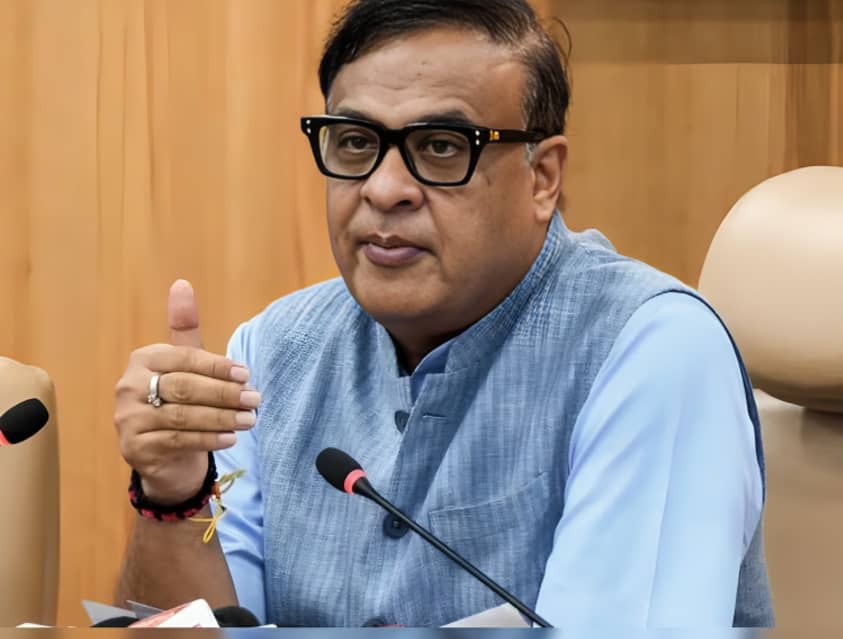
Assam Chief Minister Himanta Biswa Sarma has triggered a political debate by blaming the Congress party for the delay in implementing a Uniform Civil Code in India and ensuring equal rights for women.
Sarma made the remarks while speaking to reporters in Gujarat. He alleged that Congress had been responsible for preventing the implementation of the Uniform Civil Code and other progressive laws in the country. He also claimed that the delay had affected efforts to provide equal rights to women.
The Assam Chief Minister further criticised the Congress party over its position on social and legal reforms. He described the party as being opposed to measures that he believes would promote equality and development. Sarma also appealed to women to reconsider their political support for Congress in view of his allegations.
The Uniform Civil Code, commonly referred to as the UCC, has been a major subject of political and legal debate in India. It broadly refers to the proposal of having a common set of personal laws governing areas such as marriage, divorce, inheritance and related civil matters, irrespective of an individual's religion.
The issue has remained politically sensitive because personal laws in India have historically been governed by different religious and community-specific legal frameworks. Supporters of the UCC argue that common civil laws could strengthen equality and simplify legal provisions, while opponents have raised concerns about religious freedom, cultural diversity and the rights of different communities.
Sarma's latest comments have added another political dimension to the ongoing debate. His criticism of Congress reflects the wider disagreement between political parties over the implementation of the Uniform Civil Code and the approach that should be adopted towards personal laws.
The Assam Chief Minister also spoke about the way younger generations are categorised in contemporary society. He criticised terms such as Gen Z and Gen Alpha, describing them as Western labels that should not be used to divide children or young people.
Sarma urged citizens not to create divisions among children based on generational classifications. Instead, he called for people of different age groups to contribute collectively to strengthening the country.
Gen Z and Gen Alpha are commonly used international terms to describe different age groups. Gen Z generally refers to people born after the Millennials, while Gen Alpha is commonly used for children born in the following generation. However, Sarma argued that such labels should not become a basis for separating children within Indian society.
His comments come at a time when debates over women's rights, personal laws and the Uniform Civil Code continue to feature prominently in Indian political discussions. Political parties have different positions on how such reforms should be introduced and implemented.
The UCC is also connected to the constitutional framework of India. Article 44 of the Constitution directs the state to endeavour to secure a uniform civil code for citizens throughout the country. However, the provision is part of the Directive Principles of State Policy and has historically been the subject of extensive discussion regarding its implementation.
The debate has become more prominent in recent years, particularly after Uttarakhand became the first state in independent India to implement a Uniform Civil Code. The development has renewed discussions about whether similar legislation should be introduced across other states and at the national level.
Sarma has consistently supported the idea of a Uniform Civil Code and has linked the issue to women's equality. In his latest remarks, he argued that the absence of a common civil code has prevented women from receiving equal rights in certain areas.
However, his statement represents a political allegation and should not be interpreted as an established finding that Congress alone is responsible for the non-implementation of a national Uniform Civil Code. The issue involves constitutional provisions, legislative processes, political positions and differing views among communities and political parties.
The Congress party and other political groups have their own positions on the Uniform Civil Code. The issue has generated debate over how legal uniformity can be balanced with India's religious and cultural diversity.
Sarma's remarks also come amid a broader political discussion about women's rights and the role of personal laws. Supporters of the UCC argue that a common legal framework could strengthen gender equality, particularly in matters involving marriage, divorce, inheritance and family rights.
Opponents and critics have argued that any reform should take into account constitutional protections for religious freedom and the diversity of India's communities. These competing views have made the UCC one of the country's most debated legal and political issues.
Meanwhile, Sarma's comments on Gen Z and Gen Alpha have shifted part of the discussion towards the role of younger citizens in nation building. He called for people to look beyond generational labels and encouraged citizens of different age groups to work together.
The remarks highlight his view that young people should be seen as part of a broader national community rather than divided according to labels associated with different generations.
The latest statement has therefore brought together two separate issues: the political debate over the Uniform Civil Code and the role of young people in society. While his comments on the UCC were directed at Congress, his comments on generational labels focused on the need for social unity.
The debate over the Uniform Civil Code is expected to continue as political parties and governments discuss questions relating to equality, personal laws, religious freedom and constitutional principles.
For now, Sarma's latest remarks have renewed political discussion over whether the country should move towards a common civil legal framework and what role political parties should play in that process. His comments regarding Gen Z and Gen Alpha have also drawn attention to the broader question of how younger generations are viewed within Indian society.
The statements underline the continuing political importance of women's rights, legal reform and youth participation in India's public discourse.