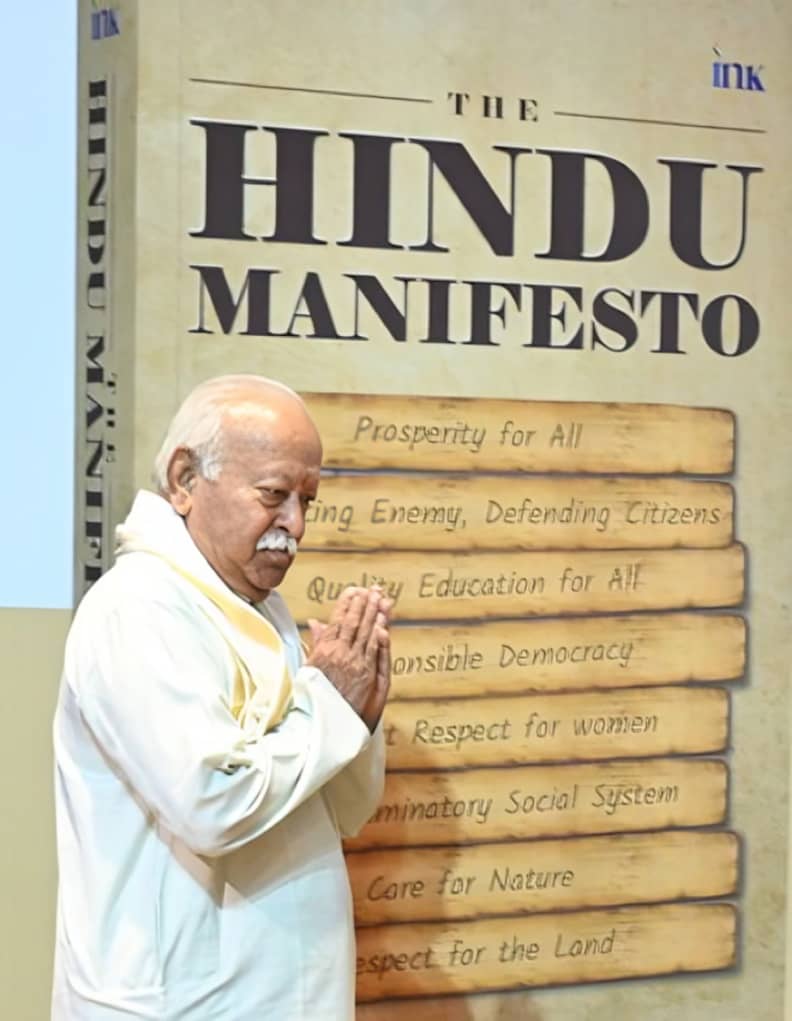
Rashtriya Swayamsevak Sangh chief Mohan Bhagwat has rejected claims that hatred forms the foundation of the organisation's activities, saying instead that its work is based on what he described as Shuddha Saatvika Prem, or pure and noble love.
Bhagwat made the remarks during a civilisational dialogue in London on Sunday as part of the RSS's international outreach programme marking its centenary. His comments focused on the organisation's understanding of social unity, belonging and the broader principles of Hindu thought.
Addressing the gathering, Bhagwat said that claims that intense hatred was the basis of RSS work were contrary to the organisation's stated philosophy. He said Shuddha Saatvika Prem was the foundation of its work and argued that this principle had remained relevant throughout the organisation's 100 year history.
Bhagwat also explained the concept of apnapan, which can be understood as a sense of belonging, oneness or emotional connection. According to him, this idea does not remain limited to an individual but extends to the family, community, society and humanity as a whole.
He said the concept also included a connection with nature. Bhagwat referred to what he described as the Hindu civilisational tradition of respecting and loving nature. He presented this connection as part of his broader explanation of how the RSS understands society and human relationships.
The RSS chief's remarks came during a period of international outreach by the organisation as it marks 100 years since its establishment. The London programme has focused on discussions around Indian civilisation, Hindu thought, social unity and the organisation's understanding of its role in society.
Bhagwat said the principle of pure and noble love has remained central to the RSS throughout its existence. He referred to a song traditionally associated with the organisation that describes pure and noble love as the foundation of its work. He argued that this principle could be seen in the conduct of its volunteers and in the atmosphere of the organisation.
During his address, Bhagwat also discussed the idea of Hindu identity and diversity. He said Hindu thought should not be understood solely through religious practices or a particular lifestyle. Instead, he emphasised what he described as a broader nature of accepting and respecting different forms of diversity.
His comments about diversity were part of a wider explanation of unity. Bhagwat has argued that unity does not necessarily require uniformity and that different traditions and viewpoints can coexist. Recent remarks at the London event similarly focused on the idea that diversity and unity can exist together.
Bhagwat's comments about Hindu Rashtra were also linked to this broader theme. According to reports from the London event, he described the purpose of the concept as communicating that diversity is natural while unity remains fundamental. He presented the idea in the context of coexistence, cooperation and social harmony.
The remarks are part of a wider international outreach effort by the RSS during its centenary year. Bhagwat has travelled to several countries as part of the programme, meeting members of the Indian diaspora and participating in discussions about Indian civilisation, Hindu philosophy, social issues and the organisation's activities.
His London visit has also attracted public debate. Some groups in the United Kingdom have criticised the RSS and opposed events associated with Bhagwat's visit. Other organisations and community representatives have welcomed his visit and highlighted the organisation's social and community activities.
The controversy surrounding the RSS reflects differing views about its ideology, political influence and role in Indian society. Supporters describe the organisation as a volunteer group focused on social service, cultural awareness, discipline and national unity. Critics have raised concerns about aspects of its ideology and its influence on political and social developments in India.
Bhagwat's latest remarks were aimed at explaining the organisation's own understanding of its philosophy. He rejected the description of the RSS as being driven by hatred and instead placed emphasis on love, belonging and unity.
The RSS chief also connected the idea of belonging with a wider understanding of humanity. According to his remarks, the relationship between individuals and society should not be viewed as separate or disconnected. Family, community, society and humanity form part of an interconnected social structure.
He further highlighted the relationship between people and nature, presenting respect for the natural environment as another element of the civilisational outlook he was describing. This formed part of his broader argument that Hindu thought encompasses social relationships as well as an understanding of the natural world.
Bhagwat's address therefore focused on the RSS's stated interpretation of its principles rather than announcing a new organisational policy. His comments sought to respond directly to criticism that hatred is central to the organisation's activities.
The remarks are likely to remain part of the wider discussion surrounding the RSS as it completes a century of existence. The organisation's international outreach has provided opportunities for its leadership to explain its philosophy and activities to audiences outside India.
At the London event, Bhagwat presented pure and noble love, belonging and respect for diversity as important elements of the organisation's stated approach. He also emphasised the idea that unity can coexist with diversity and that social relationships extend from the individual to the wider community and humanity.
The comments provide an account of how the RSS chief describes the organisation's philosophical foundation. They do not, by themselves, resolve the wider political and social debate surrounding the RSS, which continues to involve differing interpretations among supporters, critics and political observers.
Bhagwat's statement that pure and noble love forms the foundation of RSS work is therefore best understood as his description of the organisation's stated principles. The London address also placed emphasis on belonging, diversity, social unity and respect for nature as interconnected aspects of that philosophy.