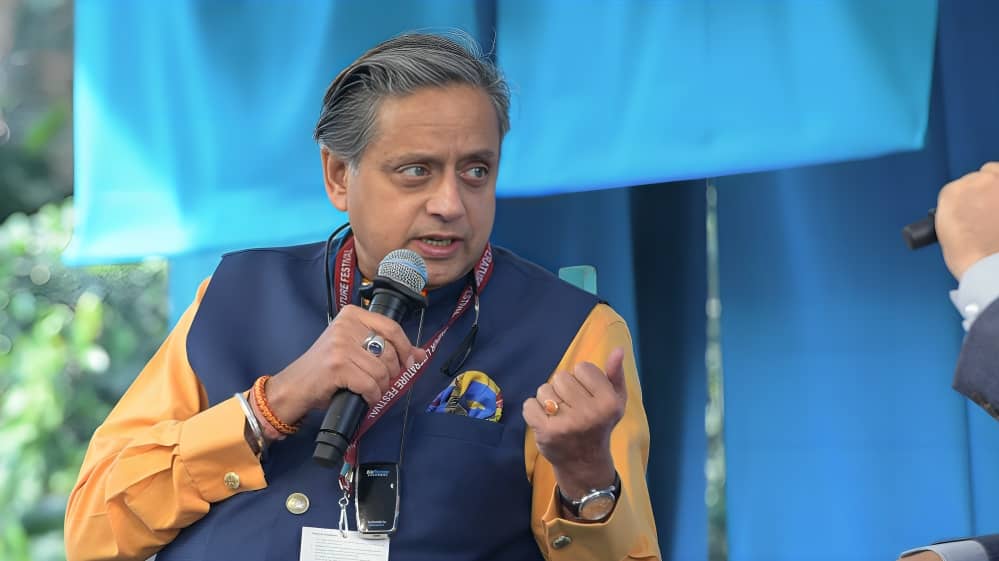
Senior Congress leader and Member of Parliament Shashi Tharoor offered a nuanced perspective on India’s first Prime Minister, Jawaharlal Nehru, while speaking at the fourth edition of the Kerala Legislative Assembly International Book Festival (KLIBF) on Thursday. Tharoor described himself as an “uncritical fan” of Nehru, praising his contributions to building modern India and laying the foundation of Indian democracy.
While expressing admiration for Nehru’s vision and leadership, Tharoor was careful to note that he does not support all of Nehru’s beliefs and policies. “Nehru was the architect of independent India’s democratic framework. At the same time, we cannot overlook mistakes made during his tenure,” Tharoor said, stressing the importance of a balanced historical assessment.
Tharoor also addressed the ongoing political discourse around Nehru’s legacy. He criticised the Bharatiya Janata Party (BJP) for portraying Nehru as a “convenient scapegoat” for India’s contemporary challenges. According to Tharoor, blaming Nehru alone for issues such as economic or governance challenges oversimplifies history and ignores the complexities of nation-building in the post-independence era.
The Congress leader argued that Nehru’s contributions to democratic institutions, education, science, and foreign policy remain foundational and should be recognised alongside any criticism of policy decisions. “We can respect Nehru’s vision while still having honest discussions about areas where outcomes could have been different,” Tharoor remarked, highlighting the need for historical perspective.
Speaking at KLIBF, Tharoor emphasised the importance of engaging with India’s past objectively. He noted that political narratives often selectively highlight historical figures’ mistakes to suit contemporary agendas. According to him, reducing Nehru’s legacy to criticisms alone diminishes the contributions of other leaders and the complexities involved in establishing democratic governance in a newly independent country.
Tharoor’s remarks also reflected on the broader conversation about India’s political discourse and how history is interpreted in contemporary debates. By calling himself an “uncritical fan,” he positioned his perspective as one of respect combined with measured critique, rather than partisan attack.
Political analysts have noted that Tharoor’s balanced approach resonates with those seeking reasoned discussions about India’s modern history, highlighting the need for careful evaluation of historical leaders without politicising their legacies.
In conclusion, Tharoor urged citizens and policymakers alike to adopt a nuanced approach when discussing historical figures, ensuring that admiration for achievements and acknowledgment of errors are both part of public dialogue. His comments reinforce the importance of informed and balanced historical discourse, especially in a politically charged environment.