

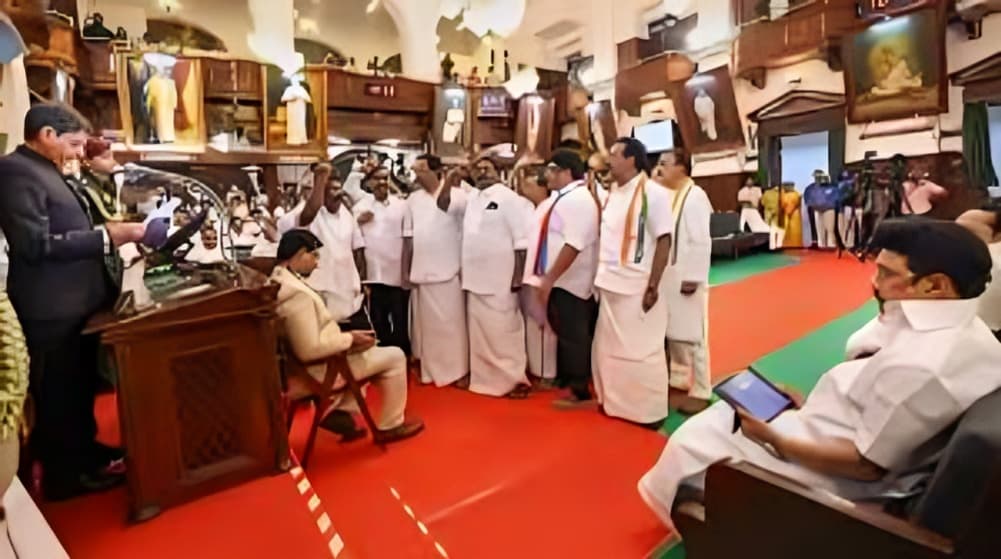
The Tamil Nadu Legislative Assembly witnessed tense scenes on Tuesday after Governor R N Ravi walked out of the House before delivering his customary inaugural address. The incident sparked strong reactions from both Raj Bhavan and members of the Assembly, highlighting ongoing friction between the state government and the Governor’s office.
According to Governor Ravi, he decided to leave the Assembly after observing what he described as a lack of respect for the national anthem. Speaking to reporters after the walkout, the Governor said he was disappointed by the proceedings and claimed that his microphone was switched off while he was attempting to speak. He also stated that interruptions during his address were unfortunate and contrary to established democratic traditions.
Inside the Assembly, the Governor’s action led to a sharp exchange between the Speaker and members present. Assembly Speaker M Appavu urged the Governor to follow the established rules, conventions, and procedures of the House. He maintained that the Assembly was functioning as per protocol and that all constitutional norms were being followed during the session.
The situation added to the already strained relationship between the Tamil Nadu government and the Governor, which has seen several disagreements in recent months over legislative and administrative matters. Opposition members and ruling party legislators expressed differing views on the incident, with some criticising the Governor’s decision to walk out, while others questioned the handling of the proceedings.
Following the incident, Raj Bhavan released an official press statement explaining the reasons behind the Governor’s walkout. The statement alleged that the Governor’s microphone was repeatedly switched off and that he was not allowed to complete his address. It further claimed that several important issues were excluded from the prepared speech presented in the Assembly.
According to the Raj Bhavan statement, the Governor was particularly concerned that issues such as atrocities against Dalits and incidents of sexual violence against Dalit women were increasing but were not adequately addressed in the speech. The statement said these omissions prompted the Governor to express his dissatisfaction and ultimately leave the House.
The state government, however, maintained that the Assembly followed due process and that the Governor’s address was conducted in line with constitutional conventions. Officials indicated that the speech reflected the policy priorities and achievements of the elected government, as is customary in legislative proceedings.
Political observers noted that the incident reflects broader tensions over the role of Governors in opposition-ruled states. Similar confrontations have been seen in other states, raising questions about constitutional boundaries, convention, and cooperation between elected governments and constitutional authorities.
As the Assembly session continued after the Governor’s departure, leaders from across the political spectrum called for calm and constructive dialogue. Analysts suggest that resolving such disputes through mutual respect and adherence to constitutional norms is essential to ensure the smooth functioning of democratic institutions.
The episode is expected to further intensify political debate in the state, with both sides likely to defend their positions in the days ahead.


