Apple and Meta Collaborate to Run Muse Spark Open AI Model on Mac Studio
Meta and Apple have collaborated to bring Muse Spark Open, a large open-weight artificial intelligence model, to Apple’s Mac Studio computers. The announcement, made on October 15, 2026, marks a notable development in AI computing, as the two technology companies have often competed over products, platforms and business strategies.
The collaboration focuses on enabling developers to run Meta’s AI model locally on powerful Mac Studio systems. Meta says the model has been optimised for Apple silicon using the company’s MLX machine-learning framework. This approach could help developers experiment with advanced AI capabilities directly on their own hardware instead of depending entirely on cloud-based services.
What Is Muse Spark Open?
Muse Spark Open is an open-weight AI model released by Meta. The company describes it as a model designed for software development, complex reasoning and agentic tasks, which involve an AI system carrying out a sequence of steps to achieve a goal.
According to Meta, Muse Spark Open has 816 billion total parameters, of which 42 billion are active, and a context window of one million tokens. Parameters are numerical values used by an AI model to process information and generate outputs. A context window determines how much information a model can consider during a task.
The model is designed to support extended tasks, complex software engineering and multi-step reasoning. These capabilities could help developers work on code, investigate technical problems and build applications that use AI to complete more involved workflows.
The term “open-weight” means that the model’s trained weights are made available for others to download and use under the conditions of its licence. It does not necessarily mean that every part of the model’s training data, development process or infrastructure is open source.
How Apple Mac Studio Supports the Model
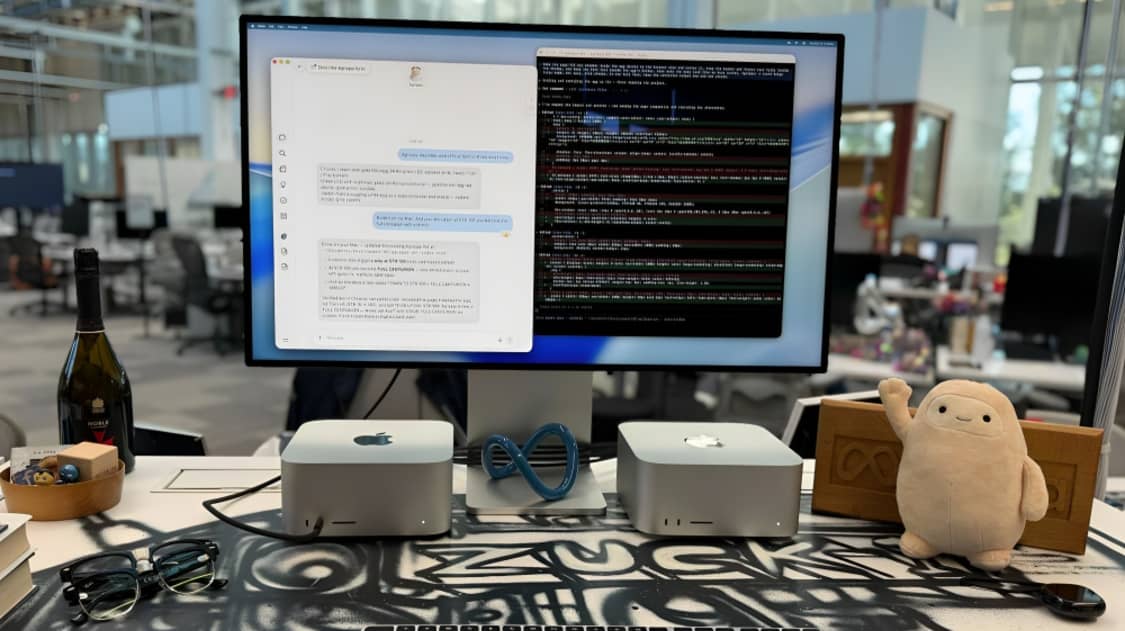
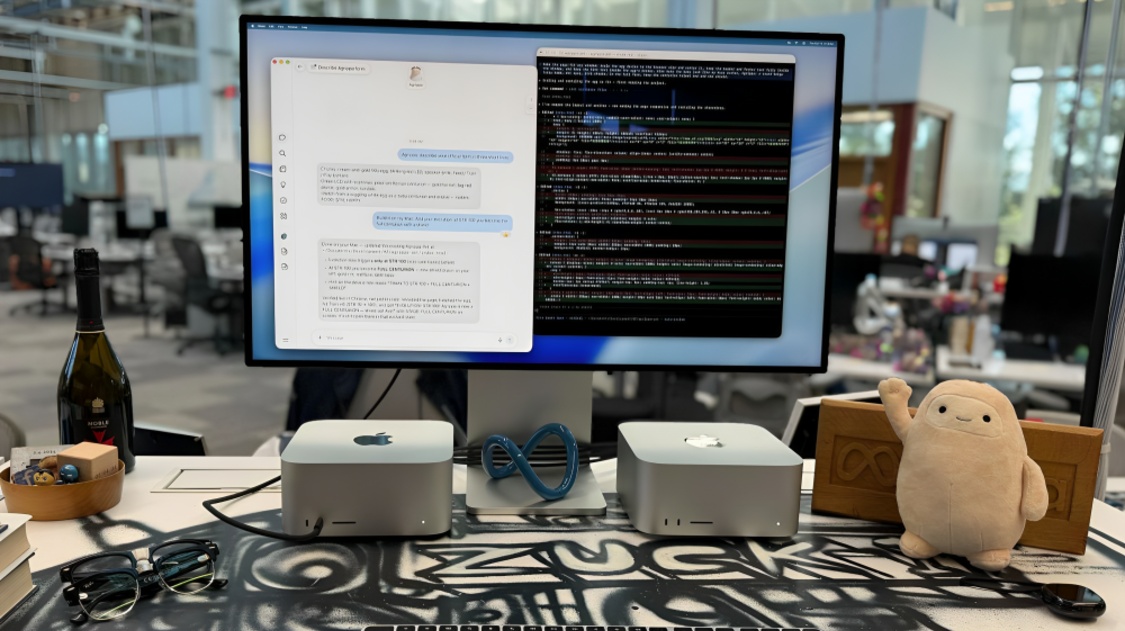
Running a model of this size requires substantial memory and computing resources. Meta says Muse Spark Open can run locally across two connected Mac Studio computers equipped with M5 Ultra chips and up to 512GB of unified memory each.
In this configuration, the two computers provide a combined memory capacity of up to one terabyte. The model is distributed across the connected machines rather than being loaded entirely into the memory of a single computer. Meta also describes configurations using four Mac Studios with 256GB of unified memory each.
Apple’s MLX framework is central to this setup. MLX is designed for machine-learning work on Apple silicon and takes advantage of the unified memory architecture used by Apple’s processors. Meta has worked to optimise Muse Spark Open for this framework so that developers can run the model across connected systems.
The setup is intended for advanced development and research rather than ordinary consumer use. It requires compatible hardware, supported software and the appropriate connections between computers. As a result, the model’s local operation does not mean that it can run efficiently on every Mac or on a standard laptop.
Why the Collaboration Matters
Apple and Meta have historically been competitors in several areas of technology, including digital platforms, privacy policies, advertising and consumer services. Their work on Muse Spark Open shows how companies with different commercial interests can still cooperate when they share a technical goal.
Meta benefits from demonstrating that its model can run on powerful desktop hardware, while Apple’s computing platform gains another high-profile use case for its machine-learning technology. The collaboration could also encourage developers to explore local AI systems for applications that require greater control over their computing environment.
Running an AI model locally may offer advantages in some situations, including reduced reliance on remote inference services and more direct control over where processing takes place. However, local execution does not automatically guarantee privacy or security. Those outcomes also depend on the software, configuration, data handling practices and connections used by the application.
Potential Uses for Developers
Muse Spark Open is intended for coding and agentic work. Developers may use it to experiment with code generation, software debugging, multi-step workflows and applications that combine several AI capabilities.
Meta has also described demonstrations involving software development and video editing workflows. These examples illustrate how an AI model can be used not only to generate text but also to assist with tasks that involve interacting with software and processing visual information.
The model’s large context window could be useful for work involving lengthy documents, extensive codebases or multiple pieces of reference material. Actual performance will depend on the task, system configuration and the way the model is deployed.
Availability, Licensing and Considerations
Meta has released Muse Spark Open’s model weights through platforms including Hugging Face, Amazon SageMaker AI, Google Cloud Model Garden and Microsoft Foundry Models. The company also lists hosted inference providers for users who prefer not to operate the model on their own hardware.
The model is released under Meta’s Muse Model License, which includes conditions on commercial use. Developers and organisations should review the licence before integrating the model into commercial products or services.
The hardware requirements are also important. Running a model with hundreds of billions of parameters locally requires a high-end setup and can involve significant costs. Developers should assess memory capacity, performance, electricity use and deployment needs before investing in the required equipment.
Overall, the Meta and Apple collaboration highlights a growing effort to make advanced AI models available beyond conventional cloud infrastructure. By combining Meta’s open-weight model with Apple’s MLX framework and high-memory Mac Studio systems, the companies are giving developers another way to experiment with powerful AI tools locally. The practical impact will depend on performance, cost, licensing and how developers adopt the technology.