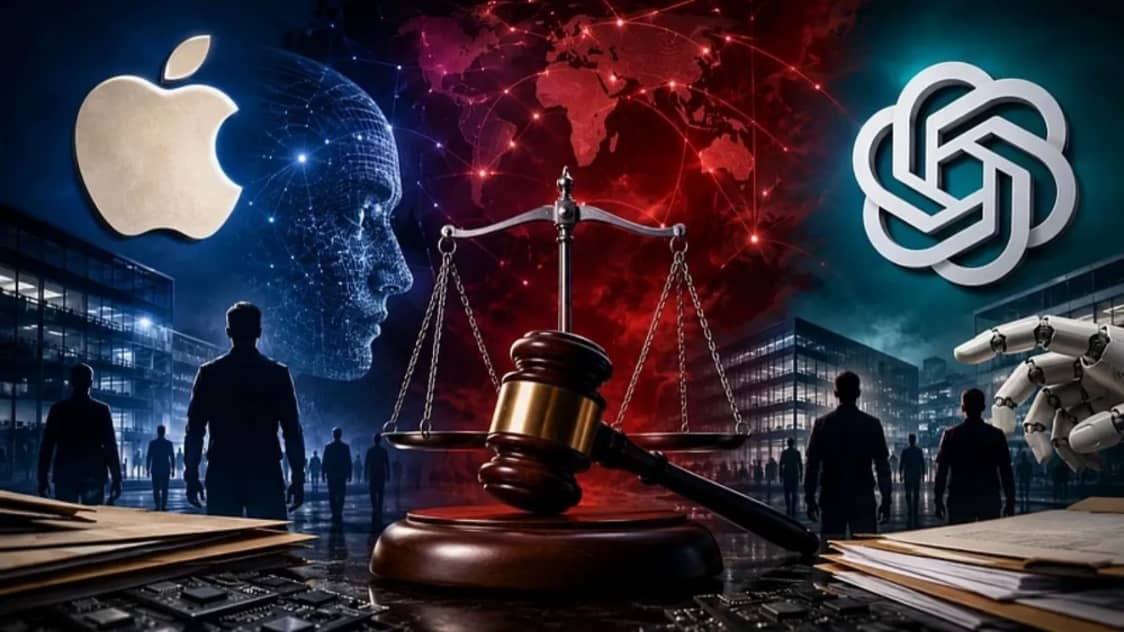
Apple and OpenAI are facing an escalating legal dispute over allegations involving confidential information and trade secrets, with Apple now asking a US federal court to reject OpenAI’s attempt to have the case dismissed.
Apple filed the lawsuit in July in the US District Court for the Northern District of California. The case names OpenAI, its hardware subsidiary io Products and two former Apple employees who later joined OpenAI. Apple alleges that confidential information relating to its hardware development was improperly accessed or sought during recruitment and after employees moved to OpenAI.
OpenAI responded earlier this month by filing a motion seeking dismissal of the lawsuit. The company argued that Apple had failed to identify specific information that qualifies as a legally protected trade secret. OpenAI also disputed Apple's description of events involving the former employees and argued that the lawsuit did not establish a plausible case of trade secret misappropriation.
Apple has now filed its response, asking the court to allow the case to proceed.
Apple Challenges OpenAI's Arguments
In its latest filing, Apple argued that OpenAI's request relies on what Apple describes as speculation, distortion and evidence that should not be considered at the dismissal stage.
Apple maintains that the allegations in its original complaint raise factual questions that should be examined through the discovery process rather than decided immediately in OpenAI's favour.
Apple has also argued that revealing highly specific details about its alleged trade secrets in a public court filing could undermine the very protections it is seeking from the court.
The company therefore wants the litigation to continue so that evidence can be examined under the appropriate legal procedures.
Allegations Involving Former Apple Employees
The lawsuit focuses partly on two former Apple employees who joined OpenAI.
Apple has alleged that former engineer Chang Liu accessed confidential Apple files after leaving the company. According to Apple's allegations, Liu exploited an authentication issue and downloaded confidential engineering information, including material relating to manufacturing and testing hardware components.
Apple has also raised allegations concerning Tang Yew Tan, a former Apple executive who later became involved with OpenAI's hardware efforts.
Apple claims Tan used knowledge of Apple's internal project names during recruitment discussions and asked an Apple employee to bring hardware components to OpenAI for a presentation or demonstration. Apple says the components included items such as batteries, system on chips and logic boards.
These are allegations made by Apple and have not been established as facts by a court.
OpenAI's Defence
OpenAI has strongly disputed Apple's claims.
In its motion to dismiss, OpenAI argued that it has no need or desire for Apple's trade secrets because it is developing new technology for its own consumer hardware ambitions.
The company also challenged Apple's description of the former employees' actions. OpenAI argued that Apple's own information management and employee offboarding practices created circumstances in which former employees could retain access to certain information.
OpenAI has also argued that Apple has described broad categories such as hardware engineering, manufacturing and supply chain operations rather than clearly identifying specific trade secrets protected by law.
The company has therefore asked the judge to dismiss the lawsuit at an early stage.
Growing Competition in AI Hardware
The legal dispute comes as Apple and OpenAI increasingly compete in the rapidly developing AI hardware market.
OpenAI has been expanding beyond its traditional software and artificial intelligence products and is developing consumer hardware. The company's hardware activities are closely associated with io Products, which was integrated into OpenAI in 2025.
Apple, meanwhile, is developing its own artificial intelligence strategy and continues to have a major presence in consumer electronics.
The movement of experienced employees between major technology companies has become an increasingly important issue as businesses compete for engineers, designers and researchers.
Apple's lawsuit alleges that OpenAI's recruitment activities went beyond ordinary competition for employees. OpenAI rejects that characterization.
What Happens Next
The court must first determine whether Apple's lawsuit meets the legal requirements to continue.
If the judge rejects OpenAI's dismissal request, the case could move into a more detailed discovery phase. That process could involve the exchange of documents, depositions and other evidence concerning recruitment, employee departures, information security and hardware development.
Apple has separately sought expedited discovery and a preliminary injunction related to its allegations. A hearing on the company's preliminary injunction request is scheduled for October 1, according to reports on the case.
The outcome of those proceedings could determine how quickly the broader dispute develops.
Partnership Continues Despite Legal Dispute
The legal battle is notable because Apple and OpenAI have also maintained a business relationship.
Apple has integrated ChatGPT into parts of its ecosystem, allowing users to access OpenAI's technology through supported Apple features. The companies' continuing commercial relationship contrasts with the growing legal dispute over OpenAI's hardware ambitions and Apple's confidential information.
The lawsuit therefore represents a complicated relationship between two companies that cooperate in some areas while potentially competing more directly in others.
Broader Impact on the Technology Industry
The case could have implications beyond Apple and OpenAI.
Trade secret disputes involving technology companies often highlight the challenges businesses face when employees move between competitors. Companies must protect confidential information while also allowing employees to change jobs and use their general skills and experience in new workplaces.
The court's handling of the case could provide further guidance on how allegations involving employee recruitment, confidential information and emerging technology should be evaluated.
For now, no final determination has been made on whether OpenAI or the former employees misappropriated Apple's trade secrets. The allegations remain part of ongoing litigation.
Key Details
Companies involved: Apple and OpenAI
Case filed: July 2026
Court: US District Court for the Northern District of California
Main issue: Alleged misappropriation of Apple's confidential information and trade secrets
OpenAI's position: Apple has not adequately identified protected trade secrets or established a plausible misappropriation claim
Apple's position: The case should proceed so the factual allegations can be examined through the legal discovery process
Next major hearing: October 1, 2026