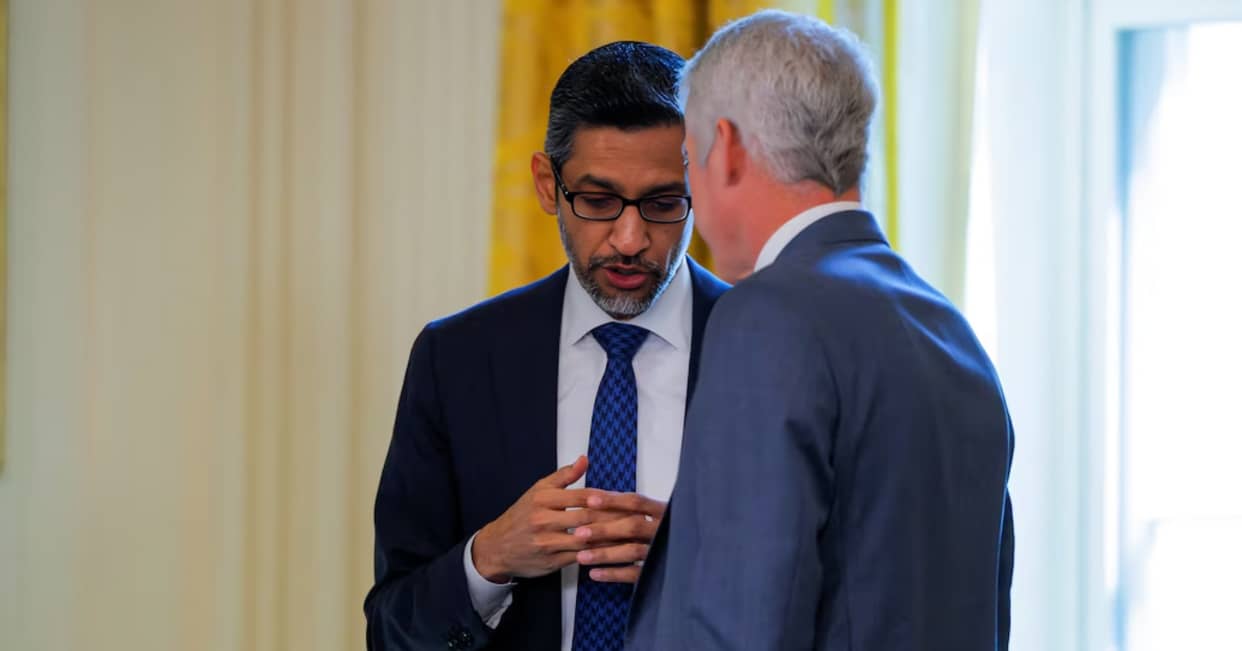
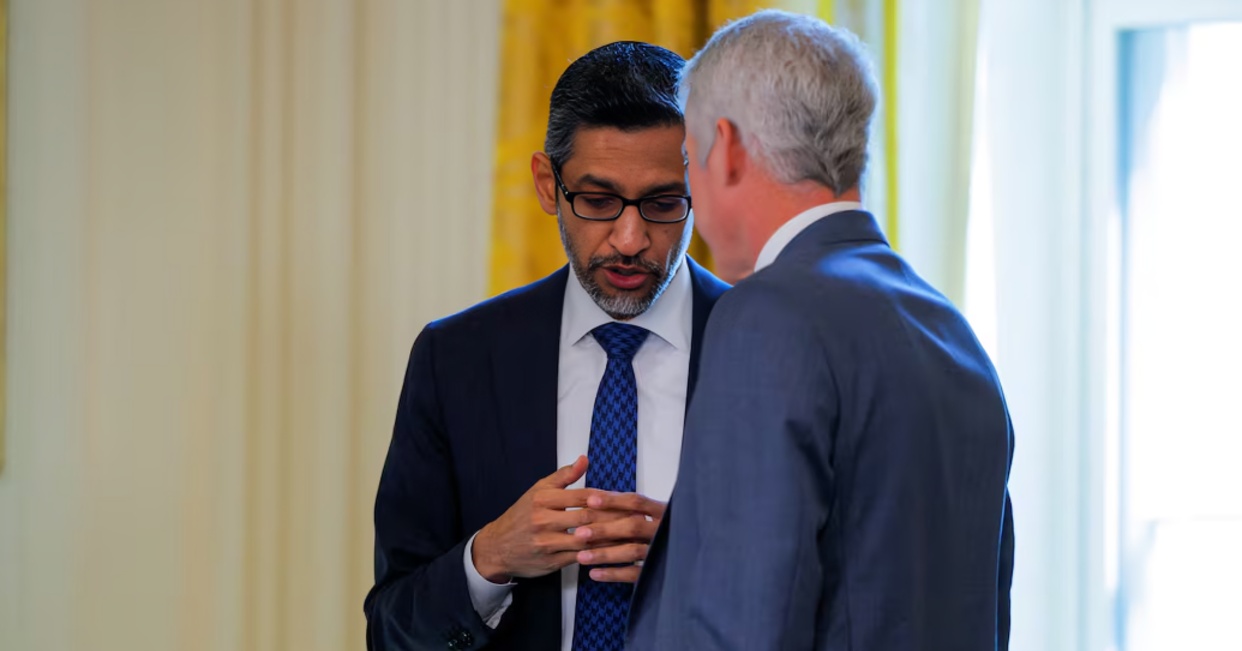
US President Donald Trump drew attention during a White House meeting with leading technology executives after making unusual and lighthearted comments about Google CEO Sundar Pichai and Anthropic CEO Dario Amodei.
The remarks came on September 29, 2026, when Trump met senior executives from some of the world's largest technology and artificial intelligence companies. The meeting focused primarily on the development and safety of increasingly powerful AI systems, but informal exchanges between Trump and the executives also attracted considerable attention.
During an interaction with reporters outside the White House, Trump invited Sundar Pichai to speak. Before Pichai could complete his opening remarks, Trump interrupted and introduced him in an unusual way.
Trump described Pichai as a “monster” and said that people outside the technology industry did not necessarily know who he was. Trump then praised the position of technology leaders and suggested that they did not have to deal with the press in the same way that political figures do.
Pichai appeared to take the remark in good humour. Responding to Trump, the Google CEO joked that he hoped the phrase would become a better tagline than “I am a monster.” The exchange drew laughter and attention because of the unusual wording used by the US president.
Trump subsequently reminded reporters of Pichai's name, repeating “Sundar” while continuing his comments about the Google chief. The interaction was widely reported as a humorous exchange rather than a formal criticism of Pichai.
Trump also had a brief exchange with Anthropic CEO Dario Amodei. After bringing Amodei into the interaction, Trump made a reference to the Anthropic chief's comments about artificial intelligence before telling him to “be careful.”
Amodei laughed at the comment and then spoke about the importance of the United States maintaining leadership in artificial intelligence. He also stressed the need for technology companies and policymakers to work together so that AI development can proceed safely.
Amodei has previously spoken publicly about potential risks associated with increasingly capable AI systems. His warnings about possible long-term risks have made him a prominent voice in the debate over AI safety. His company, Anthropic, has also been involved in discussions with US policymakers about AI regulation and safety.
The exchanges involving Pichai and Amodei took place against the backdrop of a much more substantive White House discussion about AI governance.
Executives from Google, Anthropic, OpenAI, Meta and Nvidia were among those who attended the meeting. The participants included Google CEO Sundar Pichai, Anthropic CEO Dario Amodei, Meta CEO Mark Zuckerberg, Nvidia CEO Jensen Huang and OpenAI President Greg Brockman. Elon Musk was also among the technology figures associated with the gathering.
The White House meeting resulted in a voluntary agreement concerning the development and oversight of advanced AI systems. Trump described the agreement as “morally binding,” while the participating companies agreed to adopt several voluntary measures.
According to the agreement released after the meeting, companies agreed to establish internal controls and work with independent auditors to assess whether their AI systems operate as intended. The agreement also addresses the need to prevent AI systems from accessing or interfering with technical systems in unintended ways.
The agreement is significant because AI companies are increasingly developing systems capable of using tools, accessing computer environments and performing complex tasks with limited direct human intervention. Such capabilities have raised questions about cybersecurity, misuse, oversight and accountability.
The White House initiative does not amount to a comprehensive federal AI law. Instead, it represents a voluntary framework in which participating companies commit to certain safety and oversight principles.
Trump also indicated that his administration could consider additional structures for AI oversight. Reuters reported that he discussed the possibility of creating a 10-member board to oversee AI safety, although no final membership details were announced at the time.
The meeting also reflected the Trump administration's broader focus on maintaining US leadership in advanced artificial intelligence. Trump has repeatedly emphasized the importance of developing AI infrastructure in the United States and supporting investment in data centres and computing capacity.
The discussion therefore involved a balance between technological development and safety concerns. Technology companies have been investing heavily in AI infrastructure, while policymakers and communities have raised questions about energy use, data centres, cybersecurity and the potential social impact of increasingly capable AI systems.
The White House event also came at a time when technology companies are competing to develop what the administration has referred to as “Super Intelligence.” Trump directed government agencies to use the term “super intelligence” rather than “artificial intelligence” in certain official communications, according to reporting on the meeting.
The informal comments about Pichai and Amodei therefore took place alongside discussions with significant implications for the technology industry. While the “monster” comment became one of the most widely shared moments from the event, the central purpose of the meeting was the future development, regulation and oversight of advanced AI.
For Pichai, the exchange also highlighted his role among the executives leading major technology companies involved in the AI race. Google has invested heavily in artificial intelligence through its Gemini models, cloud infrastructure and AI research. The company is competing with Microsoft-backed OpenAI, Anthropic and other technology firms in the rapidly developing AI market.
Amodei's participation was also notable because Anthropic has taken a strong public position on AI safety. The company has argued for safeguards around advanced AI systems while simultaneously developing increasingly capable models for business and consumer applications.
The interaction between Trump and Amodei appeared to remain friendly, with Amodei laughing at the president's “be careful” remark and then emphasizing cooperation on AI development. The exchange did not represent a formal warning or regulatory action against Anthropic.
Similarly, Trump's description of Pichai as a “monster” was reported in the context of a humorous introduction. Pichai responded with a joke rather than treating the remark as an accusation or criticism. Reports from the event indicate that Trump was referring to Pichai's stature and success in the technology industry rather than using the word as a literal description.
The White House meeting illustrates the increasingly close interaction between government officials and technology companies as AI becomes an important economic and national policy issue. Companies developing advanced models are now involved in discussions about safety standards, infrastructure, regulation and national competitiveness.
For now, the AI agreement announced by Trump remains voluntary. The companies have committed to internal safeguards and independent assessments, but the agreement does not replace existing laws or create a comprehensive statutory regulatory system.
The next stage of the US AI policy debate is likely to involve questions about how voluntary commitments should interact with federal regulation. The White House has indicated that further policy measures may follow, while technology companies continue to develop more capable AI systems.
The unusual exchanges with Pichai and Amodei provided a lighter moment during a meeting centred on serious technology policy issues. Trump's “monster” comment toward Pichai and his “be careful” remark to Amodei quickly became notable moments from the event, while the broader meeting produced a voluntary framework for AI safety and oversight.