
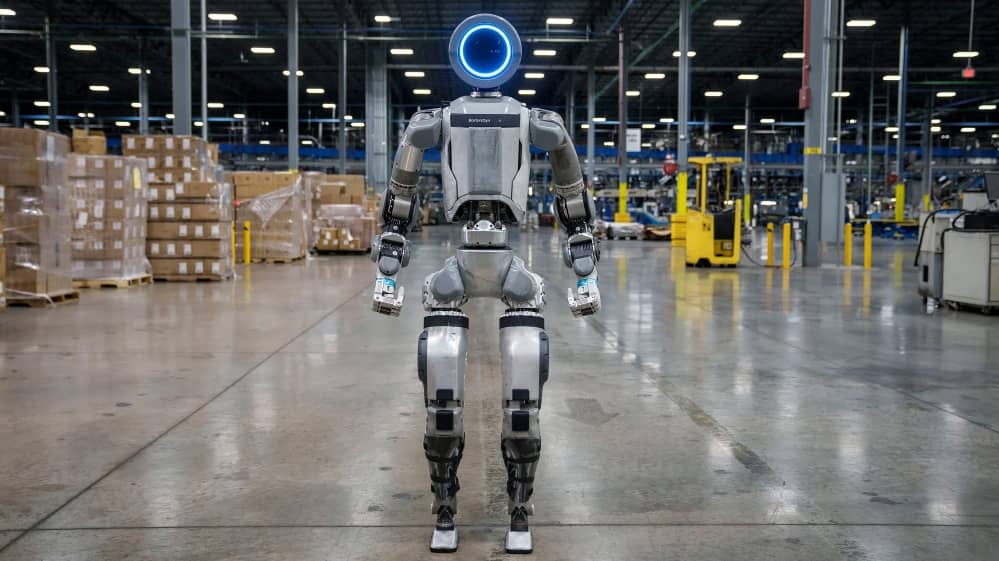

Google and Boston Dynamics have announced a major collaboration to integrate Google DeepMind’s Gemini AI into humanoid robots, signaling a new era in robotics and artificial intelligence. The initiative focuses on the Atlas humanoid robot, a model widely regarded for its mobility, balance, and agility. The partnership aims to shift humanoid robots from performing staged demonstrations to functioning as capable, intelligent machines that can operate in industrial and practical environments.
The Atlas robot has long been known for its advanced locomotion abilities, including running, jumping, and navigating complex terrain. However, while Boston Dynamics has perfected the physical aspects of humanoid robotics, AI integration has remained a limiting factor in enabling autonomous decision making. With Gemini AI, these robots are expected to achieve a higher level of cognitive function, including object recognition, environment understanding, and complex task execution.
Google DeepMind’s Gemini AI leverages cutting edge natural language processing and machine learning techniques, allowing robots to understand commands, interpret context, and adapt to changing conditions. By embedding Gemini into Atlas, the robots can interact with their surroundings intelligently, collaborate with human operators, and potentially perform repetitive or hazardous industrial tasks with precision.
Industry analysts suggest that this collaboration could be transformative for multiple sectors. In manufacturing and warehousing, humanoid robots could handle assembly, packaging, and logistics more efficiently, reducing workplace risk and improving productivity. In healthcare, advanced humanoid robots could assist in patient care, rehabilitation, or hazardous material handling, while also providing assistance in research laboratories where repetitive or precise work is needed.
The integration also has implications for AI research. By combining physical robotics with advanced cognitive AI, Google and Boston Dynamics can study how AI systems interact with dynamic real world environments. The collaboration could accelerate advancements in robotics learning, autonomous decision making, and human machine collaboration.
While public demonstrations of Atlas robots have historically focused on agility stunts and choreographed performances, Gemini integration is expected to make the robots truly functional and operational in practical scenarios. This could be a step toward humanoid robots that can assist humans in daily tasks or industrial applications without constant supervision.
Challenges remain, including ensuring safety, energy efficiency, and ethical use. Humanoid robots with advanced AI must operate reliably in environments shared with humans, requiring strict adherence to safety standards. Google and Boston Dynamics have emphasized that research and testing will continue to prioritize responsible deployment.
The collaboration is part of a broader trend in the robotics industry, where AI integration is key to making robots commercially viable. By combining Google’s AI expertise with Boston Dynamics’ robotics engineering, the project positions both companies at the forefront of the next generation of intelligent machines.
In summary, the partnership between Google and Boston Dynamics to bring Gemini AI to Atlas humanoid robots represents a significant step toward practical, intelligent robots that can operate safely and efficiently alongside humans. Experts predict that we may soon witness these humanoid robots performing real world tasks in industries ranging from manufacturing to healthcare, marking a milestone in AI and robotics innovation.


