
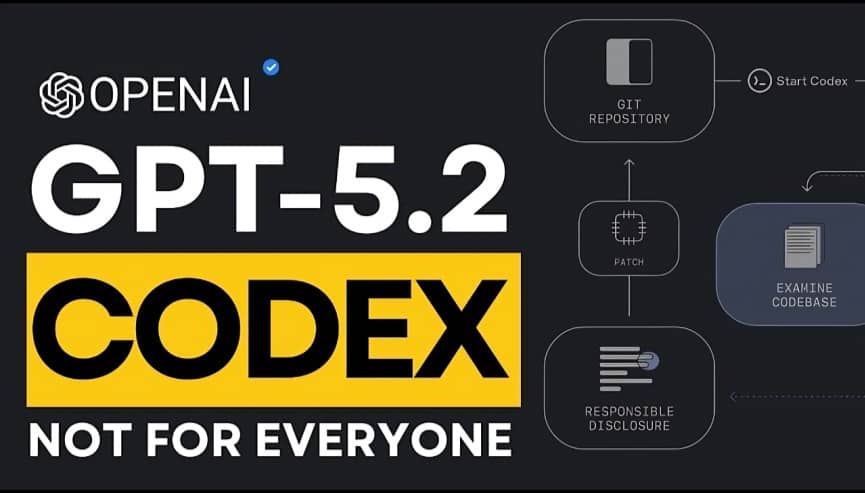

OpenAI has announced the official launch of GPT 5.2 Codex, its most powerful programming focused artificial intelligence model so far, while simultaneously opening API access to developers worldwide. The new release represents a major advancement in OpenAI’s efforts to move AI systems beyond simple code completion tools into autonomous engineering agents capable of managing complex development workflows.
GPT 5.2 Codex is built on the GPT 5.2 model family and has been extensively optimized for long running and high complexity software tasks. According to OpenAI, the model is designed to understand and work with massive codebases over extended periods, making it suitable for real world engineering projects rather than short, isolated coding queries.
Compared to earlier versions, GPT 5.2 Codex demonstrates significant improvements in long term task reliability and consistency. The model is capable of building new software features, refactoring legacy code, performing large scale architectural changes, and identifying deeply embedded bugs or vulnerabilities. These capabilities allow it to function more like an engineering assistant that can plan, execute, and verify tasks rather than simply generating code snippets.
Security has been a major focus of the new model. OpenAI has described GPT 5.2 Codex as its most secure programming model to date in terms of network and application security awareness. The model is trained to detect risky patterns, insecure dependencies, and potential attack vectors within codebases, helping developers identify and mitigate threats earlier in the development lifecycle.
The model has already been integrated into several mainstream development platforms, including Cursor, GitHub based workflows, and Windsurf. This early adoption highlights strong industry interest in agent style AI systems that can support full cycle software development, from design to deployment and maintenance.
Independent stress testing by third party teams has demonstrated the model’s ability to handle unusually long and complex tasks. In one reported test, GPT 5.2 Codex was able to work continuously for nearly a week to build a complete web browser from scratch. The project reportedly included a custom rendering engine and a virtual machine, with a final codebase exceeding three million lines. OpenAI noted that the model maintained task coherence and stability throughout the process, a key challenge for earlier AI systems.
The launch of GPT 5.2 Codex signals a broader shift in how AI is expected to assist developers. Rather than serving only as a productivity enhancer, OpenAI aims to position the model as a collaborative engineering agent that can take ownership of well defined development tasks under human supervision.
With API access now available, developers and enterprises can begin integrating GPT 5.2 Codex into their own tools and workflows. Industry observers believe the release could significantly influence software development practices, particularly for large scale and long term projects requiring continuous reasoning and execution.


