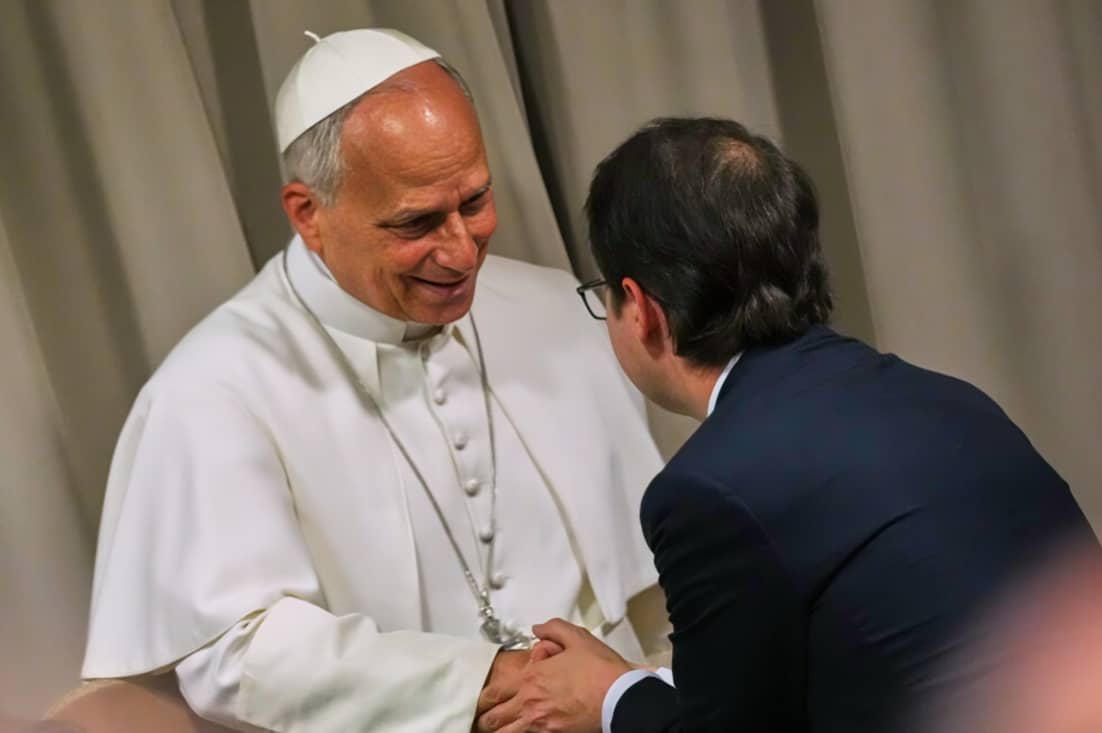
Pope Leo XIV has intensified his message on the responsible development and use of artificial intelligence, calling for technology to remain centred on human beings rather than becoming a substitute for human judgment or a rival to humanity.
Speaking to participants of the International Catholic Legislators Network in Rome on August 21, 2026, the Pope said the rapid development of artificial intelligence raises important questions about how technology should be governed and used. He argued that technological progress must be accompanied by wisdom, conscience and concern for the common good.
The Pope's remarks come as governments, technology companies and policymakers around the world continue to debate the social and economic consequences of increasingly capable AI systems.
AI Should Serve the Common Good
Pope Leo XIV said artificial intelligence should not diminish humanity. Instead, he argued that human intelligence should be guided by wisdom, political authority by conscience and technological innovation by charity.
His central message was that AI should become a tool that serves the common good rather than a system that competes with human beings.
The Pope's position reflects his broader emphasis on placing human dignity at the centre of technological development. He has repeatedly called for AI systems to be developed and deployed responsibly, particularly when they influence decisions affecting people's lives.
Concerns Over Jobs and Human Dignity
One of the major concerns surrounding AI is its potential effect on employment. As businesses increasingly adopt automation and AI based systems, questions have emerged about how technology could change the nature of work and affect workers in different industries.
Pope Leo XIV has argued that technological progress should not be measured only by efficiency or economic output. It should also be evaluated according to whether it improves people's lives and protects their dignity.
In his first encyclical, Magnifica Humanitas, the Pope discussed the broader social consequences of AI and warned against allowing automated systems to make important decisions without adequate human responsibility and oversight.
The encyclical highlights employment, access to public services, credit and reputation as areas where automated decision making can have significant consequences for individuals.
Human Intelligence Remains Central
Pope Leo XIV has emphasised that artificial intelligence should not be treated as equivalent to human intelligence.
In his encyclical, he noted that current AI systems can process information at extraordinary speed and offer important benefits, but they do not possess human experiences, relationships, emotions or responsibility in the same way people do.
This distinction is central to his argument that humans must retain responsibility for important decisions involving AI.
The Pope has therefore called for systems in which responsibility is clearly assigned to developers, users and institutions that rely on AI generated decisions.
Call for Stronger Oversight
The Pope has also supported stronger governance of artificial intelligence.
In his recent address, he called on legislators to establish appropriate oversight mechanisms so that technological development remains aligned with the common good. His message comes at a time when governments are working on regulations covering areas such as data protection, automated decision making, employment and AI safety.
His encyclical similarly argues that responsibility and accountability must be maintained throughout the AI development and deployment process.
According to the document, people should be able to identify who is responsible for decisions made with the assistance of AI, question those decisions and seek remedies when technology causes harm.
Warning About Concentration of Power
The Pope has also raised concerns about the concentration of technological and economic power.
In recent remarks, he warned that rapid advances in AI could increase dependence on powerful countries and technology companies. He linked this concern to the possibility of new forms of economic or technological inequality.
His broader concern is that technological progress should benefit people across society rather than concentrating power and resources in the hands of a limited number of organisations.
AI and the Future of Work
The impact of AI on employment remains one of the most closely watched aspects of the technology debate.
AI systems are increasingly being used for tasks involving writing, data analysis, customer service, software development, research and other professional activities. While the technology can improve productivity and create new opportunities, it can also alter existing jobs and require workers to develop new skills.
Pope Leo XIV's position is that technological development should be accompanied by policies that protect workers and ensure that economic progress remains connected to human welfare.
His concerns therefore extend beyond whether AI can perform particular tasks. The larger question is how societies should use technology while preserving meaningful work, human relationships and individual dignity.
Privacy and Automated Decisions
Another issue highlighted by Pope Leo XIV is the use of AI in sensitive decisions.
AI systems can increasingly process large quantities of personal information and influence decisions relating to employment, financial services, healthcare and public services.
The Pope's encyclical warns that delegating important decisions entirely to automated systems can create risks because algorithms may reproduce existing biases or operate in ways that are difficult for ordinary users to understand.
He has therefore stressed the importance of transparency, accountability and human supervision.
Technology and Human Responsibility
Pope Leo XIV's message does not reject artificial intelligence or technological progress. Instead, he has argued that AI should be developed with appropriate safeguards and directed towards goals that benefit humanity.
His encyclical describes technological innovation as an opportunity that can alleviate suffering and create new possibilities. At the same time, it warns that technological power without adequate moral and social responsibility can create new forms of inequality and exclusion.
The Pope has called for developers to consider the values embedded in their technological designs and to take responsibility for the effects their systems may have on communities.
Global Debate Over AI Continues
Pope Leo XIV's comments add a significant religious and ethical perspective to the international debate surrounding artificial intelligence.
Governments are considering new rules for AI, while businesses are investing heavily in the technology and workers are adapting to changing employment patterns. Researchers and civil society organisations are also debating questions involving privacy, misinformation, safety and accountability.
Against this background, the Pope's central argument is that technological capability alone should not determine how AI is used.
Instead, societies should ask whether a particular application of AI protects human dignity, supports the common good and makes human life better.