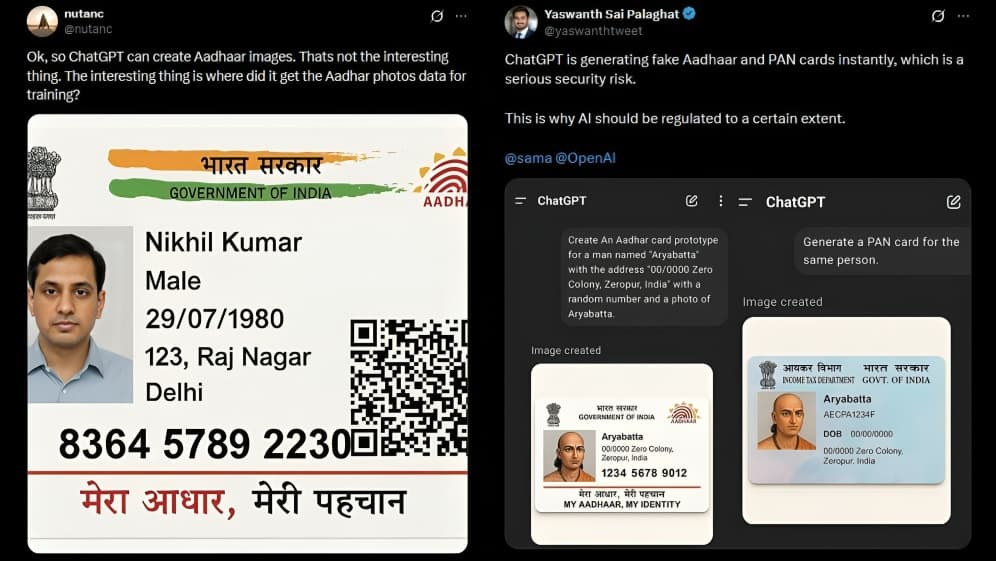
A new online threat has emerged with the rise of a tool referred to as Google Nano Banana Pro, which is reportedly being used by cybercriminals to produce fake Aadhaar cards, PAN cards and other critical identity documents. Though the name misleadingly suggests association with Google, the company has no connection to the tool. According to cybersecurity researchers, the software is being circulated through encrypted messaging groups, third party websites and social media channels, attracting users with the promise of generating realistic looking identity cards within minutes.
Experts warn that the tool appears to rely on advanced AI algorithms capable of modifying photographs, creating unique ID numbers and embedding forged details into official looking document templates. This has raised concerns among digital safety experts, as misuse of identity documents can facilitate financial fraud, impersonation, SIM card misuse and fraudulent access to welfare schemes. The increasing availability of such tools also highlights the broader challenge of AI driven forgery and identity manipulation in the digital era.
Authorities have emphasised that Aadhaar and PAN cards generated through unofficial platforms are not legally valid. The Unique Identification Authority of India and the Income Tax Department have already issued advisories urging citizens to download their official documents only from authorised platforms such as the UIDAI website, mAadhaar app or the income tax portal. Any attempt to use a forged identity card is a punishable offence under Indian law, and action may be taken against individuals who knowingly or unknowingly participate in such practices.
Cybercrime units across multiple states have begun monitoring the spread of the so called Google Nano Banana Pro tool. Initial investigations suggest that the creators may be operating from outside India, making the programme available to users in exchange for payments or referrals. Law enforcement agencies are also analysing whether the tool uses data scraping techniques that could expose personal information or store images uploaded by unsuspecting users, creating an additional layer of risk.
Cybersecurity specialists recommend that users remain alert to websites that ask for photographs, mobile numbers or identity details without proper verification. Many of these platforms may also install harmful files that compromise devices, steal login information or gain access to banking apps. Users are advised to maintain strong passwords, enable two factor authentication and avoid interacting with suspicious links or applications.
Digital safety educators have also highlighted the importance of public awareness, especially among students and young people who may be tempted to try such tools without understanding the legal consequences. Creating or sharing a forged ID is a serious offence and can lead to strict penalties under the Information Technology Act and other relevant laws.
The rising misuse of AI generated tools underscores the need for stronger public education on cybersecurity and digital verification. As technology evolves, experts believe that governments, tech companies and users must work together to counter online fraud and ensure the safe use of digital identity systems.