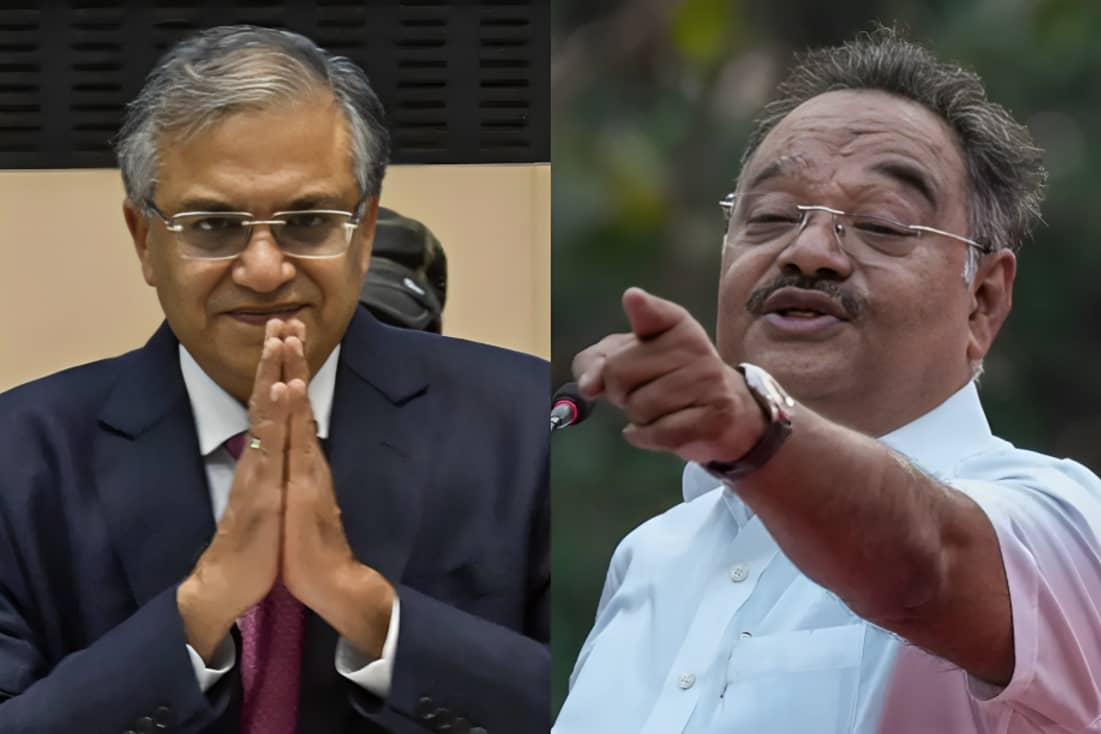
West Bengal BJP president Samik Bhattacharya has come out in support of Chief Election Commissioner Gyanesh Kumar amid the ongoing political controversy surrounding the Election Commission and the Special Intensive Revision of electoral rolls.
Speaking to reporters in North 24 Parganas on Friday, Bhattacharya said Kumar deserved at least the Padma Bhushan for the way the Election Commission handled the West Bengal Assembly election and the voter list revision exercise. The Padma Bhushan is India’s third highest civilian award.
Bhattacharya praised the conduct of the Assembly election and said voters were able to cast their ballots without intimidation. He also credited the Special Intensive Revision, commonly known as SIR, with changes to the electoral rolls.
According to reports, the BJP leader said that West Bengal had rarely witnessed an election of this nature and expressed appreciation for the Election Commission’s handling of the process. He specifically credited Gyanesh Kumar with the work carried out during the electoral roll revision.
Bhattacharya also made claims regarding the removal of names from the voter lists. He said the SIR exercise had helped address names that he described as belonging to illegal Bangladeshi immigrants. These are political claims made by the BJP leader and should not be treated as an independently established finding without supporting official evidence.
The comments came at a time when the Election Commission is facing increased political scrutiny over its functioning and the implementation of SIR. Opposition parties have demanded action against CEC Gyanesh Kumar following reports that Election Commissioners Sukhbir Singh Sandhu and Vivek Joshi had raised objections to several decisions and procedures connected with electoral rolls.
The Indian Express reported that the two Election Commissioners had raised written objections or concerns on multiple occasions over a period of several months. The reports have since become a major part of the political debate surrounding the functioning of the three member Election Commission.
The Election Commission, however, has maintained that differences of opinion and written observations are part of internal deliberations within a multi member constitutional body. The poll panel has also said that final decisions concerning the Special Intensive Revision were taken unanimously.
This distinction has become central to the current political dispute. Opposition parties have cited the reported objections as grounds for questioning the functioning of the Election Commission, while the BJP and the Election Commission have rejected the interpretation that such internal deliberations demonstrate a breakdown in decision making.
Congress and other Opposition parties have been demanding the removal or resignation of Gyanesh Kumar. Congress workers held demonstrations in several parts of the country on Friday, with protesters raising concerns about the functioning of the Election Commission and the SIR process.
The controversy has also reached Parliament, with Opposition parties discussing possible action concerning the Chief Election Commissioner. The political debate has intensified after reports about differences among members of the Election Commission became public.
Against this backdrop, Bhattacharya’s remarks represent a contrasting political position. While Opposition parties have questioned Kumar’s role and demanded his removal, the West Bengal BJP chief has publicly praised the CEC and argued that his work deserves recognition.
Bhattacharya specifically linked his support to the conduct of the West Bengal Assembly election. He said voters were able to exercise their franchise and that the election was conducted without the level of intimidation he associated with previous elections. These comments represent Bhattacharya’s assessment of the election process and should be distinguished from independently verified assessments of the election.
The BJP leader also praised the voter list revision exercise. He said the SIR process helped remove names that he characterised as belonging to deceased, fictitious and illegal voters. The Election Commission’s electoral roll revision process is currently at the centre of a wider political and legal debate, and different political parties have offered competing interpretations of its impact.
Bhattacharya’s latest remarks are also notable because he had previously raised concerns about aspects of the electoral roll process in West Bengal. According to Times of India, before the Assembly election he had asked the CEC to visit the ground in West Bengal and had alleged that booth level officers were uploading incorrect data.
His latest comments therefore come after an earlier period in which he had raised questions about aspects of the electoral process. His current position, however, is strongly supportive of Kumar and the Election Commission’s handling of the Assembly election and SIR.
The political dispute has also involved Congress leader Rahul Gandhi. Bhattacharya criticised Gandhi while responding to questions from reporters. The BJP leader questioned the importance of Gandhi’s statements and used the opportunity to defend the CEC.
Congress and the BJP have taken sharply different positions on the Election Commission controversy. Congress leaders have alleged that the functioning of the poll panel raises serious concerns about electoral integrity and have demanded accountability. The BJP has rejected those allegations and defended the Election Commission’s processes.
The Election Commission has maintained that its decisions were taken according to established procedures and that the final decisions relating to SIR were unanimous. The reported objections by individual Election Commissioners have nevertheless become an important subject of political discussion.
The controversy is not limited to West Bengal. The Special Intensive Revision exercise and questions about electoral roll management have triggered political responses in several states. Opposition parties have demanded greater transparency, while the BJP has defended the Election Commission and criticised what it describes as politically motivated allegations.
The latest comments from the West Bengal BJP leadership add another dimension to the dispute. At a time when several Opposition parties are demanding action against the CEC, Bhattacharya has publicly called for recognition of Kumar’s work.
His statement that Kumar deserves the Padma Bhushan is a political endorsement of Kumar’s performance rather than an announcement of any government decision to confer the award. There has been no reported announcement that Kumar has been selected for or awarded the Padma Bhushan.
The Padma Bhushan is one of India’s civilian honours, and its conferment follows the government’s established awards process. Bhattacharya’s remarks should therefore be understood as his expressed opinion about the CEC and not as an indication that an award has been approved.
The wider SIR controversy remains politically contested. Opposition parties have focused on reported differences within the Election Commission and questioned decisions concerning electoral rolls, while the Election Commission has said that internal notes and differing views are part of institutional deliberations and that final decisions were unanimous.
For now, Samik Bhattacharya’s statement stands in direct contrast to the demands being made by Opposition parties. While critics of the CEC are seeking his removal and raising questions about the SIR process, the West Bengal BJP chief has praised Gyanesh Kumar and argued that his work during the state election and voter roll revision deserves national recognition.
The continuing dispute is likely to keep the Election Commission, the SIR exercise and the management of electoral rolls at the centre of political discussion. Any future decision concerning the CEC or the electoral roll process will depend on the relevant constitutional, legal and institutional procedures.