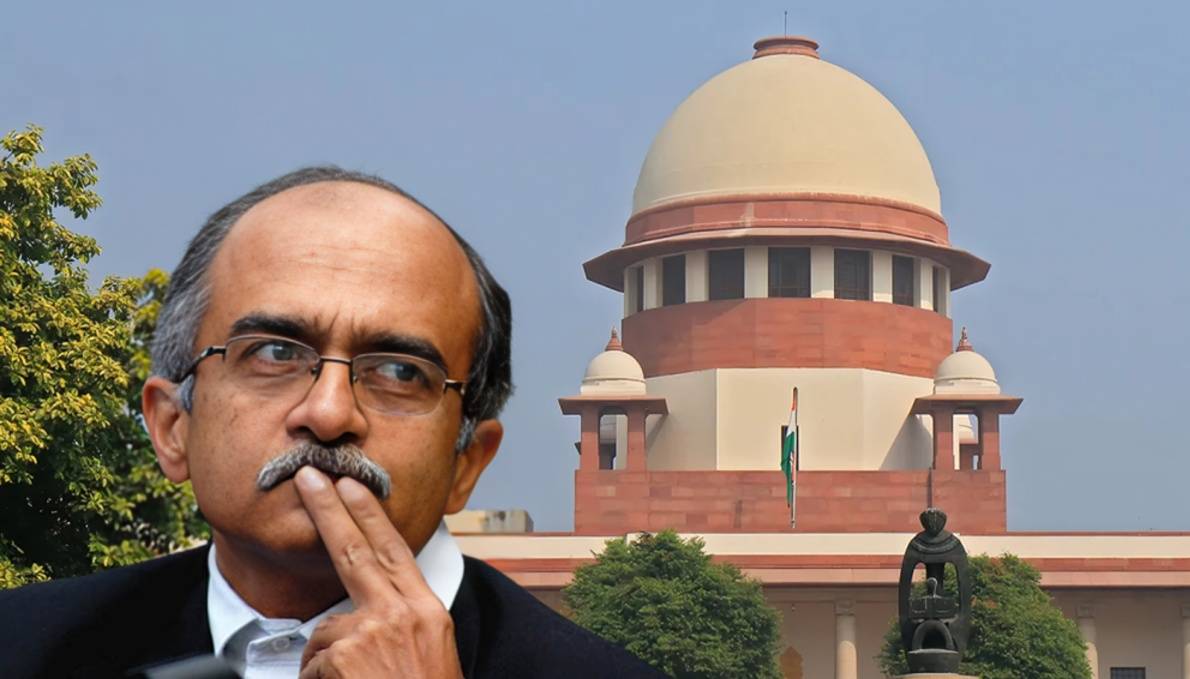
The Supreme Court on Friday declined to grant an urgent hearing to an application filed by advocate Prashant Bhushan seeking the withdrawal of an earlier order in the case concerning the appointment of Election Commissioners. The application has brought attention to questions surrounding the earlier judicial decision and an alleged conflict of interest involving one of the judges who delivered it.
Bhushan sought a hearing before the same two judges who had passed the original order. He also raised concerns regarding Justice Satish Chandra Sharma, alleging that the judge's son had appeared as a lawyer for the Election Commission of India.
The Supreme Court's decision not to take up the application urgently marks the latest development in the legal proceedings concerning the appointment of Election Commissioners.
Prashant Bhushan Seeks Withdrawal of Earlier Supreme Court Order
Advocate Prashant Bhushan approached the Supreme Court seeking the recall or withdrawal of an earlier order passed in the Election Commissioners' appointment case.
A recall application is a legal request asking a court to reconsider and withdraw an order in certain circumstances. Such applications are different from ordinary appeals and generally involve specific legal grounds for seeking the court's intervention.
In this case, Bhushan wanted the Supreme Court to reconsider its earlier decision concerning the appointment of Election Commissioners.
He requested that the application be placed before the same two judges who had delivered the original order. His request was therefore connected both to the earlier judicial decision and to the composition of the bench that would consider the recall plea.
Supreme Court Declines Urgent Hearing
The Supreme Court declined to provide an urgent hearing to Bhushan's application on Friday.
The decision means that the advocate's request for immediate consideration was not accepted at that stage. However, declining an urgent hearing should not automatically be interpreted as a final decision on the merits of the recall application.
The distinction is important because the urgency of a hearing and the legal grounds of an application are separate matters.
The available report does not provide further details about the court's reasons for declining the request or whether a later hearing date was fixed.
Conflict-of-Interest Concern Involving Justice Satish Chandra Sharma
One of the main issues raised by Bhushan concerns Justice Satish Chandra Sharma, who was part of the bench that passed the earlier order.
Bhushan alleged that the judge had a conflict of interest because his son had appeared as a lawyer for the Election Commission of India.
The allegation formed part of Bhushan's request regarding the hearing of the recall application. He sought consideration of the matter by the same judges who had passed the earlier order, while also raising the issue concerning Justice Sharma's family connection to a lawyer who had represented the Election Commission.
Conflict-of-interest concerns are significant in judicial proceedings because courts are expected to maintain impartiality and public confidence in the justice system.
However, the allegation made by Bhushan does not by itself establish that a conflict of interest existed or that the earlier order was legally affected.
Role of the Election Commission of India
The Election Commission of India is the constitutional authority responsible for conducting elections in the country.
The appointment process for Election Commissioners has been the subject of legal and political debate, particularly over the framework used to select individuals for these constitutional positions.
The case in which Bhushan filed his application concerns the legal framework surrounding these appointments. The earlier Supreme Court order became the subject of his recall request.
The latest development has once again brought attention to the relationship between judicial decisions, the appointment process and questions of institutional independence.
Why the Recall Plea Is Significant
The application is significant because it seeks reconsideration of an earlier Supreme Court order in a matter involving the appointment of Election Commissioners.
It also raises questions about how courts address allegations concerning possible conflicts of interest involving judges.
Judicial impartiality is an essential principle of the legal system. Public confidence in court proceedings depends on the belief that cases are considered fairly and without improper influence.
At the same time, allegations concerning judicial conduct must be assessed through established legal procedures and based on relevant facts. A claim raised by a litigant should not be treated as a proven finding unless it is established through the appropriate process.
What Happens Next?
The Supreme Court's decision to decline an urgent hearing has not, based on the supplied information, resolved the legal questions raised in Bhushan's application.
Further developments will depend on whether the recall plea is listed for a regular hearing and how the court deals with the arguments presented.
The matter is likely to remain significant in discussions about the appointment of Election Commissioners and the standards expected of judicial proceedings.
For now, the Supreme Court has declined to hear Prashant Bhushan's application urgently. His request to recall the earlier order and his conflict-of-interest allegation involving Justice Satish Chandra Sharma remain the central issues highlighted in the latest development.