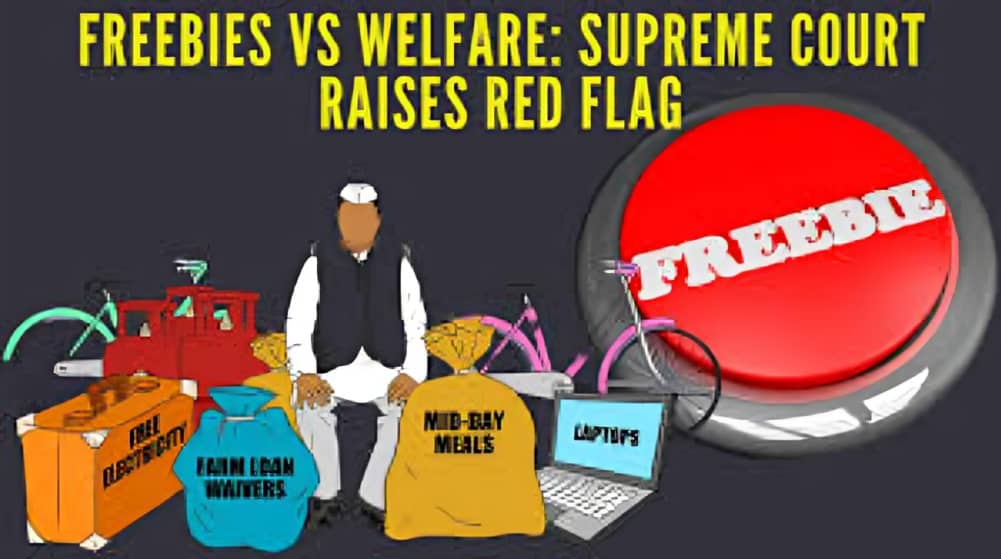
The Supreme Court of India has voiced strong observations regarding the increasing trend of political parties announcing and implementing free benefit schemes, commonly referred to as freebies. During recent proceedings, the court remarked that such measures, if not carefully structured, could hamper economic growth and impede long term development.
The bench observed that while welfare programmes form an essential component of governance in a welfare state, there is a need to ensure that financial resources are allocated in a sustainable and accountable manner. According to the court’s remarks, indiscriminate distribution of free benefits may create significant fiscal pressure on state budgets and reduce the availability of funds for infrastructure, health, education and other critical sectors.
The issue of freebies has been debated widely in recent years, particularly during election cycles when political parties announce schemes offering free electricity, cash transfers, loan waivers, or other benefits to sections of the population. Critics argue that such promises may prioritise short term electoral gains over long term fiscal discipline. Supporters, however, maintain that welfare measures are necessary to address inequality and provide social security to vulnerable groups.
The Supreme Court’s observations came during the hearing of petitions that sought guidelines to regulate poll promises and examine their financial viability. The court indicated that unchecked spending without adequate revenue planning could affect macroeconomic stability. It also underscored that economic growth depends on productive investment and prudent fiscal management.
Legal experts point out that the court’s comments do not amount to an immediate ban on welfare schemes but reflect concern about financial sustainability. The judiciary has previously noted that policy decisions primarily fall within the domain of the legislature and executive. However, when such policies raise constitutional or financial governance issues, judicial scrutiny may arise.
Economists have highlighted that excessive borrowing to fund free schemes can increase public debt and limit future policy flexibility. At the same time, targeted welfare spending has been credited with reducing poverty and improving living standards when implemented responsibly. The debate therefore centres on striking a balance between social welfare commitments and fiscal prudence.
The court suggested that a structured framework or guidelines could help ensure transparency and accountability in announcing and funding welfare schemes. Discussions in earlier hearings have included whether institutions such as the Election Commission should play a role in examining the financial implications of pre poll promises.
The Supreme Court’s remarks are likely to add momentum to the ongoing national conversation about the sustainability of free benefit policies. As India continues to pursue economic growth while addressing social welfare needs, policymakers may face increasing scrutiny regarding how public resources are allocated.
Further hearings in the matter are expected to explore possible solutions that reconcile developmental priorities with fiscal responsibility.