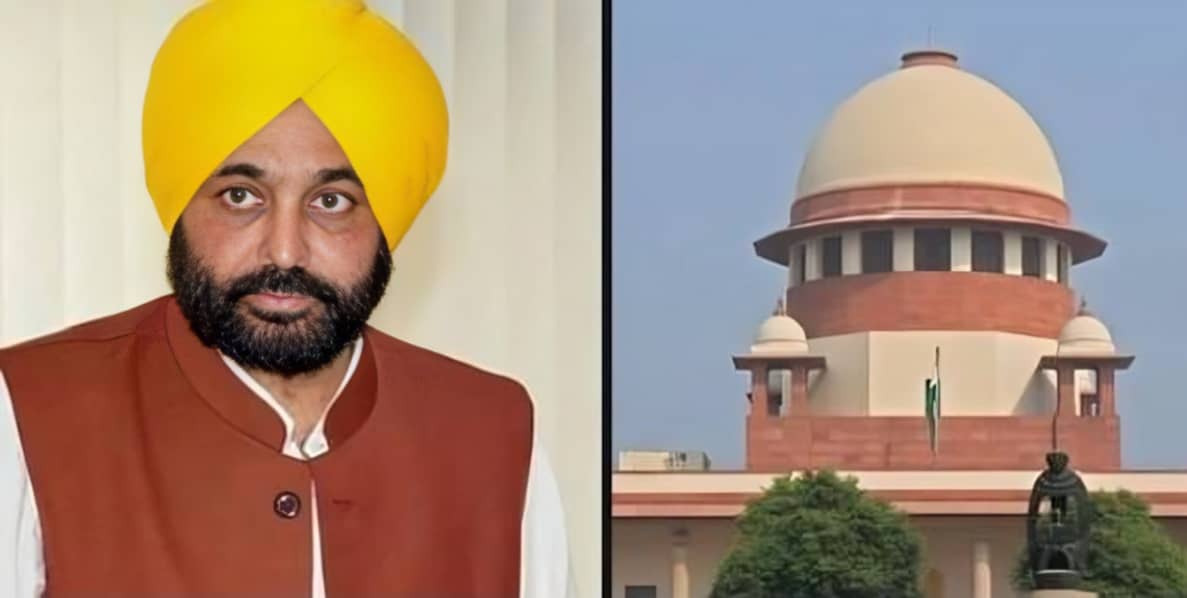
The Supreme Court is considering a plea filed by the Punjab government challenging an order of the Punjab and Haryana High Court that directed the Central Bureau of Investigation to register a case and investigate allegations of corruption linked to the office of Punjab Chief Minister Bhagwant Mann.
The Punjab government approached the Supreme Court after the High Court directed the CBI to conduct a fair and transparent investigation into allegations contained in communications sent by the Enforcement Directorate to the Punjab authorities. The High Court had also directed the CBI to proceed with the investigation and submit a report within two months.
The matter has now reached the country’s highest court, where the Punjab government is seeking relief against the High Court order. Senior Advocate Vikas Singh appeared on behalf of the state government and sought an urgent hearing in the Supreme Court.
The Punjab government has argued that the High Court’s direction to register a case and initiate a CBI investigation does not have sufficient legal and procedural basis. The state has also questioned whether the material provided by the Enforcement Directorate was sufficient to require registration of a criminal case.
According to reports, the dispute is connected to information shared by the Enforcement Directorate with the Punjab Director General of Police under provisions of the Prevention of Money Laundering Act. The allegations concern suspected corruption involving individuals linked to the Chief Minister’s Office.
The allegations reportedly include claims concerning transfers and postings of government officials, government tenders, policy-related decisions and other administrative matters. These remain allegations and are subject to investigation and legal proceedings.
The Punjab and Haryana High Court had earlier considered a public interest litigation concerning the alleged failure of the state authorities to take appropriate action on information provided by the Enforcement Directorate. After examining the material placed before it, the High Court concluded that an independent and transparent investigation was necessary. It therefore directed the CBI to register a case and proceed with the investigation.
The Punjab government has challenged this decision before the Supreme Court. During the proceedings, Senior Advocate Vikas Singh argued that a criminal case could not be registered without sufficient material establishing a cognisable offence. He also referred to the Supreme Court’s earlier judgment in the Vijay Madanlal Choudhary case while presenting the state government’s position.
The state government has also raised concerns about the timing of the proceedings, particularly in the context of the forthcoming Punjab elections. The government has argued that the High Court order raises issues concerning the federal structure and the powers of state authorities.
The Supreme Court did not grant an immediate hearing when the matter was first mentioned. Chief Justice of India Surya Kant indicated that the petition could be listed within the following days. Subsequent reports said the matter was scheduled to be considered by the Supreme Court.
The case has attracted considerable political and legal attention because the allegations concern people associated with the functioning of the state government. However, the allegations themselves have not been established as facts by a final judicial determination. Any findings regarding criminal responsibility will depend on the investigation and subsequent legal proceedings.
The High Court had directed the CBI to conduct the investigation independently and submit its report within the prescribed period. It had also directed the Punjab Police and state authorities to cooperate with the central agency and provide the required records and documents.
For the Punjab government, the Supreme Court proceedings provide an opportunity to challenge the legal foundation of the High Court’s decision. The state is seeking judicial intervention against the direction for a CBI investigation and has questioned the manner in which the case was initiated.
The Supreme Court’s consideration of the plea will therefore be significant in determining whether the High Court’s direction for a CBI investigation should continue, be modified or be stayed. The court’s decision will also clarify the legal issues raised by the Punjab government concerning the registration of a criminal case based on the material supplied by the Enforcement Directorate.
The proceedings are being closely watched because of their implications for the relationship between state authorities and central investigative agencies. The case also highlights the legal safeguards surrounding criminal investigations involving allegations against public officials.
At this stage, the matter remains before the Supreme Court, and the allegations should not be treated as proven wrongdoing. The final outcome will depend on the court’s orders and, if an investigation proceeds, the findings of the competent investigative agency.